

Commentary
Contrary to initial reports, neither climate change nor an earthquake triggered the massive flood in the Himalayas that has, to date, killed more than 1,000 people in Nepal, with 4,000 still unaccounted for.
“You basically had the lower part of a glacier tongue that sheared off because the rock below failed,” explained Jakob Steiner, a geoscientist at Austria’s University of Graz. “So the glacier had nothing to support itself. That mass of ice and rock dropped from 5,100 to 3,000 meters, damming a river. Once that dam breached, the water accumulated behind it released, causing the flood.”
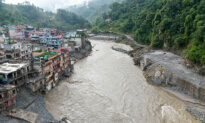
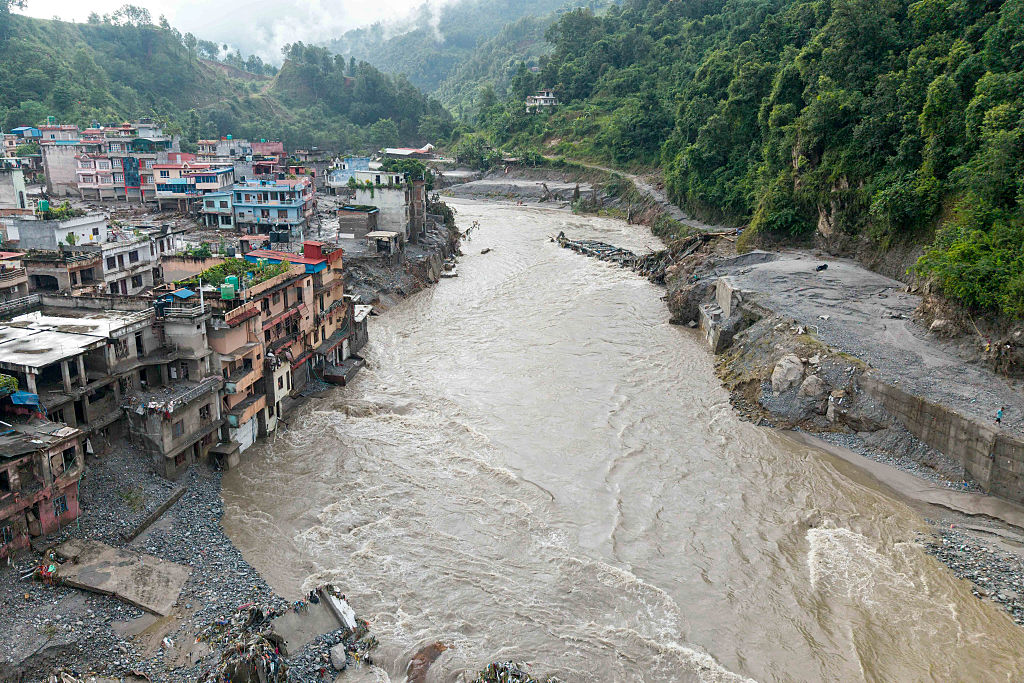
The hundreds of millions of tons of debris that flowed in the downstream devastation was then a function of an avalanche of water, ice, and gathering rock that dislodged and tumbled down the mountainous river, taking with it entire villages. Many of those dislodged tons came from the massive system of dams and associated infrastructure constructed down that same river valley.
That valley is the Lhende–Bhote Koshi–Trishuli corridor, one of the most densely developed hydropower stretches in the Himalayas. From the Nepal-Tibet border south through Rasuwa and Nuwakot districts, more than two dozen projects sit along the same steep gorge and the side valleys that were scoured by the flow of debris.
Twelve operational plants totaling 431 megawatts were knocked out. Another 15 projects still under construction, representing roughly 470 megawatts of planned capacity, were heavily damaged. Combined, more than 900 megawatts of existing and future generation—a sizable slice of Nepal’s grid—sat directly in the path.
These massive hydroelectric schemes—price tag $46 billion—weren’t driven by a market demand for electricity in Nepal but by the international development industry’s fear of climate change, and its determination to replace fossil fuels with renewable energy. International lenders promoted, financed, and accelerated the schemes to meet their goal of 28,500 megawatts of Nepalese hydropower by 2035 to electrify cooking, transport, and industry and to export surplus renewable energy to India.
The largest of the unfinished works is the 216-megawatt Upper Trishuli-1, about 84 percent complete when the flood hit. It is a flagship run-of-river scheme backed by an international aid consortium that includes Korea’s KOEN, the International Finance Corporation, the Asian Development Bank, the Asian Infrastructure Investment Bank, and climate-tagged funds, such as the Canadian Climate Fund.
Immediately downstream and upstream sit the 111-megawatt Rasuwagadhi plant (its powerhouse and substation destroyed), the 120-megawatt Rasuwa-Bhotekoshi project still under construction, the 60-megawatt Upper Trishuli-3A and its companion 3B, plus Sanjen, Chilime, the older 24-megawatt Trishuli station, Devighat, and a string of smaller plants and weirs.
Construction camps, excavated spoil, diversion tunnels, cofferdams, and access roads lined the narrow floor of the same river that received the ice-and-rock avalanche. When the dam of ice and debris breached, the torrent did not merely rise; it incorporated the loose rock and concrete already piled in the valley and then tore through the tunnels and powerhouses themselves.
Hundreds of workers were inside those tunnels. Days later, more than 500 remained unaccounted for at nine projects in the two districts; estimates at Upper Trishuli-1 alone ran into the hundreds.
In the name of protecting the environment and promoting “climate resilience,” the international aid industry sited dams in large numbers and with large workforces, in a geologically unstable gorge already known for ice avalanches, landslides, and sudden floods. The rock and ice that sheared off at 5,100 meters did the initial work. The construction sites supplied additional mass and placed thousands of people in the line of fire.
Carbon dioxide is not a threat to the Himalayan ice mass. A major Indian government review reached that conclusion years ago. In 2009, the Ministry of Environment and Forests published V.K. Raina’s “Himalayan Glaciers: A State-of-Art Review of Glacial Studies, Glacial Retreat and Climate Change.”
Raina, former deputy director-general of the Geological Survey of India, examined a century and more of observations. Glaciers have been melting and retreating since the end of the last ice age, as they do in every interglacial period. Rates have varied sharply from glacier to glacier and from decade to decade. Some fronts have advanced while neighboring glaciers have receded.
Retreat on well-studied glaciers such as Gangotri slowed after the 1990s even as global temperatures rose. The picture is of a dynamic, heterogeneous ice cover, not a single climate-driven melt-off.
Ice-rock avalanches like the Nepalese flood have occurred in the same mountains after earthquakes and without them. What changed this time was the density of people and concrete in the valley below—a density immensely augmented by the rush to build “climate solutions.” Fear of climate change put the dams and the workers there. The mountain did the rest.
Views expressed in this article are the opinions of the author and do not necessarily reflect the views of The Epoch Times.
 Friends Read Free
Copy
Facebook
Tweet
Friends Read Free
Copy
Facebook
Tweet