
Commentary
This year, Beijing began requiring developers to sell completed apartments rather than unbuilt projects. That amounts to an official admission that decades of presales had shifted construction risk onto ordinary buyers.
The same policy package extended the maximum mortgage term from 30 to 40 years—a move that lowers monthly payments only by stretching a family’s debt across most of its working life.
This is the proper lens for viewing the crisis, as the prevailing narrative gets it wrong on both counts. This was never a healthy market that Chinese leader Xi Jinping suddenly decided to destroy; nor did he have an alternative growth engine waiting in the wings, making it safe to let real estate collapse.
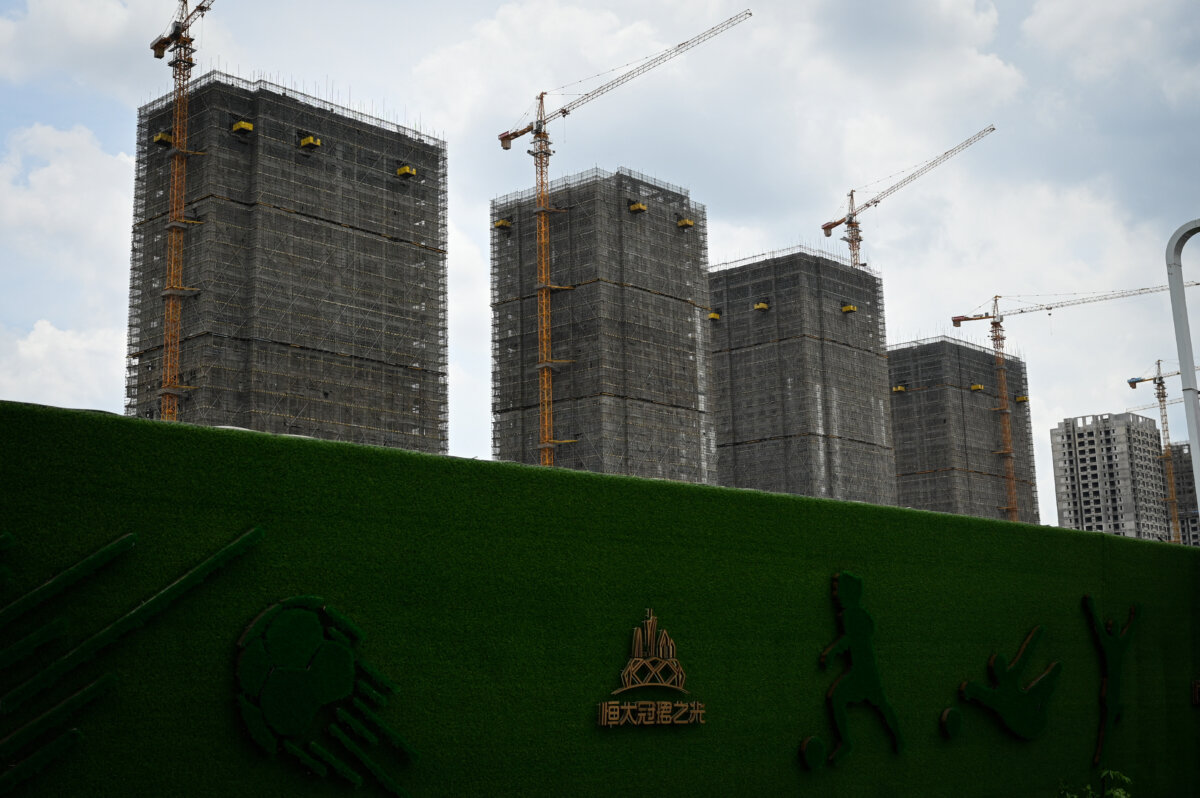
Instead, he inherited a high-leverage machine that the Chinese Communist Party (CCP) had built from land sales, bank credit, buyer prepayments, and household savings—and then abruptly shut it down. In doing so, he turned an inevitable market adjustment into a systemic balance-sheet crisis.
Property accounts for roughly a quarter of all Chinese economic activity, with nearly 70 percent of household wealth tied up in housing. Real estate served simultaneously as local government revenue, bank collateral, family savings, and the foundation of consumer credit. Dismantling it crippled all four pillars, dragging down aggregate demand across the broader economy.
Leverage by Design
Developers earned their poor reputations, but high debt was engineered into their business model.
For more than a decade, Beijing restricted property companies from raising capital by selling shares—freezing market access after 2010, reopening it briefly around 2013, locking it again in 2016, and relenting only in late 2022 after the crisis was underway.
This created a contradictory trap: local governments relied on developers to buy expensive land and drive economic growth, yet barred them from traditional capital markets. What was left to them were bank loans, trust products, buyer prepayments, unpaid supplier bills, and offshore dollar bonds.
Then, citing excessive leverage, Beijing abruptly cut off these remaining lifelines. In effect, the state engineered these precarious balance sheets, only to penalize the companies for carrying them.
It did so swiftly. In 2020, the “three red lines” on developer balance sheets and caps on bank property lending rewrote financing conditions within months. A structural problem that needed a decade of adjustment was handled as a two- or three-year administrative assignment—resulting not in orderly deleveraging, but in frozen liquidity, stalled construction, and shattered buyer confidence.
Who Pays
Speculation was only part of the problem; the real issue was cost extraction at every stage of development. Before breaking ground, a project incurs land acquisition fees, site clearance costs, and deed taxes. By the time it reaches the buyer, value-added, land appreciation, corporate, and construction taxes have stacked up. Although ongoing homeownership taxes are negligible, every upfront cost is ultimately passed on through purchase prices and rents.
The system prioritizes land sales, construction, and transaction taxes over public services. Local governments built their budgets on real estate revenues rather than establishing a stable, service-focused tax base.
Chinese families bore these costs out of necessity rather than an appetite for speculation. Gaps in social security, healthcare, education, and pensions forced high savings, while capital controls, low bank interest rates, and a volatile stock market left few viable investment channels. As a result, residential property became everything at once: a retirement fund, an education savings, a marriage prerequisite, a bank collateral, and an inheritance.
Declaring that “houses are for living in, not for speculation” is a political slogan, not an economic solution. Until retirement, healthcare, and education are reliably covered, people will naturally seek assets that preserve value. A government cannot offload life’s major financial risks onto families and then fault them for treating property as an investment.
The Mortgage Leash
Housing does more than generate wealth—it conditions civic obedience. That is the dimension most often overlooked.
An apartment cannot be moved, and urban land remains state property. Household registration, mortgage approvals, resale rights, and school admissions all run through state channels. Moreover, this wealth is hardly autonomous; it is a leveraged asset tied to a multi-decade mortgage that pledges future earnings to banks.
The payment structure is revealing. Local governments collect land revenue the moment a site is sold, while households spend three to four decades paying off the loan. Chinese mortgages also carry recourse: If prices fall below the loan amount and the bank’s auction does not cover the shortfall, the borrower still owes the difference. Market prices can drop, but the debt does not.
The result is a system of “mortgage governance.” When prices rise, families feel wealthy and continue working, spending, and servicing their debt. When prices fall, paper gains evaporate while the debt stays, so families hold tighter to their jobs and wait for a rescue. Research finds housing debt makes households more cautious and less likely to start a business. It operates as a form of labor discipline: Taking risks is difficult when a monthly payment looms for 40 years.
Yet this control cuts both ways. Research indicates that Chinese homeowners are more attentive to public affairs and more conscious of their rights, yet more likely to press demands inside the system rather than confront it—acting as “loyal opponents.” An authoritarian government welcomes loyalty; it is far less tolerant of opposition.
In this system, paper housing wealth is the carrot; the mortgage is the harness. Land supply, credit flows, and state policy dictate when the carrot is dangled—and when it is pulled away.
Why Xi Dared
Why take such a risk? Because Beijing controls the banks, the land, the capital flows, the planning approvals, and the media—and believed property risk could be contained through administrative decree. Developers possessed immense wealth during the boom, but no political shield or institutional power to block a decision made at the top.
Moreover, the central planners believed manufacturing could replace real estate, underestimating the extent to which the broader economy relied on housing.
A crash also served to weaken the private capital that Xi fundamentally distrusts. Having repeatedly warned against the “disorderly expansion of capital,” he found developers to be the easiest targets of all. Their fortunes rested entirely on state land, state banks, planning approvals, and the favor of local officials—assets the state could revoke at will.
Consider Ren Zhiqiang, the former head of a state-owned developer, who was sentenced to 18 years in prison for corruption, bribery, and abuse of power. The formal charges tell only part of the story: the punishment came after years of public dissent culminating in open criticism of Xi. In this system, wealth alone does not cross the line; using that wealth to forge an independent voice does.
Xi’s gamble was not just that emerging industries would flourish, but that the Communist Party’s system could absorb the fallout. The financial pain would bypass Beijing, landing instead on homebuying families, local governments, state banks, builders, and suppliers. Banks would remain solvent, local governments would function, citizens would swallow their losses, and Beijing would retain total control over where capital flows.
Who Is to Blame
Three facts hold true simultaneously. First, the old economic model was expiring anyway: birth rates are dropping, urbanization is slowing, housing inventory is bloated, and prices exceed household incomes.
Second, developers were far from innocent. Many borrowed recklessly, shuffled presale deposits across projects, and lied on regulatory filings. Evergrande is no victim.
But policy built the trap and then sprang it: The state relied on land sales to fuel growth, encouraged presales and household leverage, and then severed developer credit overnight—all without first establishing protected escrow accounts, deposit insurance, or a national housing delivery fund.
Blaming greedy developers alone lets the system off the hook. Blaming Xi Jinping alone ignores the fact that land finance, presales, and tight credit controls were already established under Hu Jintao and Wen Jiabao. What the Xi era added was the decision to end the system by force and then refuse to allocate state funds to cushion the financial hit for ordinary people and the private sector.
What Actually Died
Housing demand did not die; the engine driving it did. That machine was powered by local governments selling land, developers borrowing aggressively, buyers prepaying for unbuilt homes, banks expanding credit, and prices steadily climbing.
Xi did not create every flaw in the system. However, he chose to dismantle it through political control and administrative deleveraging, underestimating the severe economic and social costs.
There is no evidence of a master plan to entice the country into buying homes only to intentionally crash the market. The collapse gutted local government budgets, bank assets, employment, and the CCP’s own credibility.
A financially destitute middle class makes rule harder, not easier. What Beijing prefers instead is manageable prosperity: households with enough income to keep working and consuming, but without enough liquid wealth to assert independence from the state system.
The CCP will not abandon real estate entirely. It will curb the sector when it overheats and prop it up when revenue is threatened. Yet every cycle produces the same outcome: The state reaps gains on the way up, while families absorb losses on the way down.
The 2026 reforms apply mainly to new projects. They leave past failures unresolved, build no firewall independent of local governments, banks, and developers, and fail to address land-based municipal finance, the social safety net, or the incentives driving official promotions. They may trim future risk, but they do not restore household confidence or repair the broader economy’s balance sheet.
What Xi executed in real estate was both an economic restructuring and a structural transfer of power. It weakened developers while eroding the financial independence of local governments, private enterprise, and middle-class families. In their place, it strengthened the central leadership, state banks, and state capital. That is the core issue. Whether another industry can ultimately replace real estate is a separate question—and even if it could, that would not justify how the housing crisis was handled.
Sean Tseng contributed to the report.
Views expressed in this article are the opinions of the author and do not necessarily reflect the views of The Epoch Times.
 Friends Read Free
Copy
Facebook
Tweet
Friends Read Free
Copy
Facebook
Tweet