
The following is an excerpt from the introduction to “Puritans, Pilgrims & Prophets,” Michael Wilkerson’s latest book in the “Why America Matters” series.
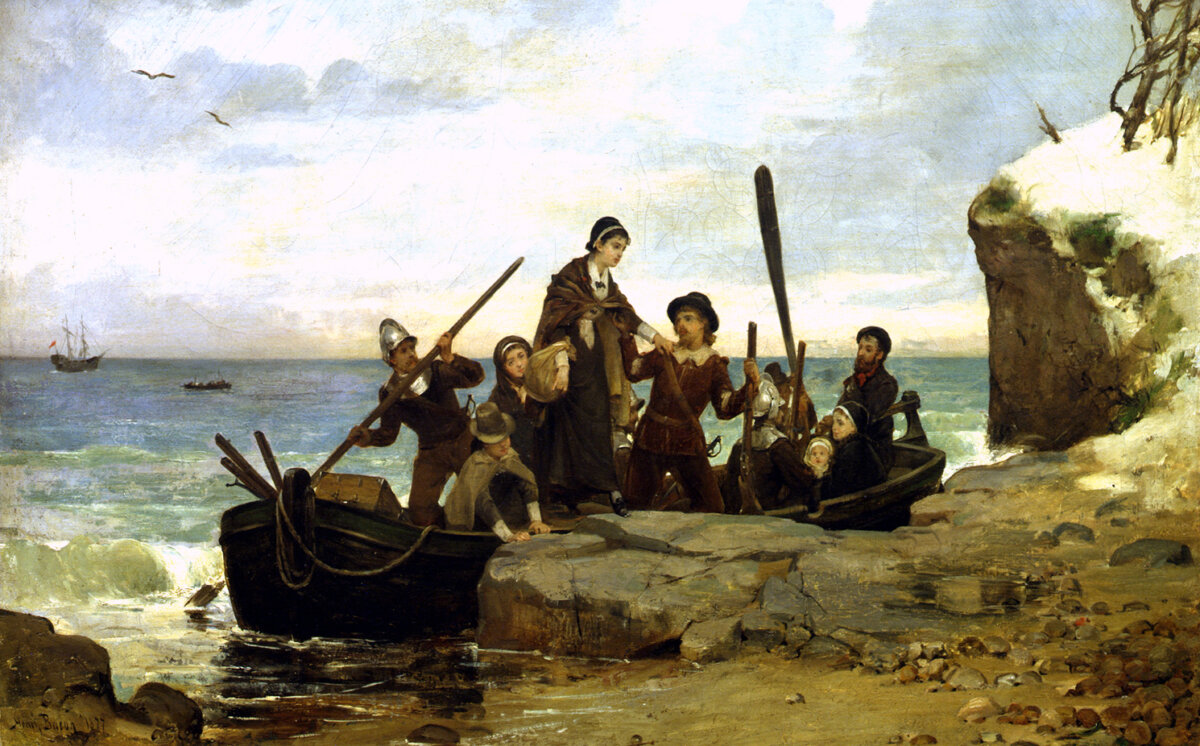
Why would an entire generation of English men, women, and children—an estimated 80,000 souls over 20 years—give up their lives and livelihoods, their homes and hearths, their families and friends, their country and community, forsaking all that they knew and took solace in, to travel for months at sea on a slow, arduous journey, devoid of any material comfort or worldly pleasure, where sickness and malnutrition were near certainties, where death and disease were real probabilities, to go to a land unmapped and untamed, where no city or town existed, where no supply of bread or wine awaited, where neither roof nor chimney would protect and warm them, where wild beasts were more populous than the “savage” natives, both of which were rumored to be hostile to English settlers?
Some came for gold and some for glory, but the surprising fact is that many—especially those traveling to New England—came for God. They believed that God had called them, like the Israelites of old, to leave the slavery of Egypt and take possession of a Promised Land that God had prepared for them to possess. They believed that they were to create a “city on a hill,” a godly community established on biblical principles that would serve as a beacon of light for religious and political freedom to the nations of the Earth. They were the Puritans, pilgrims, and prophets who, while peering through a glass darkly, could nonetheless see a future society that sought to usher in the biblical kingdom of God. It is their remarkable story this book sets out to tell.
The 17th century was critical in shaping the futures of America, England, and the nations of Europe. Wars and plagues would shift the balance of power. The devastation wrought by both would convince many that the end of the world was nigh. The fact that Europe was also in the middle of the Little Ice Age, with some of the coldest temperatures on record, didn’t help ease the apocalyptic dread. The climactic shift, with short and wet summers and long winters, also meant more crop failures, which in turn meant starvation and famine.
At the same time, the 17th century was a period of great promise.
The Protestant Reformation and the near simultaneous rise of humanist thinking would fundamentally alter European societies, cultural and political norms, and religious practice.
In an age before the internet, before phones and facsimile machines, and before the telegraph, news, and ideas nonetheless circulated across the civilized world with relative speed. Roman roads and communication posts still crisscrossed Europe. Innovative and dangerous ideas alike were carried as mail, books and newspapers by mounted postmen and by travelers on coaches and shipping lines, promising change and threatening the status quo.
Microscopes and telescopes brought the world closer for inspection, and scientific knowledge exploded. Literacy rates skyrocketed alongside the development of new printing technologies. Faraway lands would be conquered, enormous stores of resource wealth discovered and developed, and old religious and political orders upended. Ancient civilizations would fall, and new ones would arise.
The advent of the printing press and movable type greatly facilitated the expansion of knowledge and the democratizing of society. No longer was scriptural literacy limited to a priestly caste. For the first time, the Bible was accessible in the reader’s language, and at an affordable price. As a result, more and more people were learning to read the Bible and other literature. Interest in both biblical and classical themes exploded. The Renaissance led to the Reformation, and the Reformation led to the Enlightenment.
The Puritan migrants came to New England for many reasons which we will seek to unpack. But chief among them was a deep spiritual commitment and a widely held belief that they were called and chosen to create a spiritual “city on a hill,” a model of the kingdom of God on Earth, whose light would shine brightly into a dark world with the hope of the gospel message of Jesus Christ.
The ideals they carried—of self-governance, of covenant and community, of mission and calling, of divine guidance and grace—would not only sustain them but lay the groundwork for the establishment of the United States, one of the greatest nations in the history of mankind.
America was birthed on a set of foundational ideals born out of the Protestant Reformation, the Renaissance, the Scientific Revolution, and later, the Enlightenment. The spiritual and intellectual seeds were planted and would grow in the rocky soil of New England. The Puritan generation of the 17th century laid the moral and political foundation, and indeed the chief cornerstone, for the grand experiment that would eventually erect the American national edifice.
“Puritans, Pilgrims & Prophets” strives to uncover an increasingly lost but essential part of our history, and to remind all of us—as newly arrived or multi-generational Americans—how important our shared patrimony is to the survival of our nation today. E pluribus unum—out of many, one—presupposed that a diverse group of people could align and unify around a common spiritual and cultural heritage. As the book will unfold, that worthy and redeemable American legacy finds its roots in the Puritan New England of the 17th century. The story of Puritans, pilgrims, and prophets provides the keystone clue as to why America matters.
Views expressed in this article are the opinions of the author and do not necessarily reflect the views of The Epoch Times.
 Friends Read Free
Copy
Facebook
Tweet
Friends Read Free
Copy
Facebook
Tweet