
Commentary
Sitting on a train and listening to a gaggle of Gen Z’ers carry on is among life’s most painful experiences. The vocabulary is so limited as to be unfavorably compared with a primitive tribe. The inability to form a basic sentence is alarming. The relentless use of “like” and “you know” and “whatever” is painful to the ears. I’m no fan of AirPods or headphones but they are essential on these occasions.
The problem is broader than a single generation. Most podcasts I find unlistenable simply because whatever language they are speaking is not English. It’s something else entirely and barely coherent. My complaints are not traceable to some kind of grammatical snobbery. There is much more at stake here: the very capacity of humanity to communicate.
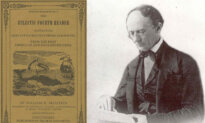
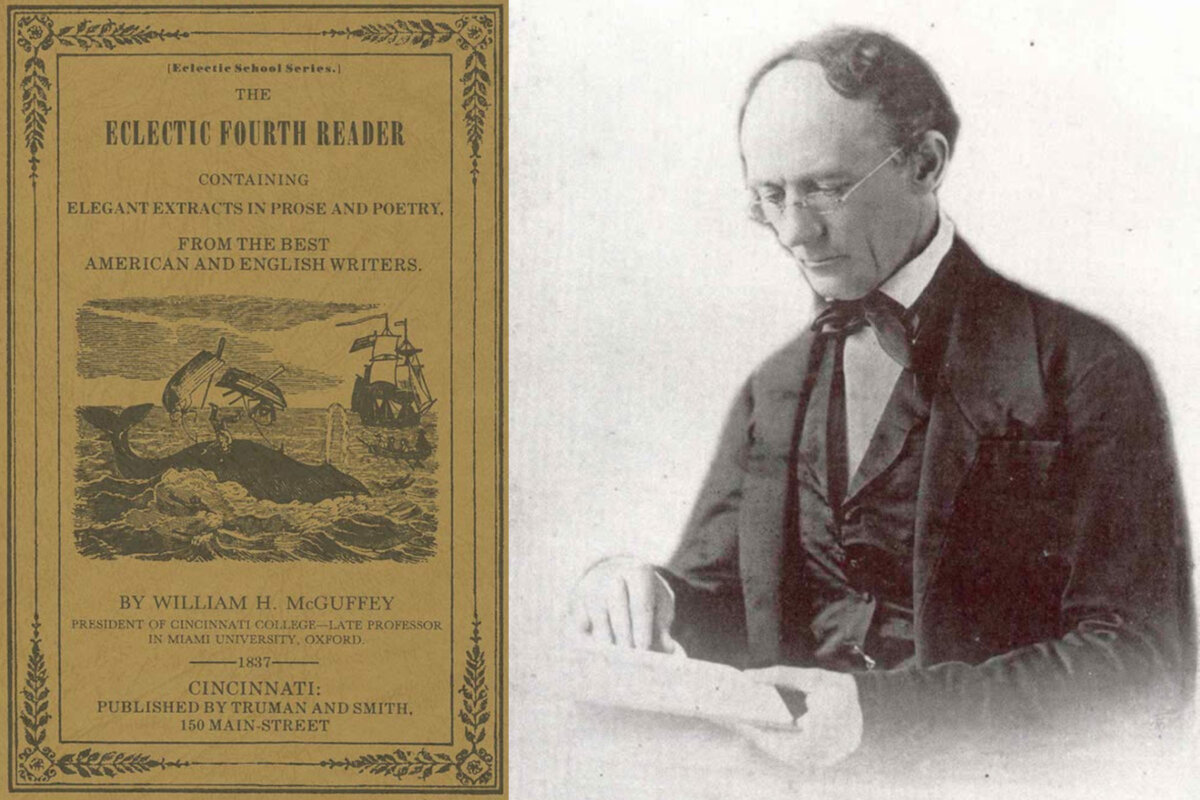
Reflecting on this problem—it affects everything from movies to popular music—I was curious how people long ago came to develop literacy and erudition. That sent me on a search for the “McGuffey Reader” of the old times. They are still widely available in physical and digital forms. I confess to never having picked one up before. I had heard of them and maybe even owned one when I was young but had never actually opened it or read it.
The first reader was published in 1836 as edited by William Holmes McGuffey, an English professor at Miami University in Oxford, Ohio. The famed novelist Harriet Beecher Stowe had recommended McGuffey to the publisher. The result consisted of sections of stories and poetry for grades one through six, one book for each grade. They became the core textbooks for most American kids—all over the country—for nearly a century, selling 150 million copies.
I fully expected that they would be written at a higher level than you see in newspapers today, to say nothing of typical prattle one would hear on trains or podcasts. Nothing could have prepared me for what I found in them. I decided not to game my quest by going immediately to the sixth reader. Instead I chose the reader for the fourth grade, the one published in 1901.
This is a book for 10-year olds, used in almost all classrooms at the time, whether in the city or country.
To my amazement, the book opens with a lesson on what is called elocution. This is the art of speaking. The text explains how to stand and read, how to properly breathe when speaking, how to modulate sentences to make them more coherent and communicative. It was here that I realized: much of the content in the book was designed to be read aloud by students in the classroom. The poetry was designed for memorization.
Does this practice still go on today in conventional classrooms? I have doubts. And you know why? Because the skill called elocution is not on standardized tests. This is surely one reason it has fallen into disuse. Then there is the problem of time. All kids are tested these days and schools judged on the results.
In any case, I plunged right in with the first short essay. It is about an event in the life of a young Benjamin Franklin. He and some friends saw some stones in a farmer’s yard and decided to take them to build a wharf on a lake. They worked all afternoon and planned to come back the next day to do some fishing. When they returned, the stones had been moved back.
Ben complained to his father and told him the story. His father pointed out that those stones did not belong to him but to the farmer. He was not within his rights to move them, even if he believed the wharf would have benefited the public. The father concluded:
“My son,” said Mr. Franklin solemnly, “so far as it was in your power, you have done a greater harm to the public than to the owner of the stones. I do verily believe, Benjamin, that almost all the public and private misery of mankind arises from a neglect of this great truth,— that evil can produce only evil, that good ends must be wrought out by good means.”
The story concludes: “To the end of his life, Ben Franklin never forgot this conversation with his father; and we have reason to suppose, that, in most of his public and private career, he sought to act upon the principles which that good and wise man then taught him.”
Can you believe that this was a fourth grade book, something written to instruct a 10-year-old child? The point here is absolutely profound and philosophically sophisticated. It pertains to our own time, don’t you agree?
And this is the very first lesson in the book! The writing style is high and the vocabulary complex. At the end of each story, there is a list of new words deployed, and questions for discussion. I can just imagine how classrooms in the 19th century could discuss just one of these stories through an entire morning of teaching.
But there is still more to observe about this story that characterizes the kind of content in this book. Each entry is not just designed to teach reading, vocabulary, and elocution. They are also designed to give practical moral education in right and wrong. Of all that is missing in modern education, I would list this at the top. The “McGuffey Reader” provided that.
The next essay is about a father teaching his children what he said was the hardest word in the English language: no. The kids laughed and said that was surely the easiest word. But the next day, some kids in the neighborhood proposed skating on a pond that had only just frozen. The boy was unwilling to say no. The ice broke and some kids fell in and had to be rescued. The father’s point is made in the conclusion. No is indeed the hardest word.
Next comes a poem about song and how it is always present in our lives, with particular attention to bird song and the crickets that chirp up all night. It’s a lovely poem designed for memorization.
Next comes an absolutely astonishing essay called “The Journey of Life.” I was reading it literally and only realized at the end that the story is an allegory of life itself. Incredibly, it ends with a reflection on mortality. The ending packs a powerful punch, one I felt deeply in my bones.
Then comes another poem, this one called “What I Live For,” followed by a fantastic story of a kid trying to get a kite to fly. He tries and fails, repeatedly. His aunt urges him to keep trying and urges changes in technique. Gradually, the boy gets the hang of it and flies the kite high in the sky.
The final lesson: “Yes, dear children, I wish to teach you the value of perseverance, even when nothing more depends upon it than the flying of a kite. Whenever you fail in your attempts to do any good thing, let your motto be,—try again.”
I could go on to describe every single entry in this book. I read it out loud and felt the power of each entry. One essay is a perfect description of the beauty and majesty of the eagle. I studied this essay thoroughly to see how to write so well about something as common as a bird in the sky.
The shock came with the essay that followed. It was about an eagle nesting in a tree who daily flew 10 miles to the shore to get a fish to feed the young in the nest. A boy watched in amazement and one day saw some workers who taunted the eagle which dropped the fish the workers proceeded to eat. Exhausted, the eagle set out for the shore again to get another. It returned fully depleted but the young were fed.
The conclusion: “I will never forget hereafter, that when the spirit is determined it can do almost anything. Others would have drooped, and hung the head, and mourned over the cruelty of man, and sighed over the wants of the nestlings; but thou, by at once recovering the loss, hast forgotten all. I will learn of thee, noble bird! I will remember this. I will set my mark high. I will try to do something, and to be something in the world; I will never yield to discouragements.”
Somehow I needed this lesson just now. We all do.
I will finally mention a piece on what it means to be rich. A boy was marveling about how his friend seems to have so much money. The grandfather said that he could make his grandson rich right now and offered to buy his eyes and his ears. The price kept rising and rising but the boy kept saying no. Grandfather totaled up the huge amount that the boy refused and pointed out that his ability to see and hear is worth vast wealth, even in his own estimation. The boy suddenly felt both rich and blessed.
There is so much more in this book, one essay after another, each beautifully written and each with a fantastic lesson in mind. This is not just reading. This is instruction in elocution, character, morals, and life purpose.
It is also extremely serious literature. There is no condescension in these pages as if adults are trying to appeal to the mind of a 10-year-old. On the contrary, this reader is being prepared for a well-lived life.
Is this one book enough to consume a year’s worth of reading, training, and memorization? It’s 260 pages and more than enough for a child. I dare suggest it is more than enough for today’s adults!
If you want to understand how it came to be that America by the end of the 19th century had astonished the world with its civility, prosperity, creativity, and overall goodness as a people, there is no reason to look further. This is what children were taught. Now I see that adults today need to be taught these lessons, and that I am among them.
Thanks to the “McGuffey Reader,” I have indeed gone back to fourth grade, and find myself in awe of what I’m learning.
Views expressed in this article are the opinions of the author and do not necessarily reflect the views of The Epoch Times.
 Friends Read Free
Copy
Facebook
Tweet
Friends Read Free
Copy
Facebook
Tweet