
Commentary
A member of my household was sick. Thinking this through, it dawned on me that countless times in my life I’ve been told that chicken soup is great for seasonal and flu-like infections. As much as I’ve cooked with chicken my entire life, I have never really made a genuine, no-compromise, hard-core, from scratch, old-fashioned chicken soup.
Not from the can. Not from the steel vat at the grocery. Not from the carton in the frozen section. None of these will do. We are talking about a roiling, boiling, real broth and bones, authentic chicken soup made with a whole chicken.
Not breasts. Not thighs. The whole bird.
Exciting stuff and the season seems to call for it. Looking it up, I found many variations, but my purpose here was healing. So I wanted only the real deal, no odd variations. There must be no shortcuts, no flavoring tricks, no canned anything, lest the medicinal component be weakened in some way I cannot understand.
How can I know this? Here’s how: tradition. It embodies more truth than any journal or elite faculty member, to say nothing about AI.
Of what does it consist? You won’t believe this: carrots, celery, onions, garlic, a whole chicken, salt, pepper, and water. That’s it. Add herbs as you want.
The result is a marvelous symphony of deep, rich, evocative flavor, magically emerging just from your stove top over four hours of roiling, boiling fun.
My first step was to go to the store to buy the bird. There were many choices but because I was going for the whole back-to-nature thing, I seized upon the fussy cage-free organic whole chicken. Yes, it is twice as expensive but the meat-to-size ratio is far more dense. These are muscly birds that have enjoyed a life of salads and bugs, not cage animals pecking at corn bits. It shows too, for these are beefy birds with a more vibrant flavor.
I’m not even much of a fan of chicken, by which I mean the rubber chicken you get at banquets or the typical chicken dish you order at restaurants. But get the right kind of chicken and the right method of cooking and you have a genuine gourmet treat. If you are going to do soup, you might as well do it the right way.
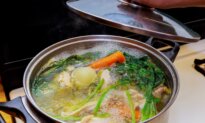
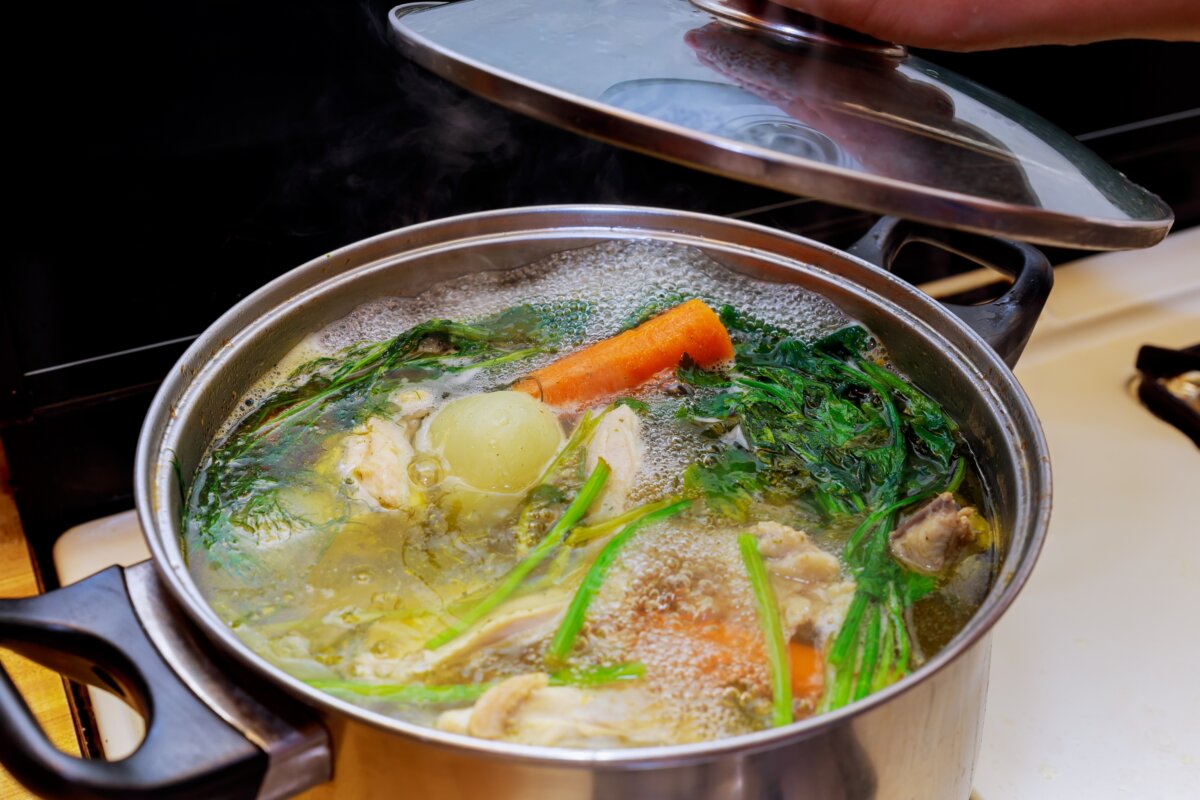
Once you have your ingredients lined up, you can begin with onions and then garlic in a large soup pot. Add herbs of your choosing. Then the fun part comes: set the whole chicken right in there, no cutting or chopping. Then add huge amounts of carrots and celery. Fill the pot with water.
Then what? Then you cover the pot and forget about it for 4–6 hours as it cooks on medium to medium low heat.
That’s it. You might think, hey wait, what happens to the skin and bones? They cook into the broth. At the end of the process, you can easily fish out the bones with a spatula. You can find them because they are hard and stand out in the mix.
You don’t even need rice or noodles, for the broth is plenty thick. You will be happy that you kept it simple. It’s actually remarkable how only a handful of ingredients with a high-quality chicken can generate such enormously impressive results. Plus your entire house will smell like real chicken soup, which is super-appetizing!
What about the science of this as curative? Last year, researchers from Scotland and Australia embarked upon a meta-analysis of the literature. The results appeared in the journal Nutrients, a peer-reviewed publication. Here is what they said:
“This systematic review highlights the potential role of soup in the management of Acute Respiratory Tract Infections, offering benefits in reducing symptom severity, promoting hydration, and supporting overall well-being. The findings underscore the potential therapeutic value of combining nutrition, hydration, and anti-inflammatory properties, which make soup a biologically plausible, culturally relevant and accessible intervention.”
Another 2019 study found that traditional broths were as good or better anti-malarials than pharmaceuticals. A 2022 study wanted to know if it really mattered for the healing benefits if the soup was made from a cage-free animal or an industrial chicken. Indeed the difference was profound:
“All 3 chicken soups showed immune-modulating activities, but their mechanisms were different: the GCS [cage free] helped restore the peripheral blood indicators and promoted the secretion of IL-2, IL-6, IL-10, TNF-α, and IFN-γ, and increased the concentration of IgA and IgG. The HCS stimulated the Th1 immune response and promoted IgG secretion, stimulating the immune system. The CCS increased the ratio of CD4+ and promoted T cell functions. The GCS was superior to the HCS and CBS in promoting immune recovery in mice from the comprehensive analysis of cellular immunity and humoral immunity. These effects are probably attributed to the content and types of peptides in chicken soup.”
It’s not about the science. No one trusts that stuff these days any more. Trust your instincts. You smell that scent in the air and it reminds one of healing. This is wired into our cultural code for a reason. The reason is that it is true.
Meanwhile, we’ve still got physicians out there right now pushing Tamiflu despite extensive documentation that it achieves nothing at all. “In this systematic review and meta-analysis among influenza-infected outpatients, oseltamivir was not associated with a reduced risk of hospitalization but was associated with increased gastrointestinal adverse events.” Oh!
It gets worse. Here is the latest study as reported in the Lancet: “Treatment with oseltamivir [Tamiflu] is ineffective and highly likely to increase 90-day mortality in critically ill patients with influenza.”
Forget the pharmaceuticals and trust tradition.
Sickness and healing aside, a good quality chicken soup surely ranks among the most delicious and wonderful dishes you will ever make and eat.
My soup was ready by evening. I ladled it into bowls, and we sat down to what can only be described as a restorative meal. The broth was golden and clear, with a depth of flavor that no powder or concentrate could ever approximate. The meat was in tender strands, and the vegetables had surrendered their essence into the liquid, becoming soft and yielding. The patient ate two bowls and went to bed early. By morning, the fever had broken.
Was it the soup? Was it the rest? Was it the combination? I do not know, and I do not care to know with the precision of a controlled study. What I know is that the body recognized what it needed, and the soup provided it.
There is something else that happens when you undertake this kind of cooking, something the studies do not measure. The act itself is medicinal. You cannot rush a four-hour broth. You must surrender to the process, to the rhythm of the simmer, to the gradual transformation of raw ingredients into something greater than their sum.
This is the opposite of the pharmaceutical mindset, which seeks to bypass process in favor of outcome, to extract the active ingredient and discard the rest. But we are not machines to be repaired with isolated compounds. We are organisms, embedded in tradition, in culture, in the accumulated wisdom of generations that discovered—through trial and error, through intuition, through love—that certain foods heal in ways that cannot be fully decomposed and analyzed.
I think about my grandmother, who made this soup without ever consulting a recipe or a journal article. She knew because her mother knew, and her mother before her, stretching back to some village kitchen where the first someone thought to boil a bird with root vegetables and time.
There is a chain of knowing in operation here. It is empirical knowledge refined across centuries, tested on billions of human bodies in uncontrolled, real-world conditions. The arrogance of the modern expert is to believe that knowledge begins with the invention of the double-blind study, that nothing true existed before peer review. But the soup in my pot testified otherwise. It was older than the FDA, older than the pharmaceutical industry, older than the germ theory of disease itself. And it worked before anyone could explain why.
The sick member of my household recovered fully within two days. No Tamiflu required. No trip to the urgent care clinic. Just rest, warmth, and the ancient alchemy of bones and water and time.
We have been sold a lie about our own incompetence, told that we lack the expertise to manage our own health, our own nutrition, our own lives. But the truth is simpler and more liberating. The tools for healing are within reach, in the grocery store and the kitchen, in the patience to do things the long way. The experts will not save you. The soup might.
Views expressed in this article are the opinions of the author and do not necessarily reflect the views of The Epoch Times.
 Friends Read Free
Copy
Facebook
Tweet
Friends Read Free
Copy
Facebook
Tweet