
Commentary
Sir Reginald Blomfield, a notable early 20th century English architect, wryly observed the changes within his profession emerging on the continent in the 1930s. “The less one’s mind is stored with knowledge of antiquity, the more confident the architect is in his own unaided genius.” Blomfield intended this as a stinging rebuke of modern architects’ approach to education. That the 21st century reader might mistake it as an inspirational maxim rather than an indictment demonstrates how far such lines of thinking have infiltrated society’s approach to education, expression, and the public arts. The hubristic self-confidence and rejection of the past that fueled the birth of architectural modernism (and indeed, every revolution) continues to the present, and the public is left to deal with its alternately oppressive, frivolous, and insulting results.
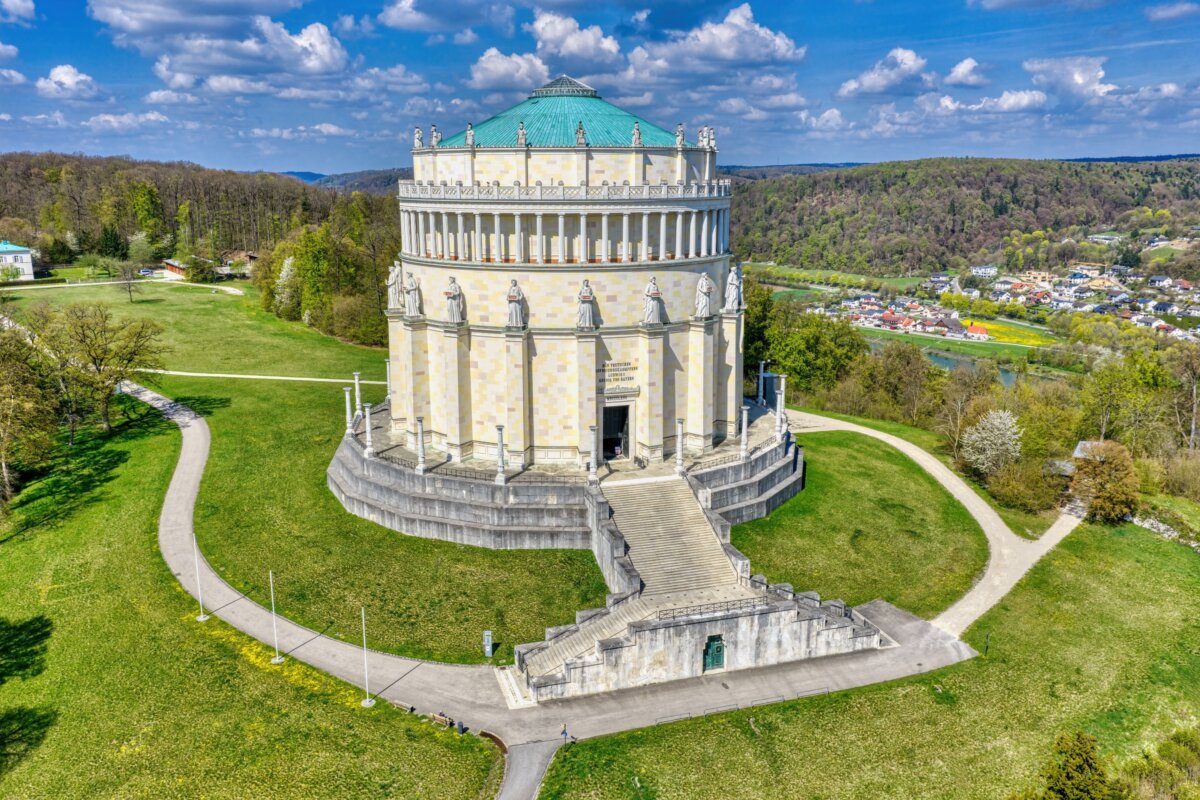
Not all, however, succumbed to abstraction and the architect’s whims. The late James Stevens Curl, an architectural historian, spent the better part of 60 years as a voice crying out in the wilderness, criticizing architectural modernism in both principle and product, while pointing to the virtues of classical architecture abandoned a century earlier. With the vigor and righteousness of an Old-Testament prophet, he persisted in the face of institutional and professional opposition, wielding an eloquent wit at which only Englishmen can excel. His argument is elegantly presented in a revised edition of his 1992 “Classical Architecture: Language, Variety, & Adaptability,” recently republished by John Hudson Publishing. Prescient in its return, it joins a national conversation about classicism’s propriety, particularly in its recent and public displays at the national level.
Curl’s book elegantly comprises more than two millennia of classicism accompanied by copious illustrations and thorough explanations of how each historical development falls firmly under the umbrella of the term. For Curl, Classicism is an approach to architectural composition based on ordering, arrangement, and beauty through proportion, most fully embodied in the Greco-Roman orders of columns and entablatures, but whose grammar and precedent allow for great variability.
The virtue of the book is that it serves as something of a cross between David Watkin’s 1986 “A History of Western Architecture” and John Summerson’s 1963 “The Classical Language of Architecture,” a work which is both a descriptive history and a compelling claim for classicism’s superiority in composition, its relation to the occupant, and its response to its surroundings. Indeed, Curl is much the inheritor of Summerson in championing classicism as a language made up of a vocabulary, a grammar, a syntax, and ultimately a legibility. Like Summerson, Curl’s work is borne out of a reaction to modernist intolerance of challenges to its ascendancy; however, it benefits from greater public dissatisfaction with the movement, and a larger interest in classicism than existed in Summerson’s time.
The book admirably presents architectural classicism as a language, showing its variability throughout history through copious photographs and diagrams, and providing the reader with a glossary to assist with the subject’s large and specific vocabulary. While it offers insight for those already familiar with architecture and particular exemplary examples, it is not unapproachable for those with no acquaintance with the subject. Indeed, it could serve as a comprehensive introduction to the interested layman. The most compelling feature of Curl’s writing, though, and that which sets him apart from similar works, is his framing of classicism vis-á-vis the rise of modernism that took hold in the years after World War I.
After addressing the principles of classicism exhibited over 2,000 years, Curl addresses modernism directly and takes no prisoners as he demolishes the generally accepted narratives around modernism. Rather than treating it as a natural evolution of architecture in which technological developments ultimately drive design, he blames a group of ideologically driven architects who successfully took charge of institutions. By exposing the radical theories of the Bauhaus School and the installation of its architects in notable schools in the United States, Curl reminds the reader that historical developments are not simply a rising tide of sentiment, but deliberate actions perpetrated by individuals. Just as the Bolshevik revolution was not an expression of popular will, but the political ideologues taking advantage of social turmoil to seize the key centers of power, Modernism is not the logical end of technological and stylistic development, but an intentionally crafted imposition upon the public.
Having attended architecture school in the late 1950s, at the height of modernist ascendancy, Curl witnessed the particulars of its implementation. In a speech given at the Nordic Symposium on Beauty in Architecture, Curl recounts his professors’ prohibitionist attitude toward students looking to historical precedent to inform their design. After completing the age-old architecture student’s assignment of measured drawing, he and his classmates were told to forget what they had learned, and not apply it to their studio projects. Design had become arbitrary and expressionist, “casting aside an expansive vocabulary and two and a half millennia of precedent, codified in numerous texts, which had allowed architects of moderate talent to create streets and buildings that harmonized with each other.” Metaphorical (and sometimes literal) book burnings of old architectural treatises and pattern books became part of school as they were deemed irrelevant, intimidating, or elitist. Curl describes the introduction of modern architecture in schools as an “ideal for people who wanted the easy way out, who did not care about the environment, the past, or how human beings adapted their buildings to that environment.” Architecture had become the expression of the architect’s will, uninhibited by concepts of propriety, and architectural education had become nothing more than indoctrination rather than the pursuit of truth and the development of talent.
A typical response to such unpalatable revelations is to restrict these excesses to the rigidity of orthodox modernism or to internationalism and point to the reforms that began to emerge in the 1960s, marked by changes in architectural approach and materials, and by buildings designed with sensitivity to their settings. Those who would become known as the post-moderns even included classical elements in a “playful” manner towards the end of the 20th century. Curl, rooted in deep tradition, wasn’t convinced. He maintained that these novel approaches were still lazy and debatable as architecture, “owing more to the fairground, to commercial vulgarity, or to the modern movement with a few illiterate nods to classicism stuck on. Like the student who googles a Shakespeare quote from a play they’ve never seen to lend their presentation a false gravity, these descendants of high modernism played with parts while ignoring the whole. Throwing a broken pediment on a box doesn’t redeem a building or ennoble its inhabitants.
One of the book’s most delightful passages, though, is his response to the monotonous and ever-present claim of classicism as fascist—by this point terribly dull and painfully predictable. That such criticisms are made regarding designs in Washington, D.C., the capital of the most notable self-governed nation, is an irony not lost on Curl. While Albert Speer, chief architect of the Third Reich, designed numerous institutional structures in stripped classicism, the same was being done in the United States, France, Scandinavia, India, and the Soviet Union; all with varying quality. If classicism, particularly stripped classicism, is to be maligned by this proximity and called the architecture of fascism, then it is also the architecture of liberal democracy, empire, communism, monarchies, and the local city council. If guilt by association is to be the standard, then perhaps modernists should tend to their own garden and research the totalitarian proclivities of the unholy trinity of their ideology: Mies Van de Rohe, Le Corbusier, and Walter Gropius. As Curl states, moral judgments of architecture are very tricky, and usually faulty: a relic of Ruskin and questionable 19th century romanticism. “One should judge architecture as architecture, not through biased blinkers clouded with scruples of hindsight.”
Perhaps this line best encapsulates Curl’s undertaking. He argues for classicism not as a style, but as a language; not for its symbolism, but for its delight and ennoblement because of its proportions, composition, and understanding of what makes buildings legible and delightful to the viewer. To dismiss it as antiquated and kitsch is as logical and prudent as disposing of one’s spoken language and expecting to communicate anything of worth. Curl had seen what had been created in the last century and found it wanting. As the monks of the early Middle Ages assiduously kept the flame of civilization alive by copying the ancient texts on their wind-swept rocks in the Atlantic, so too does he fulfill the role of one who maintains past wisdom amidst the darkness around him. While he can no longer preach the good news of classicism in person, his book gives current and future students a foundational understanding and the conviction to carry the torch forward. This republishing reflects the encouraging work done in the three decades since its initial release. With more schools teaching classicism and more firms informed by its principles, it is safe to say that its future is far brighter than it was at the beginning of Curl’s career. No better illustration exists than the difference between what the federal government commissioned in 1963 and the recently released designs for the Federal Courthouse in Chattanooga. The reader may choose which is preferable, but it cannot be disputed that much of the credit in this development is due to the man who was brave enough to keep the flame of truth alive in its darkest times.
Reprinted from Civitas Outlook, a publication of Civitas Institute
Views expressed in this article are the opinions of the author and do not necessarily reflect the views of The Epoch Times.
 Friends Read Free
Copy
Facebook
Tweet
Friends Read Free
Copy
Facebook
Tweet