
Commentary
In researching birth rates, I’ve run across the claim that among countries where men share more equally in housework, rates of birth are higher. The empirics of the matter strike me as thin and hardly determinative. It’s the kind of casual observation that makes for good social media fodder and probably academic promotions provided the claim is backed by piles of statistics.
A sure way to make certain that men will not do more housework is to make the demand hectoring, officious, and politicized. Framing this as a feminist issue is a sure way to send husbands back to the man cave to crack open beers and watch sports.
That said, there are interesting issues here to explore.
Who should be master of the home and myriad tasks, skills, and concerns that make up domestic life? According to prevailing ideologies, technologies, and cultural understandings, the answer is: no one.
The homestead as a concern has been abandoned, and with it a major source of beauty and order in our lives. It’s been outsourced to machines and no one in particular, as if whatever needs to be done will take care of itself.
Sometimes it does. Most of the time, it does not.
That explains the decline of the dinner party, interior design, gentle lighting, home cooking, graceful living, manners and decorum, elegance in dress, cleanliness, sewing skills, standards in socializing, and so much more. We should bring all this back and place the responsibility squarely if implausibly at the feet of men.
Many professional men today are wholly detached from engagement with the physical world. The sphere of their productivity, such as it is, is their screen and the flow of digits. This raises a profound problem of alienation and loss of a deeply biological need to see, touch, and experience one’s role in transforming the world around you.
Labor market data on male participation is grim. A third of working-age men have dropped out of the labor force entirely. From postwar highs of 87 percent participation, the rate just keeps falling, hitting 67 percent. That’s about 7 million men gone missing.
There are many reasons, of course, but a general lack of purpose and direction is one of them. The corporate world is hostile in inchoate ways and jobs there are less secure than in decades.
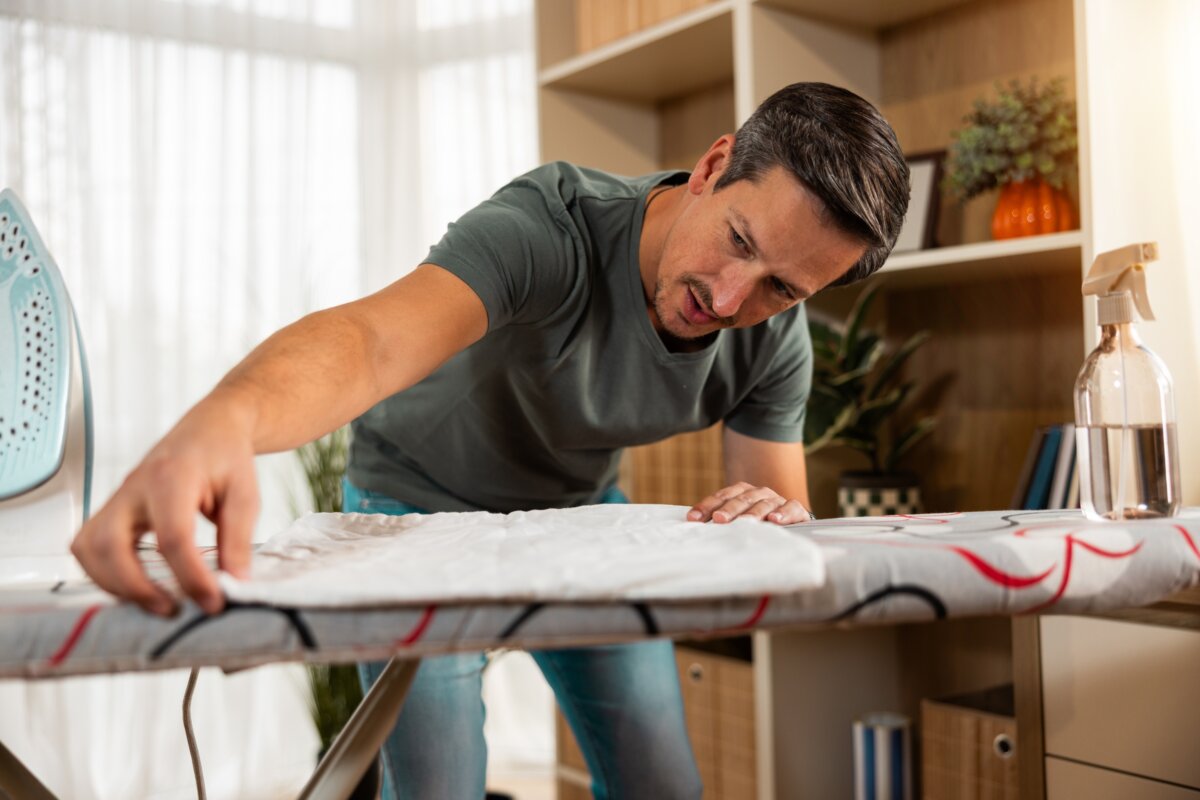
To address this problem, writers have suggested to men everything from outdoor sports to farming and gardening. A quicker and more satisfying route is all around us. It’s in our homes. The objects in need of transformation are our dining tables, the clothing we wear, the food we eat, the floors on which we walk, the lighting and decor of where we live, the grit and grime on everything from shutters to sideboards that cry out for cleaning, and the bathrooms we use daily. They are all in desperate need of attention and care with a spirit that the masculine touch can bring.
Somehow, there is resistance to this idea on grounds of gender roles. Men are not supposed to do this stuff or even care about it. The proposition is absurd. Men can and should. This is not about taking away roles from anyone—must less about acquiescing to politicized demand–but more like an act of homesteading, newly inhabiting the uninhabited realm.
A century and a half ago, the roles of men and women in the house were stabilized by gender. Men worked outside the home either in the fields or factories while women tended to domestic matters. Families of higher social class had servants to manage the laundry, cooking, and keep things going, while those who could not afford such luxuries made do by cultivating womanly arts while men’s remunerative work paid the bills. Men of a certain social class even had valets to manage their clothing choices.
With this stability in place, a cultural passion developed for beautifying and perfecting domestic life and spaces. In the 1880s and 1890s, there was a series of best-selling books on the decoration of houses that were bestsellers in the UK and United States. Houses were growing in size and ever more people could afford larger homes, which called forth the need for more furniture, paintings, wallpaper, rugs, and so on. It was a new opportunity for millions at the time and everyone wanted to know how to do it well.
Edith Wharton and Ogden Codman wrote a popular book “The Decoration of Houses” (1897). There was Charles Eastlake’s “Hints on Household Taste” (widely reprinted in the U.S. in the 1870s–1880s), and Robert W. Edis’s “Decoration and Furniture of Town Houses” (1881). Oscar Wilde came to the United States in 1882 to go on tour to speak to the topic of aesthetics with a focus on home decoration in particular. His lectures were wildly popular because everyone wanted to know how to do it right.
This was primarily a woman’s domain and doing a good job was in her best interest: shepherding a family and making art out of what used to be merely shelter. The books above were mostly written by men, however, and pitched to women but with an inclusive tone too, because men need to know these matters too. At the very least, they need to appreciate and value the contribution that women were making in shaping domestic life.
Good times. They did not last. The Great War changed everything. Men were drafted from fields and offices into service, women into worry and work, and community stability went into upheaval. That was just the beginning.
Huge technological and demographic shifts came following the Great War. Daughters moved to the city and took new jobs while delaying marriage, while men faced new options in an industrial society. The sewing machine and factory fabrics had already kicked off the change in domestic life. Urbanization and the end of agronomy sealed the deal: mastery of domesticity, and all that is associated with its careful curation and cultivation, was poised for extinction.
At some point, there was a much-reduced role for “homemaker,” apart from the raising of children. The rise of home appliances and modern kitchens after the Second World War further deprecated the household arts. In the 21st century, these arts have suffered from grave neglect: cooking, cleaning, dressing properly, entertaining, decor, laundry, table manners, and so on.
Today an entire class of tasks and concerns—the very ones that consumed public interest in the late 19th century—seems to belong to no one in particular. Sure, there are wide exceptions to the rule but those are conscious decisions undertaken one household at a time. There is no longer a culturally assumed pattern. It has been replaced with a sense that domestic life should run itself. Perhaps just the right robot will come along.
As the machines took over ever more tasks, people migrated from place to place to chase better professional options, and services outside of the home took care of all needs, people lost not only skills but cognition. How many people today would even know how to clean a shirt or a pair of socks without a washing machine? So detached have we become from how the machines even operate that we don’t think about it at all.
Even worse, the domestic arts have been slaughtered by politics, such that any expectation that this is “women’s work” is regarded as patriarchal and exploitative, while men who take them on are seen as vaguely suspect in their orientation. “Homemaking” classes in school are gone because who needs to know that stuff?
This is all ridiculous and ultimately degrading. After all, we do need clean and neat clothes, beautiful domestic environments, good home-cooked food, lovely dishes and glassware, immaculate bathrooms, pressed clothing, and some sense of decorum in private life.
Home is where we live and where the blessings of freedom are realized. Meanwhile, corporate workplaces are dominated by an officious and prosecutorial HR regime that works to ban all signs, real or imagined, of “toxic masculinity.” It’s hardly a place where a man feels at home.
Proposition: Men should take it upon themselves to rediscover the domestic arts. That includes decor, tasks, dress, manners, and all that is associated with an orderly and decorous private life. We are uniquely suited to the task. We like a good challenge, especially one that requires some technical and even artistic skill.
Technological advancements have also made remote work more common such that men are spending more time at home than perhaps ever before. It’s time to embrace that role and become essential to household management. I don’t just mean taking out the trash but also managing provisions, curating art, maintaining clothing, and prepping meals.
Consider something seemingly simple like removing a wine stain from a tablecloth. There are ways to do this and ways not to do this. There are elements of chemistry involved in addition to some manual labor. Achieving it feels like a real accomplishment, the application of brains and brawn to transform our environment. The same is true of cooking a roast, sewing a seam, polishing silver, or cleaning a bathroom.
For reasons of history and cultural caricature, men have been invited to neglect all of this. There is no good reason for it.
H.L. Mencken’s book “In Defense of Women” (1913) observes that men in fact do have a great facility at domestic tasks from cooking to laundry to rug cleaning and even decorating something besides a man cave with a 90” TV for watching sports. It’s just a matter of cultivating the skills (and good taste) and taking on tasks with courage and discipline. Indeed, it was Mencken’s view that the cultural assignment of such to women exclusively makes no sense in the modern age.
So, sure, men should take a bigger role in household management in all issues big and small. It’s in their own interest. It’s engaging and satisfying work, much of which speaks to strengths of the masculine character. It’s not the cultural expectation but the time has come in any case.
Views expressed in this article are the opinions of the author and do not necessarily reflect the views of The Epoch Times.
 Friends Read Free
Copy
Facebook
Tweet
Friends Read Free
Copy
Facebook
Tweet