

Commentary
Your grandmother likely had a big collection of tablecloths for all occasions, hanging in a wardrobe or folded in a buffet drawer. Some were seasonal with holiday themes. But many were just for everyday use. Dinner (and lunch) always involved a tablecloth and cloth napkins.
Count this as another grand tradition blasted away by the god of convenience. No one wants to deal with the laundry problem. People don’t even know how to remove spots anymore. The less laundry the better, people say, so we eat on wood, stone, or, more likely, some surface made of petrochemicals.
Even by the 1970s, tablecloths came to be compromised, made of polyester or nylon or some other nasty fabric that subtly drains away the joy. The proper tablecloth must be made of cotton, linen, embroidery, or lace to elicit the right amount of elegance to enhance the meal experience.
Even now when I go to a restaurant with cloth tablecloths, I always find the manager and thank him for going to the trouble. Especially in a public eating place, cloth tablecloths and napkins introduce higher costs and real trouble. Paper napkins are fine for fast food and ballparks but real dining requires cloth.
Doing so shows that they truly care about the dining experience.
Shouldn’t you also care about your home dining experience? For starters, get a cloth tablecloth.
It’s not just about elegance. It’s about training for the best eating decorum.
You see, the tablecloth is indefatigable and unforgiving. Let’s say you have a plate of spaghetti with tomato sauce. That’s hard to eat regardless. With a white tablecloth, every splash or spill appears on the cloth. There is nothing you can do. The spot just sits there begging to be cleaned. It sits there broadcasting a message to all: the person in front of me made a mess.
After the meal and plates are collected, you can see who did a good job and who did not. It’s like having a permanent record of everyone’s eating sins right there before one’s eyes, person by person.
Just knowing that this is true strongly incentivizes the best-possible manners. It forces everyone to be a conscious eater, cutting meat carefully, taking second helpings with gentleness and caution, and otherwise recalling your best techniques for manipulating forks, spoons, and knives.
Chopsticks are a challenge for anyone who did not grow up with them. The tablecloth will train people to use them properly and do so in an unforgiving way.
The tablecloth is a cruel taskmaster. But the results are a dinner with greater presence, decency, and caution. There are few rewards in life as wonderful as that moment when you clear the table and view a completely unstained white tablecloth that can be reused for the next meal. A toast to the disciplined eaters!
You are also left with a profound sense of guilt when your wine glass leaves a circle, your soup has stained the space between your bowl and the table’s edge, or you have dripped butter from the mashed potatoes on their way from the silver bowl to your plate.
Someone has to clean that mess and that mess is yours, invariably due to your own carelessness now on display for all the people you have been trying to impress. Yes, of course the hostess says it is all fine. But you know that it is not, not really.
You see, a tablecloth turns the ordinary act of eating into moral drama. It demands mindfulness in a world engineered for distraction. In our times of phones at the table, endless scrolling, and “family dinners” that consist of everyone staring at glowing rectangles while inhaling takeout, the tablecloth reasserts the power as a real event that demands ritual and settled liturgy.
The tablecloth forces the meal to engage your full attention. Your posture straightens. Your voice lowers. You are careful when you first pick up your silverware, maybe even waiting until everyone is served. You actually taste the food because you are not frantically mopping up disasters with paper towels or pretending the spill never happened.
This is even more true if you can add beeswax taper candles to the table. In this case, poor trimming technique or excessive movement means drips on the table. That requires some serious skill with an iron and brown paper. Even then, the wax can leave a permanent stain on white cotton. That’s a high price to pay for your misbehavior.
Children especially benefit. I have seen kids who normally eat like tiny demolition crews suddenly transform when a crisp white cloth appears. It becomes a game: no stains allowed! What do you know, they suddenly care about manners if only to avoid humiliation.
They grip utensils with unexpected seriousness. They slow down. They learn the quiet satisfaction of doing something well. One spill, one visible ring of grape juice, and the lesson lands more effectively than any lecture.
The tablecloth becomes a silent teacher of self-control, far more effective than plastic mats printed with cartoon characters that forgive every catastrophe.
Those mats say, “Be a slob because it doesn’t matter.” The cloth says, “It does matter. Try again.”
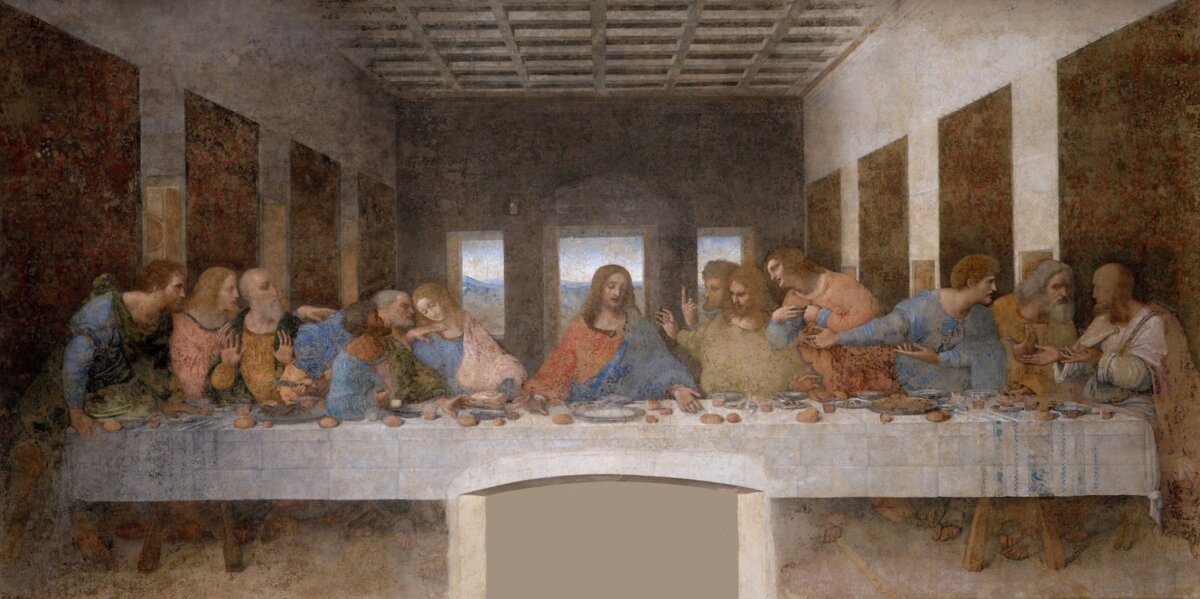
Every culture that valued refinement understood the power of textiles at the table. Ancient Romans draped their triclinia with fine linens. Medieval banquets featured embroidered cloths that signaled status and care. Victorian households maintained entire linen closets organized by occasion. One only need to consider Leonardo da Vinci’s Last Supper: of course the table is covered in embroidered linen.
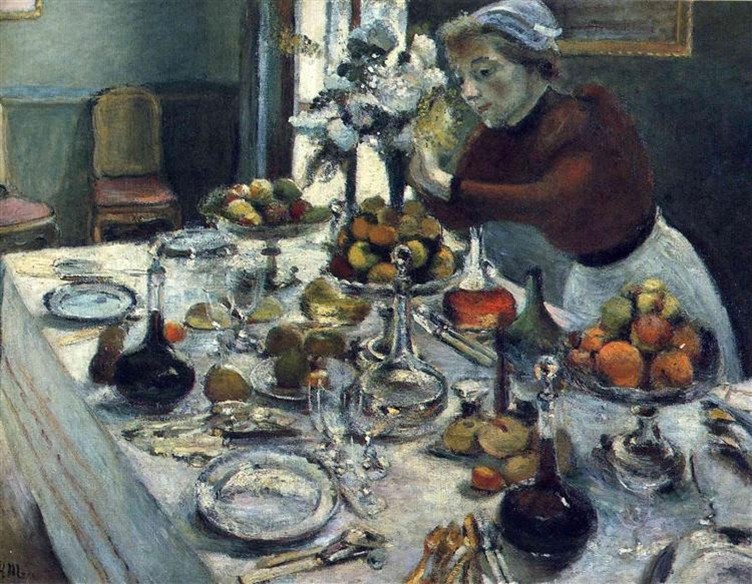
Or check out Henry Matisse. Does it get any better?
Even in leaner times, people mended and starched what they had rather than surrender to bare surfaces. The postwar rush toward convenience—paper plates, formica tables, “no-iron” synthetics, plastic place mats—coincided with a broader cultural loosening of standards. We traded ritual for efficiency. Then we wonder why manners, conversation, and even food quality itself seem diminished.
Consider the economics too. A good set of cotton or linen tablecloths is an investment that pays dividends for decades, even generations. Unlike disposable products that constantly cycle through landfills, quality fabric can be passed down. My own collection includes pieces inherited from my mother’s mother, still beautiful after careful laundering.
How to clean them? Different stains require different methods. Red wine is easily removed with hydrogen peroxide, soap, and water. Grease and beef stock are tackled with soap and baking soda. Tomato sauce is cleaned with a cold water rinse. Never be tempted by bleach, please. It will ruin the cloth. And consider drying in the sun.
There is also a sensory pleasure that plastic and bare wood cannot match. The soft hush of fabric under plates, the way candlelight catches the weave, and the subtle scent of freshly ironed linen are all signs that elevate a weeknight night spaghetti dinner into something ceremonial.
You dress the table, and in doing so you dress the occasion. Suddenly the meal feels like something over which to linger. Conversations stretch. Jokes land better. Even the food tastes superior because presentation matters. A beautiful table makes simple food feel abundant.
Critics will call this fussy but they miss the point entirely. Using cloth is not about impressing guests with luxury. It is about refusing to participate in the cheapening of daily life. We already accept disposable everything. Must the dinner table surrender too?
The home is the last redoubt of civilization. If we cannot maintain beauty and order in the place where we break bread with those we love, what hope is there for the larger culture?
Start small. Buy two or three good-quality tablecloths in neutral colors that coordinate with your dishes. White for special occasions, ivory or soft gray for everyday. Invest in cloth napkins too, with a dozen as a good beginning number. Teach the family the simple rules: no elbows on the cloth, no reaching wildly, napkin in lap.
Make clearing the table a shared ritual where everyone inspects the evidence of their own care (or lack thereof). Laugh about the disasters. Learn from them. Over time the incidents decrease. The standard rises.
You may discover that the tablecloth subtly reforms more than table manners. It encourages better planning of meals. It discourages mindless snacking. It makes hosting friends feel natural again rather than a chore. And on those rare evenings when the cloth survives completely pristine, there is a small, almost ridiculous triumph. You feel you have held the line against entropy for one more day.
In the end, the case for tablecloths is the case for living deliberately. Against the current that pulls us toward sloppiness, disposability, and distraction, the humble cloth offers resistance. It asks us to eat like people who respect themselves, their families, and the gift of nourishment.
Your grandmother kept her collection for a reason. She wasn’t just being fancy. She was preserving a way of life that valued beauty in the ordinary. We can do the same. A few good cloths, a bit of know-how, and the willingness to care: that’s all it takes to bring the tradition—the liturgy of the meal—back to the table.
Views expressed in this article are the opinions of the author and do not necessarily reflect the views of The Epoch Times.
 Friends Read Free
Copy
Facebook
Tweet
Friends Read Free
Copy
Facebook
Tweet