
Commentary
My life is pretty dirty. Literally.
I have four young children. I work on a farm. I spend plenty of time in a restaurant kitchen. By the end of most days, there is dirt under my nails, animal hair on my clothes, grease stains somewhere on my shirt, and usually something mysterious wiped onto the knees of my pants by a toddler. My clothes live a hard life.
A few years ago, I largely stopped buying new clothes, with the exception of undergarments and denim jeans. I am particular about how jeans fit, and when you find the right pair, you hold onto them for dear life. Outside of that, almost everything I wear now comes from Goodwill or other secondhand shops.
My accountant laughs at me because I spend almost nothing on myself compared with what I spend on my children. She teases me about my monthly Goodwill habit, somewhere between $90 and $110. But honestly, I think it is one of the smartest systems I have built into my life.
Part of it is practical. I wear only natural fibers: cotton, wool, linen, silk. No synthetics.
There have been plenty of studies raising concerns about synthetics and their impact on fertility and the endocrine system. Our skin is our largest organ. Wrapping it in plastic has never felt like a particularly good idea to me.
Part of that perspective probably comes from how I was raised.
My mother was a fashion designer, so much of my childhood was spent wandering through the garment district in New York City or exploring obscure fabric warehouses out on Long Island. My brother and I would run through the aisles, dragging our hands across endless rows of fabric bolts, learning to identify materials by touch alone. We would guess the fabric makeup before checking the tag: linen, cotton, silk, or wool.
We were trained from a very young age to understand quality and to recognize how natural fibers behave differently in our hands. Natural fibers breathe differently, move differently, and age differently. They soften over time rather than break down.
My mother primarily designed linen clothing. She had two companies: Angel Hart Designs and Flex. Before I understood anything about endocrine disruptors or microplastics, my mother had already ingrained in me the importance of natural fibers.
She used to joke: “We’re not going to wrap you in plastic. Your body needs to breathe.”
The problem is that natural fiber clothing is expensive. Especially good natural fiber clothing. A quality wool sweater or linen dress can easily cost more than $100 new. Add in the reality that I destroy clothes quickly, and suddenly clothing becomes an absurd expense.
But the thrift store is the great equalizer.
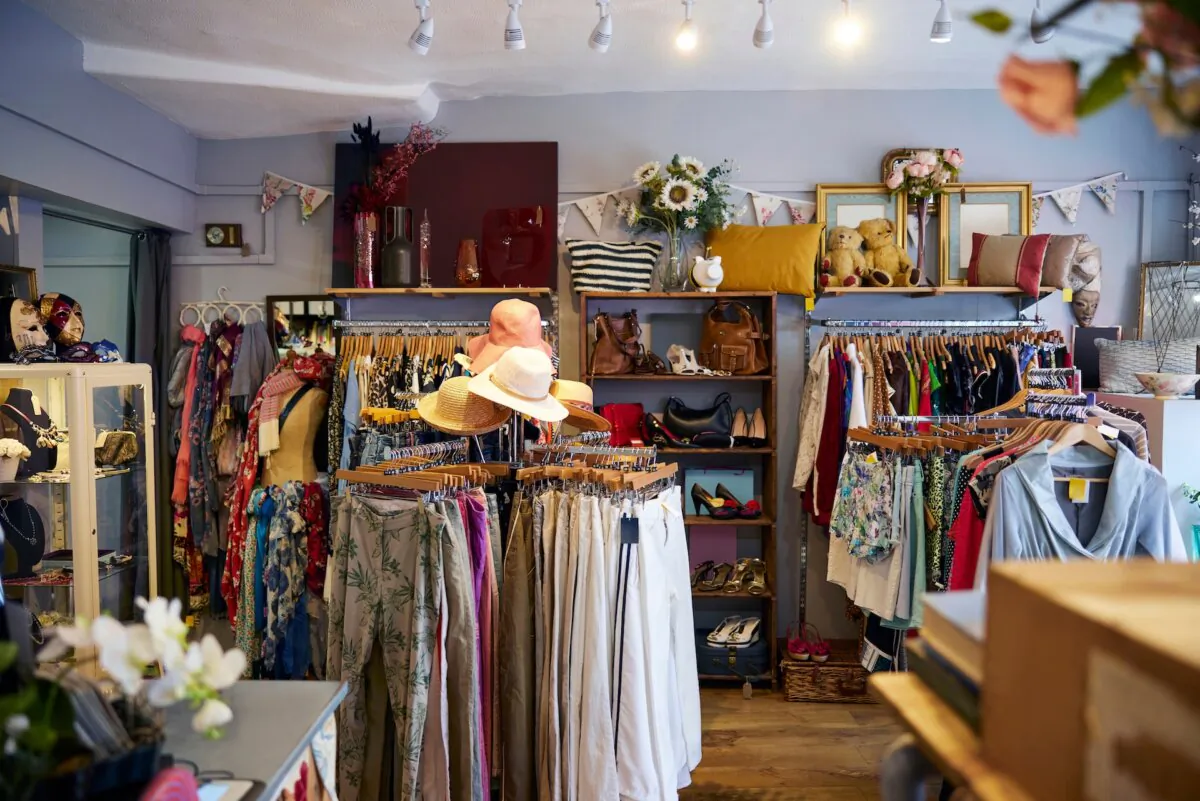
At Goodwill, the acrylic sweater from Forever 21 and the 100 percent wool sweater from J.Crew are both just labeled as a sweater. The polyester fast-fashion shirt and the perfectly worn linen button-down live on the same rack.
So I treat Goodwill like a treasure hunt.
I walk through the aisles feeling fabrics between my fingers, checking tags, searching for gems hidden in plain sight. There is an art to it. You learn the feel of linen before you even read the label. You can spot quality stitching from six feet away. You become oddly skilled at identifying cashmere by touch alone.
And honestly, some of the joy is not even finding things for myself.
Sometimes you see something too perfect to leave behind because it belongs to someone you love.
This week, I found an extra-large organic cotton muslin jumpsuit with front buttons and immediately thought of my friend, Shay. She is almost 6 feet tall, still breastfeeding, and built in that powerful maternal way that requires clothing designed by someone who understands real women’s bodies. The jumpsuit was $8.99. I looked it up later, and even used online, it was selling for about $40. There was no universe where I was leaving that behind.
I found a 100 percent linen houndstooth button-down for summertime. Then three separate size-medium linen shirts for my brother, who is heading to Africa for a regenerative agriculture project around Memorial Day—perfect hot-weather travel shirts for a fraction of what they would cost new.
I found a pair of size 8 work boots that looked almost unworn and grabbed them for one of our employees.
Then there are the practical victories that feel almost euphoric when you run a place like ours.
At the ranch, we constantly need bedding for tiny homes and Airbnb units. This week, I found queen-size 100 percent cotton sheets for $1 apiece: $1 for the fitted sheet, $1 for the top sheet, and $1 for the pillowcases. I found a goose-down comforter for $8.
Again, Goodwill is the great equalizer. The real goose-down comforter sat beside a poly-fill Target comforter for the exact same price because the system does not differentiate between quality and imitation.
And maybe that is part of what I love about it philosophically.
The thrift store quietly exposes how distorted modern consumption has become. We live in a world flooded with cheaply made synthetic products designed to fall apart quickly. Clothing has become almost disposable. People buy bags full of trendy outfits, wear them a handful of times, then donate them in giant waves of overconsumption.
Mixed into all of that excess are these beautiful relics from another era. Heavy linen. Thick cotton. Wool coats made to last 20 years. Real craftsmanship buried under piles of disposable fashion.
Goodwill rewards patience and discernment. You cannot force it. Some days you find nothing. Other days, you walk out with an entire season’s wardrobe and sheets for three beds for less than the price of one new synthetic sweater at the mall.
There is also something deeply human about secondhand things. Objects carrying little traces of previous lives. A linen shirt softened by years of washing. A wool sweater already broken in. Children’s books with handwritten names inside the covers. Sometimes, I wonder about the people who owned these things before us.
As strange as it sounds, thrift shopping also makes me feel hopeful. It reminds me that abundance does not always require endless manufacturing. There is already so much excess in circulation. So many perfectly usable, beautiful things already exist.
And for people like me—whose life involves mud, kitchens, livestock, children, spilled coffee, and constant movement—there is tremendous freedom in not being precious about clothing. I do not panic when a child wipes sticky hands on my sweater. I do not spiral if I kneel in dirt wearing linen pants. Everything had already lived another life before it came to me.
Goodwill is one of the few places left where quality, status, and branding quietly disappear for a moment. Everything gets thrown onto the same rack together, and the only thing separating treasure from junk is whether you have learned how to see it.
Views expressed in this article are the opinions of the author and do not necessarily reflect the views of The Epoch Times.
 Friends Read Free
Copy
Facebook
Tweet
Friends Read Free
Copy
Facebook
Tweet