
Commentary
The power of biblical archaeology lies in its demonstration of the Bible’s historicity. It also confirms the presence of the Jews in their ancestral homeland. And it supports the founding pillars of America—such as the Declaration of Independence and the Constitution—as well as those of Western civilization.
The philosopher Leo Strauss said the West was built on two pillars: Athens and Jerusalem. Athens represents classical reason, free speech, and democracy. Jerusalem represents the idea of divine creation and a divine source for rights, the Exodus as a model of liberation from tyranny, and the Ten Commandments and the teachings of the prophets as a code and recipe for the good life.
Athens, in a sense, needs no defense, but Jerusalem does. And yet the West is no less dependent on Jerusalem than on Athens. To consider just America, where would this nation be without Jefferson’s tracing of our fundamental rights to our Creator? Why, if not for their divine source, are our rights “unalienable”?
How immeasurable is the impact of the Exodus narrative on black slaves anticipating their freedom?
How much inspiration and knowledge have we gained from the great figures of the Bible, such as Abraham and Moses, from the Hebrew prophets like Isaiah and Jeremiah, and from the Jewish messiah named Jesus?
And how much more chaotic would our society be without the guiding influence of the Ten Commandments, the Psalms, and the wisdom literature of the Bible?
Since the Enlightenment, and even more since the 19th century, the Bible has come under fierce attack. Skeptics insist the Bible was written long after the events it describes, and that much of it is based on myth and fable.
Biblical archaeology refutes the attack by confirming the Bible’s historicity. Biblical archaeology is not concerned with miracles or theology, but if the people, places, and events of the Bible are shown to be real, that increases the credibility of the narrative as a whole.
My new book “The Stones Cry Out” covers the entire sweep of biblical history, from the patriarchs who lived around 2,000 B.C. to Moses, who lived around 1,500 B.C., to the Hebrew prophets who lived from the eighth to the fourth centuries B.C. to the life, ministry, and death of Jesus and also the first-century A.D. movement of early Jewish and Christian followers of Jesus the messiah.
As a preview of the book, here I want to give three examples—two from the Old Testament and one from the New Testament—of how biblical archaeology authenticates the historicity of the Bible, down to its tiny details.
Balaam, Son of Beor
When Joshua leads the Israelites toward the Promised Land—this is around 1,500 B.C.—he must cross through Moabite territory, which is modern-day Jordan. The king of Moab asks a soothsayer or diviner named Balaam, son of Beor, to curse the Israelites so that they suffer plagues and other obstacles to their journey.
Balaam is up for it, but the Bible says God prevents him from doing that and instead compels him to bless the Israelites. Balaam then concocts other schemes to corrupt the Israelites and is eventually slain by them in a subsequent battle.
Now, this Balaam is a strange and somewhat unbelievable character. The Bible portrays him as accompanied by a donkey, and it’s a talking donkey. Not surprisingly, skeptics over the centuries concluded that Balaam was a legendary or fictional character. They insisted the Jews made him up as part of a larger fictional narrative about the great crossing into the Promised Land.
But a few decades ago, archaeologists digging in Jordan came across an inscription in plaster that said, “The Sayings and Warnings of Balaam, son of Beor.” The inscription is dated to around 800 B.C., so much more recent than Joshua’s time, although surely the sayings and warnings themselves came down from an earlier period and were merely recorded on the inscription.
Now, consider the following. The first name is the same: Balaam. Yet it’s possible that Balaam was a fairly common name. The plaster inscription, however, also gives Balaam’s father’s name: Beor. Moreover, the inscription is found in Jordan, which was Moabite territory. And the reference to “warnings” and “sayings” confirms that Balaam was some sort of prophet or soothsayer.
Put all of this together, and it’s obviously the same Balaam described in the Bible. Now, I suppose a critic could say that even the Balaam inscription doesn’t definitely prove he was a historical figure. Maybe the inscription, too, refers to a legendary figure, especially given the distance of time between the inscription and the person it refers to. On balance, however, I think the evidence favors Balaam as a real guy rather than a fictional character.
The Jeremiah Seals
The prophet Jeremiah lived in the sixth century B.C. and was a doom-and-gloom man. He warned the faithless kings of Judah that they would be overrun by a foreign power as punishment for their sins.
In particular, Jeremiah said the latest ruler, Zedekiah, would lose his kingdom and his sons would be killed. Jeremiah urged Zedekiah to surrender to the Babylonians and submit to the captivity of their ferocious despot Nebuchadnezzar.
Zedekiah was not happy with Jeremiah’s counsel of despair and surrender. He rounded up two of his sidekicks—Jehucal, son of Shelemiah, and Gedaliah, son of Pashur—and urged them to keep an eye on Jeremiah. The two spied on Jeremiah and even joined with a gang in throwing Jeremiah into a pit, from which Jeremiah only escaped due to the intervention of a foreign eunuch who got permission from Zedekiah to save Jeremiah’s life.
Fast forward two and a half millennia, and archaeologists in the early 2000s are digging in Jerusalem. They find several clay seals dating to the time of Jeremiah. The seals were used to secure correspondence; the correspondence is lost, but the clay hardens and survives, and the best part is that it bears the name of the person sending the protected correspondence.
One of the seals, uncovered in 2005, bears a name: Jehucal, son of Shelemiah. The archaeologist who finds it, Eilat Mazar of Hebrew University, doesn’t recognize who it is at first. But later she consults a biblical concordance and realizes, to her astonishment, that this is a minor figure in the Bible, an aide to King Zedekiah.
Two years later, around the same location, a second seal is found. It bears the name: Gedaliah, son of Pashur. And suddenly, these two cameo figures from the Book of Jeremiah jump out of the Bible and into the pages of history via the pathway of biblical archaeology. Moreover, if these two characters are real, their seals also support the historicity of Zedekiah and Jeremiah.
The Caiaphas Ossuary
While Balaam, son of Beor, and the two dudes in the Book of Jeremiah are fairly minor characters in the Old Testament, I now want to turn to a fairly major figure in the New Testament, the high priest Caiaphas.
Caiaphas is one of the villains of the Bible. He is one of the four major figures who features in the trial and crucifixion of Jesus. The four major figures are: Jesus, the accused man; King Herod; the Roman governor Pontius Pilate; and the high priest Caiaphas.
All four are very different men. Jesus is haunted, taciturn, and says virtually nothing. Herod is mocking and contemptuous, but he wants this case to be resolved between the high priests and the Romans. Pilate would rather wash his hands of the matter, but he fears a Jewish uprising that might incur Rome’s displeasure and compel the Romans to send in the legions to put it down.
Caiaphas is the key figure, manipulating first the priestly council or Sanhedrin and later Pilate into giving their approval for Jesus to be crucified. The Bible gives him a single name: Caiaphas. The Jewish historian Josephus, who was also a Roman official, gives us his full name: Joseph Caiaphas.
So evidently, Joseph was his first name and Caiaphas his family name. Now, jump ahead 2,000 years. In 1990, just a few decades ago, archaeologists were digging in the so-called priestly quarter of Jerusalem, where the ancient aristocratic families lived. They uncovered a number of stone ossuaries dating to the first century A.D.
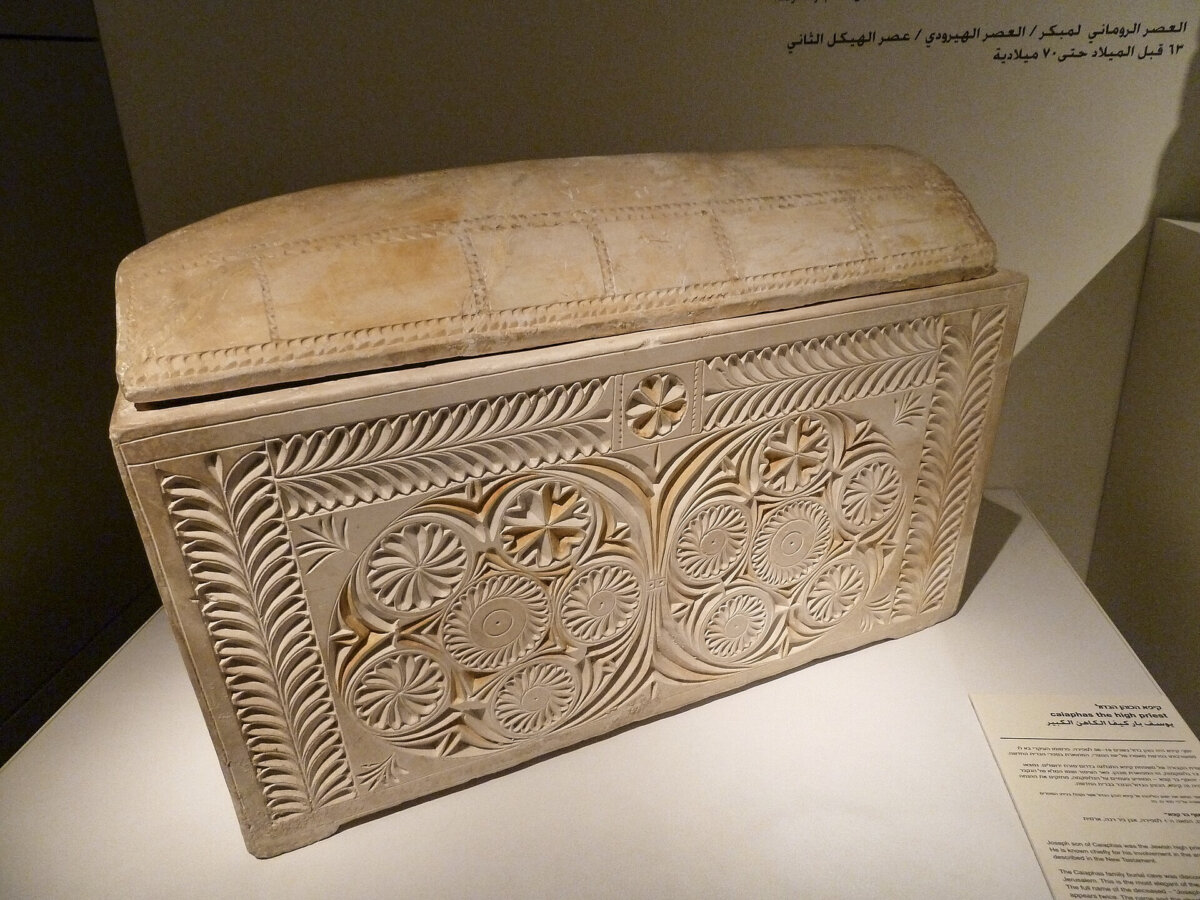
An ossuary is a stone box. Around the time of Jesus, once you died, you were buried in a tomb. When your body deteriorated, your bones were removed from the tomb and placed in a stone box or ossuary. Your name was then inscribed on the ossuary, and the box was decorated in keeping with your distinction in life.
Surveying the ossuaries, the archaeologists found one that was especially ornate. And inscribed on it was a name: Yehosef bar Qayafa, or Joseph son of Caiaphas. Inside the ossuary were the bones of a 60-year-old man.
It’s Caiaphas! Who else? And the remarkable thing is that we don’t merely have an inscription or reference to him; we have his actual bones.
Suddenly, the dramatic scenes of Jesus being taken to the house of the high priest, and of Caiaphas intimidating Pilate into consenting to Jesus’s execution, take on a new and powerful historical scaffolding with this extra-biblical confirmation of Caiaphas.
The power of these examples—and there are around a hundred given in my book—is that they stunningly confirm that the events in the Bible are not merely a matter of faith; they are also a matter of fact.
Consequently, we can trust the Bible, and our confidence in the biblical foundations of America and in the “Jerusalem” pillar of Athens and Jerusalem is thereby reinforced.
Views expressed in this article are the opinions of the author and do not necessarily reflect the views of The Epoch Times.
 Friends Read Free
Copy
Facebook
Tweet
Friends Read Free
Copy
Facebook
Tweet