

Commentary
Have you been invited to a dinner party lately? Held one yourself? If you say yes to either question, you are in the minority. I’ve long suspected that the dinner party has become a thing of the past. Now we have the data to prove it. The man who has compiled it is Substacker Derek Thompson. Here is what his survey results reveal.
Combining the older DDB Needham data with the new Data for Progress replication, the share of Americans who host friends or family at home at least monthly fell from 42 percent in 1975 to 12 percent in 2026—a 70 percent drop.
Other eye-popping results from the 1995 vs. 2026 comparison (the share who did the activity at least once in the past year): Entertaining people in one’s home has fallen from 88 percent to 67 percent. Attending church or a place of worship is down from 74 percent to 54 percent.
Going on a picnic has fallen from 58 percent to 39 percent. Going to a club meeting is down from 45 percent to 26 percent. And so on it goes from playing cards to going to any function outside the home or office. In the last 30 years, Americans have seen double-digit declines in practically every measure of socializing.
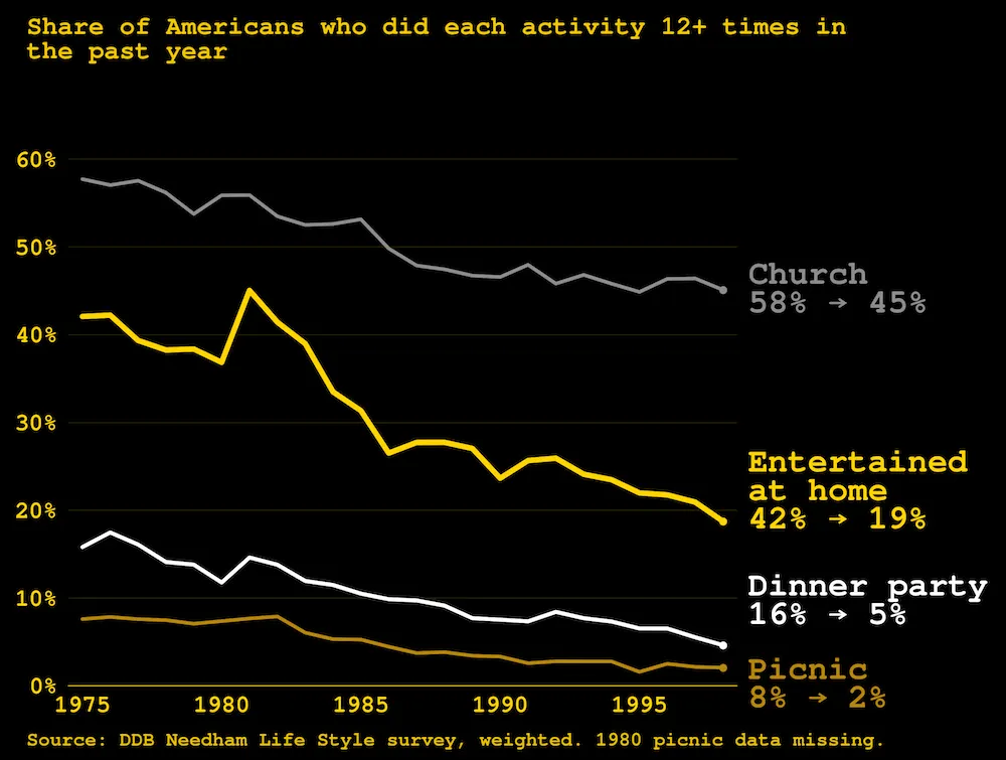
“Overall face-to-face socializing has declined significantly in the last few decades,” Thompson writes, “and the restaurant industry has actually noted a sharp increase in people eating alone.”
So what are Americans doing? This won’t shock you. They are hanging around the house. The amount of time spent just sitting around the house has tripled since 2019. It appears that the “stay at home” orders in the pandemic era really did stick. The policies disrupted whatever socializing Americans did do. The interruption in the normal ritual of life created a new ritual of binging movies and games at home.
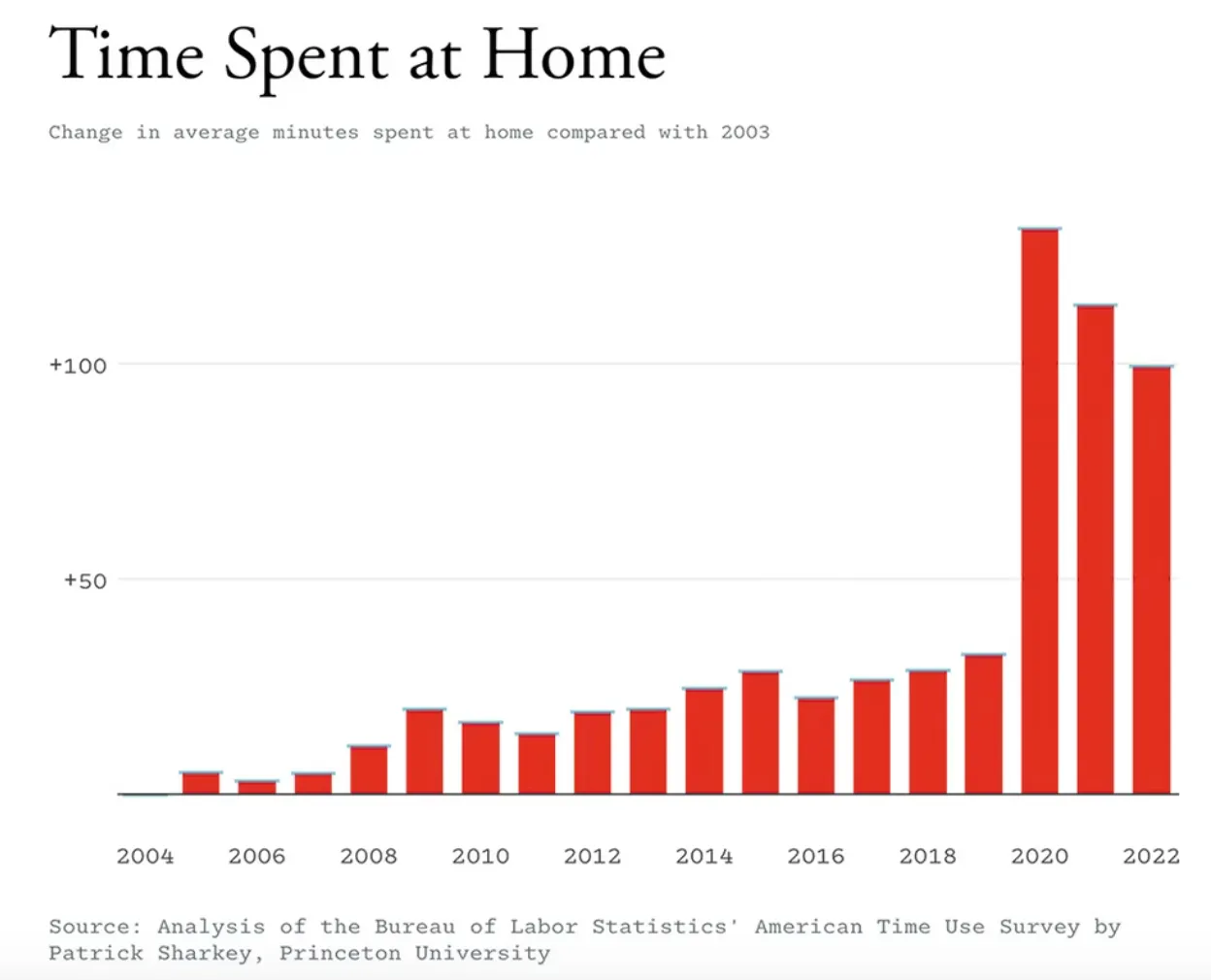
To be sure, we have technologies that we did not have in the past that reward sitting around on your sofa and tooling around the Internet or watching movies and shows. That’s part of the reason.
These are startling numbers that confirm intuition. Americans just are not socializing as they once did. This depletes life of energy, creativity, and adventure. Sure, it is always safer to decline to engage but consider the loss to community life. It’s no way to live.
Another major factor apart from brutal policies is the changed composition of the American household. Marriage is delayed more and more while couples are having fewer kids. Most strikingly, we moved from one income per household to two incomes per household, mostly as a consequence of women moving into full-time professional work.
This change has completely altered the culture of private life. The home as a domestic space is no longer cared for as one would put on display to guests. On the contrary, people are terrified to let anyone inside. They fear being judged for their furnishing, wall art, decor, and messes. All of this is hidden away, shielded from public view.
The simple reason is that no one is responsible for caring for the home, much less cooking, cleaning, laundry, furnishings, or anything else in the home. It is the most neglected space in our daily lives. Offices are cared for more than homes. Indeed, the home is an afterthought, a place to camp daily as we plunge back into the office.
Something deeper has been lost beyond the dust bunnies and unwashed dishes. The dinner party was never merely about food. It was the primary mechanism through which civil society reproduced itself. It was where introductions were made, where professional networks formed organically, where young people observed adult conversation and learned the rhythms of social interplay.
The dinner party was the original social media, the place where information traveled between disconnected social circles, where the married couple met the single friend who might become less single, where the newcomer to town found their footing.
Without this institution, we have become paradoxically more connected and more isolated than ever. We know what hundreds of acquaintances ate for lunch via Instagram, yet we cannot name five neighbors. We maintain hundreds of weak ties while our capacity for deep friendship atrophies.
The dinner party demanded something that screen interaction never requires: the hard work of presence, of reading facial expressions across candlelight, of navigating the delicate politics of seating arrangements, of investing in a meal that cannot be deleted or muted.
A friend of mine was recently shopping for a home with one condition: it must have a dining room. Did you know that such places are no longer easy to find? New homes are being built with big kitchens and instead only an eating bench in the kitchen. Maybe a breakfast nook.
But dining rooms? Architects are no longer presuming that people want them.
Can you even imagine? The art of dining in the Western tradition—actually all traditions—traces back to the ancient world. The core of Christian liturgy is about a meal with disciples. There are many examples of house parties in the Gospels. The remainder of the New Testament is filled with dinners in private homes. This was the core of the teaching work of St. Paul.
None of this could have unfolded as it did in today’s world where homes are locked to guests.
Modern table manners trace to the Court of Louis XIV and the industrial production of table cutlery. Homes made huge investments in table linens, crystal glassware, and porcelain plates and bowls. Dressing the table was a major status symbol.
What has become of all of this? Go take a visit to your local Goodwill store. It’s all for sale at rock-bottom prices. Maybe new brides still pick out patterns in plates and glassware but is it ever actually used or just stored away?
It was only a few generations ago that people would think nothing of calling on family, friends, and neighbors with a knock on the door, resulting in coffee or an invite to dinner. Today all of this is unthinkable.
And here is what gets my goat: the terrible predicament in which we find ourselves—with our homes no longer welcoming guests much less sharing a meal in a home—has been cheered as liberation and prosperity.
The liberation point traces to a preposterous claim that women should abandon the home and be dragged to the office, pay taxes, obey the boss, and compete with coworkers for raises.
The claim that this is prosperity relies on a statistical trick: counting household income rather than calculating income per hour worked. Once you do that math, you generate a picture of declining living standards over half a century. Sure, we have more electronic toys but what we’ve given up is civilized life.
Regardless, the damage is done. A major feature of what we called civilization is nearing extinction. However, there is something you can do about this. Plan your next dinner party. Start with just two guests and then add. Pledge to yourself that you will do this monthly. Maybe this results in a New Year’s party or some friendly get-togethers over the winter months.
This problem, this tragedy, is fixable, one household at a time.
Views expressed in this article are the opinions of the author and do not necessarily reflect the views of The Epoch Times.
 Friends Read Free
Copy
Facebook
Tweet
Friends Read Free
Copy
Facebook
Tweet