
Commentary
With its revealed range in “excess of 250 nautical miles” (287 miles), the U.S. Navy’s new long-range air-to-air missile (AAM) constitutes a major upgrade in the ability of the United States to arrest China’s quest for superior air power in Asia.
On May 7, 2025, Chinese air combat technology gave Pakistan a historic, beyond-visual-range (BVR) victory, when, during a record aerial engagement between 72 Indian Air Force and 42 Pakistan Air Force combat jets—that did not enter the other’s territory—Pakistan claimed to have shot down five Indian combat aircraft at ranges approaching a record 125 miles, including three French-made 4.5-generation Dassault Rafale fighters.
Pakistan’s victory was enabled by its acquisition of 20 Chengdu Aircraft Corporation 4.5-generation J-10CE fighters, equipped with an estimated 105- to 125-mile-range active electronically scanned array (AESA) radar, and armed with 125-plus-mile-range Luoyang PL-15E (‘E’ for export model) long-range AAMs.
When long-range AAM engagements exceed the range of the fighter’s radar, “off-board cuing,” or guidance, is necessary, such as from Pakistan’s Chinese-made Shaanxi KJ-500 airborne warning and control system (AWACS) with an estimated 300-mile-range AESA radar, but these reportedly were undergoing modifications and were not in the battle.
But Chinese-source rumors at the time credited China with helping Pakistan fight this air battle by providing satellite and perhaps electronic intelligence that helped enable maximum-range interceptions by Pakistan’s PL-15 AAMs.
This performance has also finally encouraged more foreign sales for the J-10CE, with Uzbekistan now taking delivery of about 12 to 24, and Bangladesh and Algeria reportedly close to placing orders for 20 to 30 each.
China’s very large investment in longer-range and self-guided AAMs provides the “tip-of-the-spear” for Beijing’s massive investment in air superiority, starting with the 2000 purchase of 50-mile-range Russian Vympel R-77 self-guided AAM technology to enable the 60-mile-range Luoyang PL-12 by 2005—similar to early versions of the U.S. Raytheon AIM-120 AMRAAM.
By 2011, China was providing the first glimpse of its Luoyang PL-15 being carried in the internal weapons bay—to preserve stealth—of a prototype Chengdu J-20 fifth-generation heavy fighter, with an estimated range of up to 190 miles, far outranging the best U.S. fifth-generation Lockheed Martin F-22A and AIM-120 combination.
Furthermore, in 2016, China’s People’s Liberation Army Air Force (PLAAF) revealed its longer-range Luoyang PL-17, carried externally on a Shenyang Aircraft Corporation J-16 heavy twin-seat strike fighter, reportedly in PLAAF service since 2022.
These advanced Chinese AAMs can now arm 1,838 fourth- and fifth-generation fighters in the PLAAF, according to the latest annual Defense White Paper of the Japanese Ministry of Defense.
These now include: 308 J-20 fifth-generation fighters, whereas the Obama administration halted F-22A production at 187; 350 J-16 fighters compared to only 133 of the similar U.S. Air Force (USAF) Boeing F-15E heavy twin-seat strike fighter; and 608 J-10 fighters, more than 300 of which may be AESA-equipped J-10B and J-10C fighters, compared to about 150-plus USAF Lockheed Martin F-16C AESA-modified fighters.
But long-range BVR engagements by these fighters can be enabled by about 100 PLAAF AWACS platforms, including about 90 KJ-500s, whereas the USAF has had to fight furiously to secure funding for 26 next-generation Boeing E-7 Wedgetail AWACS with new AESA radar.
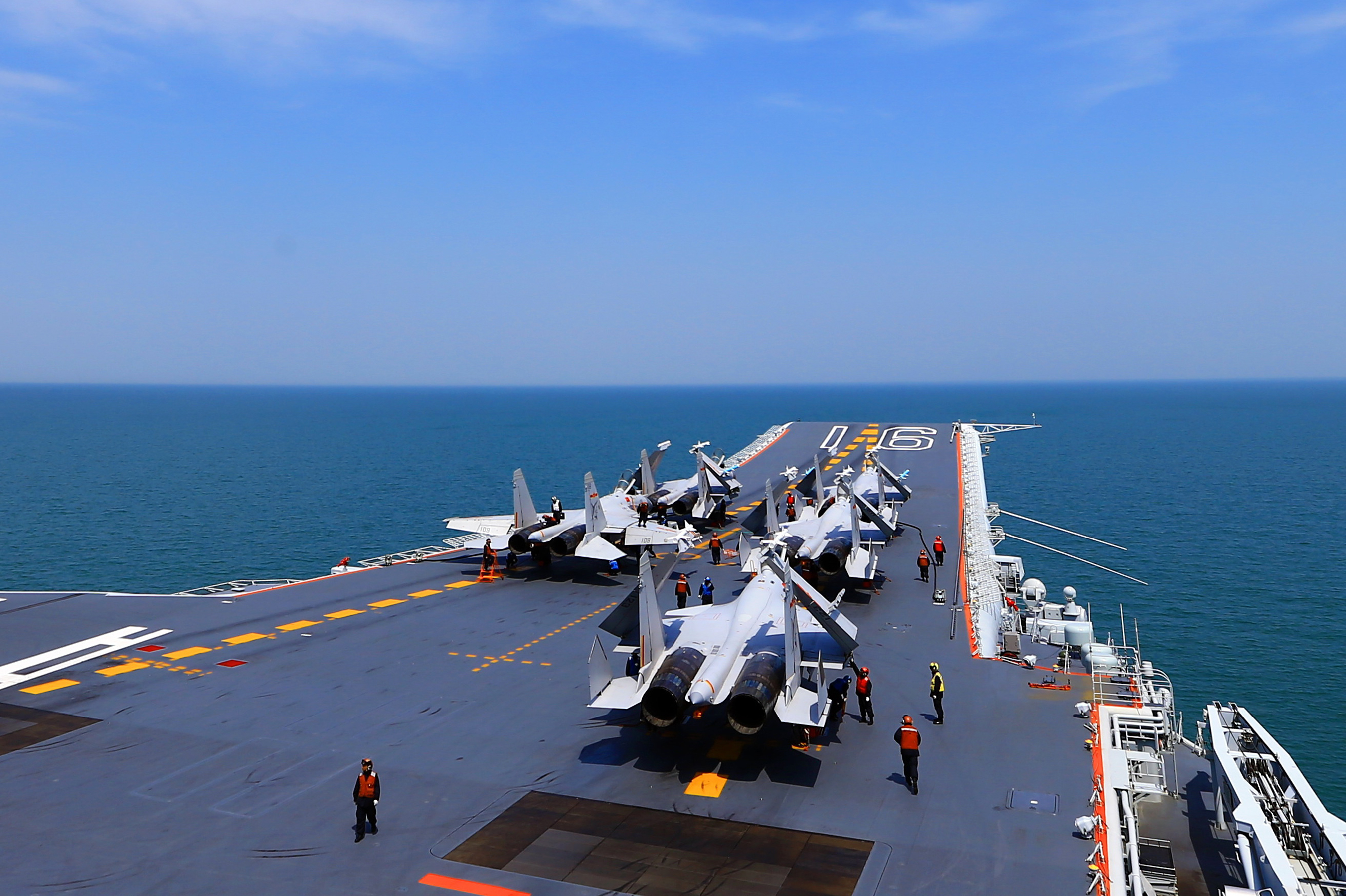 J-15 fighter jets on China’s sole operational aircraft carrier, Liaoning, during a drill at sea on April 24, 2018. (AFP via Getty Images)
So it is an understatement to say that the United States, which fought hard to achieve air superiority over the Soviet Union to keep the Cold War from turning hot, is now in a vital race to ensure that U.S. air power can continue to deter global conflict with China and its Russian and North Korean allies.
Central to the U.S. air power investment is the Lockheed Martin fifth-generation F-35 medium-weight fighter, which now has about 800 of a planned purchase of 2,450, to be extended by a networkable virtual “aerial alliance” of 700 to 800 more F-35s ordered by non-U.S. air forces.
The F-35 likely employs the world’s superior AESA radar, along with ultra-long-range optical sensors and perhaps the world’s best offensive/defensive electronic warfare systems, with advanced networking, and is capable of providing off-board cueing for ground-launched missile interceptors.
By the early 2030s, the USAF expects to take delivery of the Boeing F-47 sixth-generation fighter, with technology development prototypes having flown in 2020. The U.S. Navy is expected to select its sixth-generation fighter developer later this year.
To multiply and extend its combat power, the United States plans to acquire up to 1,000 CCAs and is now testing prototypes developed by Anduril and General Atomics.
But central to the American air power investment for more than a decade has been an effort to develop better, longer-range AAMs to keep pace with and overtake the Chinese AAM threat.
In addition to continually improving and extending the range of the AIM-120, the U.S. Navy has led the development of the Raytheon AIM-174B Gunslinger, revealed in July 2024, with a classified range estimated at up to 300 miles, but this large AAM can only be carried externally.
In development since at least 2019, the first images emerged in May this year of the estimated 120-plus-mile-range Raytheon AIM-260 AAM, which is close in size to the AIM-120 and can be carried internally by the F-22A and F-35.
But on Aug. 22, reporting from a Reno, Nevada, symposium of the Tailhook Association, a nongovernmental organization that supports naval aviation, Aviation Week and Space Technology magazine first revealed the U.S. Navy was “flight testing” the AIM-424 Malice.
About a day later on its webpage, the U.S. Navy revealed size and performance data for the AIM-424 Malice, to include a range in “excess of” 287 miles—with unofficial estimates approaching 400 miles—and a size that would allow internal carriage by the F-35 and the F-22A.
Images of the AIM-424 reveal that it is a two-stage AAM, meaning that unlike single-stage long-range AAMs, it has a better chance of sustaining high energy, or speed, to ensure lethality at the end of its engagement.
China’s immediate response has been to throw “shade” at the AIM-424, with Chinese state media Guancha publishing Aug. 28 commentary by Taiwanese expert Lu Shili saying:
“I believe that at this stage [AIM-424] is still more of a concept, and its main function is to respond to the development of China’s long-range air-to-air missiles and prevent the United States from looking too bad in terms of public opinion and equipment comparison.”
For sure, the Chinese Communist Party dearly wants to preserve its promoted image that its new air combat technology is superior to that of the United States, even though it has only been demonstrated in one, albeit large, air battle.
But the reality is that since World War II, the United States has been, and intends to remain, the world’s superior air power, a fact just affirmed by the revelation of the AIM-424 Malice.
Views expressed in this article are the opinions of the author and do not necessarily reflect the views of The Epoch Times.
 Friends Read Free
Copy
Facebook
Tweet
Friends Read Free
Copy
Facebook
Tweet