
Commentary
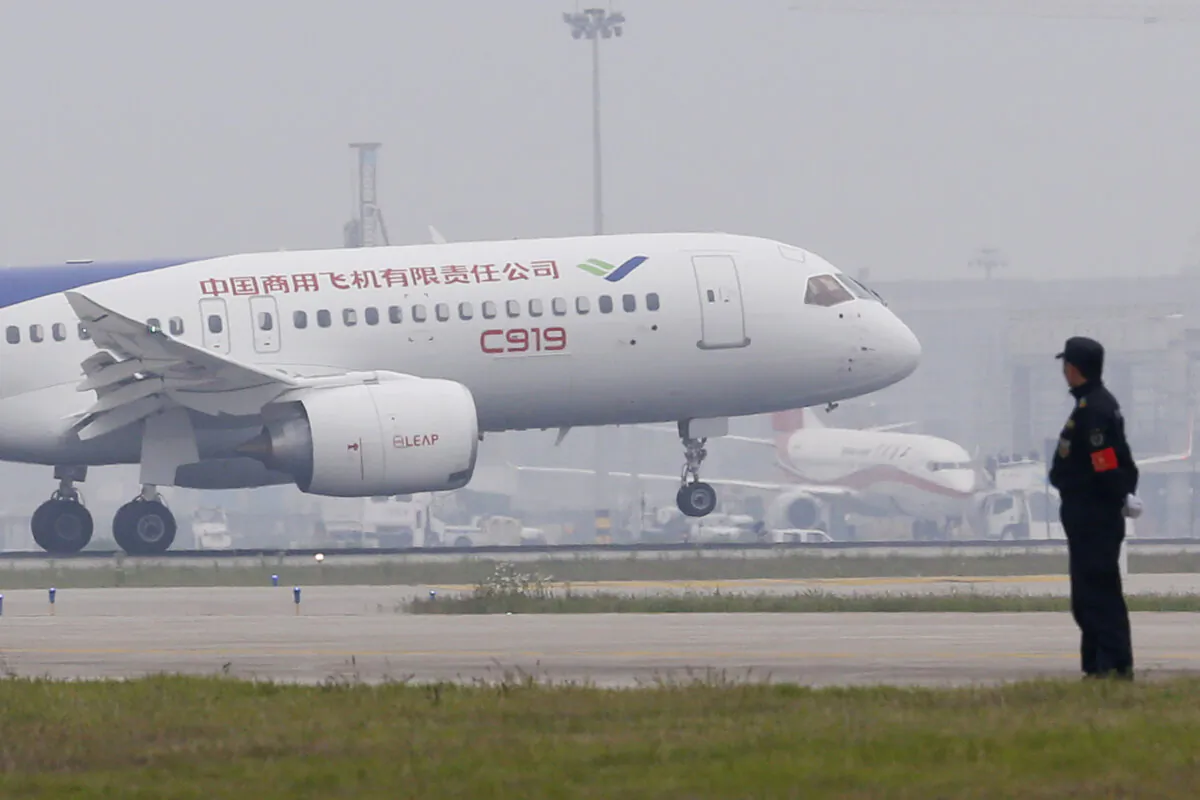
In a major challenge to Boeing, Airbus, and Embraer, a Chinese C919 narrowbody aircraft flew on Aug. 12 to Ulaanbaatar, Mongolia. The C919 has flown at air shows in Singapore and the United Arab Emirates, but the Mongolia flight marked the beginning of its first scheduled commercial international route.
The C919 can accommodate as many as 192 passengers and is competitive in China, at least, with the Boeing 737 MAX, Airbus A320neo, and Embraer E195-E2. The daily C919 flight to Mongolia displaced a previous reliance by Air China on a 737 MAX for the Ulaanbaatar-to-Beijing route. The C919 is also in competition with the E195-E2, a Brazilian jet that uses U.S. engines. To the author’s knowledge, no Chinese airline has purchased an E195-E2, but it does fly in China through Hunnu Air of Mongolia. Hunnu started using the E195-E2 for the Ulaanbaatar-to-Beijing route last year.
China is one of the largest global markets for passenger jets, so the C919 particularly threatens the bottom line of the world’s two biggest airplane manufacturers. In 2024, China imported passenger jets (of the type that are more than 33,000 pounds unladen) worth $8.8 billion, trailing only Ireland, the European Union, and the United States. Chinese airlines already operate dozens of C919s, and as they increase their purchases, demand for Western-manufactured jets will be subject to downward pressure.
The Commercial Aircraft Corp. of China (COMAC), which manufactures the C919, is a state-owned company. COMAC and Air China are both supported by the regime in Beijing, raising questions about the C919’s commercial viability and whether corrective tariffs or export controls should be imposed by the United States and EU. The tariffs would not directly affect the C919, which is not currently imported by the United States or EU, but they could be imposed against China’s other exports through Section 301 of the Trade Act of 1974 and justified by the C919 subsidies.
The “international” flight between Beijing and Mongolian capital Ulaanbaatar took just one hour and 40 minutes. The plane flew on the LEAP-1C engine manufactured by a joint venture of GE Aerospace in Ohio and Safran Aircraft Engines in Paris. Last year, the U.S. government restricted sales of the LEAP-1C engine to China during trade tensions related to rare-earth export restrictions imposed by Beijing. After Beijing relented on these restrictions, the United States relaxed some of its own restrictions, including on the LEAP-1C. Beijing is attempting to reduce its reliance on the LEAP-1C by producing the CJ-1000A engine using China-only supply chains, but the Chinese engine is not yet ready for mass production.
COMAC only delivered 15 C919s last year, a setback to its goal of 75. Compare that to the dozens of competing narrowbodies produced monthly by each of Boeing and Airbus.
However, the C919 does demonstrate China’s ability to fully integrate the necessary parts and supply chains to produce passenger jets capable of flying internationally. If C919 manufacturing can be scaled and the C919 can be produced more inexpensively than its Boeing and Airbus counterparts, including through further subsidies, then the plane is positioned to take increasing market share of short international flights between China, Southeast Asian countries, Central Asia, and South Asia. This will affect the previous “duopoly” that Boeing and Airbus had on the international passenger jet sector in Asia.
In February, COMAC reportedly said it had delivered more than 200 C919 and C909 jets, including approximately one-quarter operated by Indonesian, Vietnamese, and Laotian airlines. Brunei’s GallopAir has also placed a large order for COMAC aircraft, and Cambodia is planning a purchase of approximately 20 planes. The C909 is a regional jet smaller than the C919. Seven countries have reportedly certified the C909’s airworthiness.
The Mongolia flight was possible because China had negotiated a bilateral air safety arrangement in which both countries recognize each others’ airworthiness certificates. The C919 will probably not sell for use on U.S. or European routes anytime soon, as neither of the Western aviation flight safety regulators have certified the plane. COMAC has applied for European certification of the C919, but Europe’s aviation safety regulator said the plane will not be approved until 2028 at the earliest, and possibly as late as 2031.
The lack of U.S. and European certification will have effects on the C919’s marketability beyond the United States and Europe. Airlines in South America, the Middle East, and Africa want jets not only capable, but also certified to fly in the United States and Europe. COMAC does not release detailed data on safety and cost metrics, such as maintenance, fuel consumption, and dispatch reliability. Beyond China, few airlines have chosen to risk their brands by using unproven planes of little geographic range and for which the safety and cost data are opaque.
Views expressed in this article are the opinions of the author and do not necessarily reflect the views of The Epoch Times.
 Friends Read Free
Copy
Facebook
Tweet
Friends Read Free
Copy
Facebook
Tweet