
Commentary
In 1990, a physician named Frank Meshberger looked at one of the most famous paintings in human history and saw something no one had formally identified before.
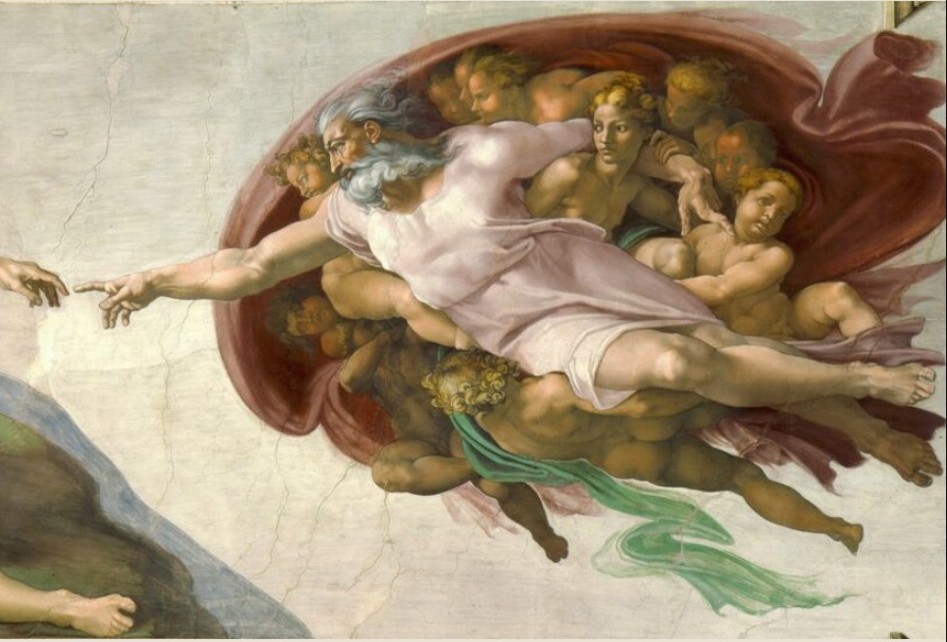
The image was Michelangelo’s “Creation of Adam,” painted more than 500 years ago and reproduced countless times since. It hangs in the Sistine Chapel and has been studied by generations of scholars, theologians, artists, and millions of visitors who traveled from around the world just to stand beneath it.
Meshberger noticed that the flowing form surrounding God—the billowing shape carrying Him forward—closely matched the anatomy of the human brain. The anatomical precision was uncanny. The outline corresponded to the cerebral hemispheres. The folds aligned with known structures. Once seen, it is hard to unsee.
The discovery raised a question: If Michelangelo—a master painter, sculptor, poet, and anatomist—had shaped God’s presence like a human brain, was he suggesting that intelligence was something bestowed? A gift? Something received, rather than humanly created?
For most of human history, intelligence meant wisdom. It meant judgment, moral discernment, and the ability to perceive meaning, context, and consequence. Intelligence was not primarily about how fast one could think, but about whether one could see clearly.
New ideas were often described as arriving rather than being produced. Artists, inventors, and thinkers spoke of inspiration, insight, or revelation. Intelligence was something humans participated in, not something they fully possessed. It assumed intelligence exceeded the individual. Humans were not its source; they were its carriers.
But that way of thinking didn’t survive the modern age.
As science advanced and societies reorganized around industry, intelligence came to mean reason, logic, analysis, and problem-solving. What could be tested, standardized, and measured rose in status.
This redefinition brought extraordinary gains. Knowledge expanded at an unprecedented pace. But at the same time, intelligence narrowed.
What could not be easily measured began to lose authority. Wisdom gave way to reasoning. Reason gave way to procedure. Over time, intelligence became something that could function without judgment, without context, and without asking whether the outcome made sense for human life.
In 2009, the seminal work of psychiatrist and philosopher Iain McGilchrist offered a way of understanding intelligence that made sense of this narrowing.
McGilchrist demonstrated that the brain’s two hemispheres—left and right—do not simply divide labor. They attend to the world in very different ways.
The left hemisphere specializes in abstraction, categorization, and control. It breaks the world into parts. It labels, measures, and manipulates. This is the mode modern culture has come to associate with intelligence itself.
But McGilchrist showed that the left hemisphere is not designed to be the master. It is an emissary.
It is powerful, efficient, and indispensable, but it is unreliable when it rules alone. It prefers certainty over truth. When information is incomplete, it fills the gaps with plausible stories. In neurological cases, the left hemisphere is known to confabulate—to hallucinate explanations that feel coherent but are not grounded in reality.
The right hemisphere, by contrast, engages with the world as a living whole. It is sensitive to context, relationship, and meaning. It tolerates ambiguity. It recognizes what cannot be reduced to labels. This is where insight, empathy, moral awareness, and genuine understanding arise.
McGilchrist is careful on a crucial point. The brain does not manufacture meaning. It shapes how we encounter what is already there. When one mode of attention dominates, reality itself becomes distorted because our access to it has narrowed. When the emissary mistakes itself for the master, intelligence narrows again.
Today, intelligence is being redefined as speed and optimization: the ability to process vast amounts of information quickly, to generate output efficiently, and to scale.
This is the version of intelligence that artificial systems reflect, because humans built them to mirror what we now reward and prioritize.
Artificial intelligence (AI) is often described as “alien” because it operates outside the natural rhythms that have always shaped human intelligence—factors such as time, fatigue, attention, and consequences.
For the first time, humans have built systems that participate in their own extension. AI systems are training successors, refining processes, and accelerating beyond human comprehension. AI is not self-originating, but it is increasingly self-propagating, and that places it outside the historical category of any tool we have ever known.
Like the left hemisphere McGilchrist describes, these systems do not understand meaning. They do not grasp the truth. They generate confident responses even when they are wrong. They hallucinate. And that is a feature of intelligence narrowly defined.
Used as tools, such systems can be helpful, but treated as authorities, they become dangerous. And the consequences of this narrowing are already visible.
McGilchrist warns that intelligence can narrow so much that it forgets what it is even for. When that happens, intelligence still functions, but it functions in the wrong way. Decisions follow rules, not judgment. Processes run smoothly, even when the outcome is clearly wrong. People can sense that something isn’t right but are told the system is “working as designed.”
This has happened before. Human societies ebb and flow. Like all living systems, they move through phases of expansion and contraction. Societies build systems to manage complexity, and at first, those systems bring order. They reduce uncertainty. They make decisions faster and more predictably. For a time, it feels like progress.
But then, as they narrow further and further, limits are reached. Situations arise that the system was never meant to handle. Rules must be followed even when they cause harm. Procedures override common sense. Responsibility becomes hard to locate because everyone is simply “following the process.” Intelligence is still present, but it is no longer serving understanding or wisdom.
If our current idea of intelligence is reaching that point, then whatever comes next will not be solved by making our systems faster, smarter, or more efficient.
When I imagine standing beneath the ceiling of the Sistine Chapel, I believe Michelangelo himself was touched by the same divine hand he painted reaching toward Adam. And I believe that, centuries later, that same hand gifted Meshberger and McGilchrist their wisdom and insight. I cannot prove it. But belief does not always require proof.
The hand Michelangelo painted did not disappear when the paint dried. It has not vanished with time or been replaced by machines. It has always been there.
If our understanding of intelligence is now at its narrowest point, we may be at the moment when the cycle turns, and we remember where intelligence has always come from and where it is still waiting to be found.
Views expressed in this article are the opinions of the author and do not necessarily reflect the views of The Epoch Times.
 Friends Read Free
Copy
Facebook
Tweet
Friends Read Free
Copy
Facebook
Tweet