
Commentary
There is a tension running through several of America’s biggest political conversations right now, yet we keep discussing each one as though the others don’t exist.
Americans are furious about grocery prices. Politicians and commentators insist that food must become cheaper.
We are debating importing hundreds of thousands of tons of additional beef while simultaneously talking about rebuilding American agriculture, protecting American farmers, and making this country less dependent on foreign food.
At the same time, we are having an enormous national conversation about immigration. Secure the border. Deport people who are here illegally. Reduce legal immigration. Protect American workers from foreign labor that suppresses wages. One argument is that with fewer immigrant workers, employers would have to pay American workers more.
That may very well be true. But then we have to finish the equation.
Labor is not separate from the price of food. Labor is one of the costs of producing it. If we dramatically restrict the supply of workers and wages rise as a result, the cost of producing food rises, too.
How exactly are we going to make groceries cheaper simultaneously?
And perhaps the more immediate question is: Who is going to do the work?
I have a particular knowledge base from which to ask this question, but I also have biases, and intellectual honesty requires me to disclose both.
I spent 15 years owning restaurants in Los Angeles. Today, my family operates a farm, ranch, restaurant, and hospitality business in Texas. I employ H-2A agricultural workers, and many of them are quite literally my family—my husband’s brothers, cousins, aunts, and other relatives who come legally to the United States to work with us. My husband himself was undocumented when I met and married him.
I know how easily someone can reduce my position to a sentence: Of course, she supports foreign workers. She benefits from cheap immigrant labor.
Someone on the other side will call me racist because I believe the United States should secure its border. I’ve even heard versions of the argument that marrying a Mexican man is simply how I conceal my racism.
This is what our political discourse has become: Identify the tribe, locate the talking point, and dismiss the person.
But life isn’t binary. Agriculture isn’t binary. Economics isn’t binary. Immigration certainly isn’t binary. Intellectual honesty requires the ability to hold multiple facts in our minds at the same time, including facts that make our preferred political positions uncomfortable.
I believe America should have a secure border. A sovereign nation should know who enters it. Allowing cartels and criminal organizations to control human movement across our southern border is insane and dangerous, not only for Americans but also for Mexico and for migrants themselves.
I also believe American agriculture currently depends heavily on foreign-born labor. Both things can be true.
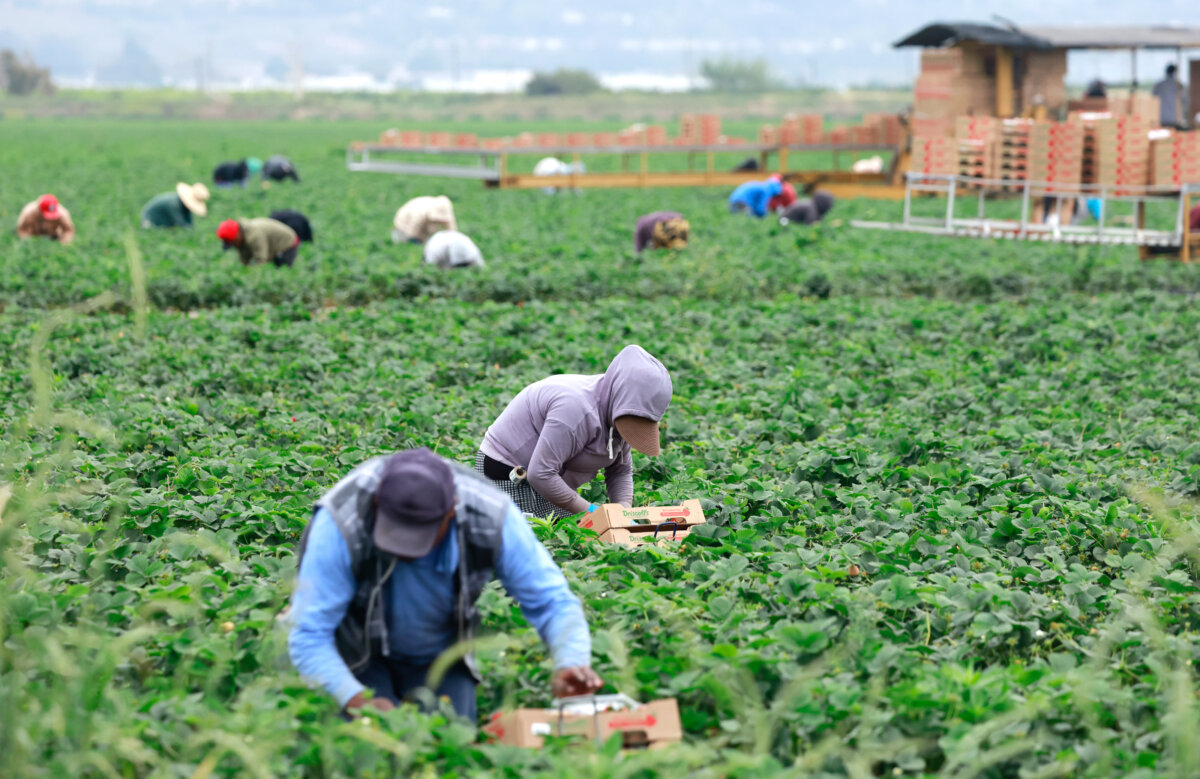
According to the U.S. Department of Agriculture, among hired crop farmworkers surveyed from 2020 through 2022, only 32 percent were born in the United States, 68 percent were foreign-born, and 42 percent lacked work authorization. Separate federal data that include manual livestock workers show foreign-born workers are important there, too, although less dominant than in crop agriculture.
Nearly seven out of 10 hired crop farmworkers are foreign-born and should be somewhere near the center of any serious discussion about immigration and food prices. Yet somehow these conversations rarely seem to meet.
I spent 15 years hiring restaurant workers in Los Angeles. In all those years, I cannot remember one American-born person walking into one of my restaurants and applying to wash dishes. Not one. By the time I left Los Angeles, our dishwashers were earning around $21 an hour plus a small percentage of the tip pool.
Today, I sometimes struggle to find American workers willing to reliably perform jobs considerably more comfortable than agricultural labor. It can be difficult to get someone to pull espresso shots in an air-conditioned environment during a six-hour shift with breaks. Putting the phone down, remaining present with other human beings, and working continuously for several hours can feel like an extraordinary demand.
Now, put that worker in a field for eight or 10 hours in August.
Something else has changed in the workforce, particularly among many young Americans who graduated from high school or college during and after COVID-19. Obviously, this doesn’t describe everyone. I know extraordinary young Americans with a tremendous work ethic.
But after decades of employing people, I have watched a softness emerge: less tolerance for boredom, discomfort, correction, physical exhaustion, and the simple requirement to push through something difficult.
I’m apparently not the only employer noticing it. Recent surveys of business leaders who hire new graduates have reported widespread concerns about initiative, professionalism, communication, work ethic, and receptiveness to feedback.
Perhaps we shouldn’t be surprised. For decades, our culture has increasingly taught people to maximize money while minimizing effort. Find the hack. Create passive income. Work from anywhere. Monetize your following. Retire at 35.
There is nothing wrong with making work more efficient. But somebody still has to pick the strawberry. Somebody has to wash the plate, milk the cow, process the meat, clean the barn, and repair the fence.
People walk onto my ranch regularly and say some version of the same thing: This seems so hard. Why would you choose to do something this hard? You must never get to go on vacation.
They’re right. Farming is hard. Animals don’t care that it’s Christmas. Vegetables don’t care that you’re tired. A broken water line doesn’t care that you have dinner plans.
But what could be more foundational than growing nutrient-dense food for the body that houses our soul?
What could be more meaningful than caring for the land, feeding people, and, hopefully, creating a ripple that inspires others to do the same?
We have spent decades culturally training Americans to avoid difficult physical work, and now seem surprised that many of the people willing to do that work come from elsewhere.
There is another uncomfortable reality underlying the border conversation: If there weren’t jobs here, people wouldn’t keep coming.
People don’t pay thousands of dollars and make dangerous journeys simply because there is a geographical line they desperately want to stand on the other side of. They come, in significant part, because there is work.
America has an enormous demand for labor. There is an enormous supply of people outside the country who desperately want that work. As long as those two realities exist without an adequate legal bridge between them, there will be tremendous economic pressure to cross the border.
Right now, criminal organizations have effectively become part of that bridge.
Migrants can pay $10,000 to $13,000, depending on their route and circumstances, to smugglers and cartels to reach the United States. Whenever I suggest a more robust legal worker program, someone asks how poor migrants could possibly afford the fees associated with entering legally.
My question is: How are they paying the cartel now?
What if, instead of sending that money into a criminal economy, we created a serious five- or 10-year work permit?
Vet people. Background-check them. Document them. Allow them to enter legally, work legally, pay taxes, and travel home to see their families without having to pay a criminal organization to cross the border again.
Then secure the border.
To me, these aren’t opposing ideas. They reinforce each other. Make illegal entry substantially harder while creating legal labor pathways that reflect the actual needs of the American economy.
I recently listened to a Tucker Carlson interview with Gregory Bovino, who spent nearly three decades with Border Patrol. I agreed with many of their concerns and disagreed with others. But as I listened to a conversation about immigration largely through the lens of border enforcement, I kept thinking about the part of this equation I know from experience.
I don’t know what it’s like to spend 30 years patrolling the border. Bovino does, and that expertise deserves respect. But I know what it’s like to make payroll. I know what it’s like to look at a dish pit that needs somebody standing in it that night.
I know what it’s like to have food ready to harvest and need hands to harvest it. I know what it’s like to operate restaurants, farms, and hospitality businesses where the work doesn’t disappear because the political conversation has changed.
That expertise deserves a place in the conversation, too.
And here is where the discussion about cheaper food becomes particularly disconnected from the immigration debate.
If reducing immigration tightens the labor market, wages should rise. Advocates of restricting immigration often make that argument precisely: American workers will benefit because employers will be forced to pay more.
Fine. But higher wages don’t materialize from nowhere. They become a higher cost of production.
Farmers cannot simply absorb that increase. Absorb it with what? Many American farms already operate on margins so thin—or negative—that farm families work off-farm jobs to subsidize the privilege of continuing to farm.
Something else has to give. Consumers pay more. Government subsidizes more. Farms automate where they can. Businesses close. Or production moves elsewhere, and America imports more food.
This is where all these supposedly separate political conversations collide.
We want cheaper beef, so we discuss importing hundreds of thousands of tons. We want stronger American agriculture. We want more young people to farm. We want farmers to earn a living. We want American workers to earn higher wages. We want cheaper groceries. We want fewer imports. And we want to dramatically reduce the foreign labor force doing much of the work required to produce our food.
Maybe we can accomplish some combination of those things, but we cannot pretend there are no tradeoffs.
If Americans decide they want their food produced almost entirely by American-born workers earning considerably higher wages, that is a legitimate choice. But politicians and commentators should look consumers in the eye and tell them what that choice costs.
Groceries may cost more. Restaurant meals may cost more. Some crops may no longer be economical to grow here. Some farms will mechanize, some will disappear, and some food production will move overseas.
Maybe that’s a price Americans are willing to pay. But we should actually have that conversation.
I don’t believe the solution is an open border, and I don’t believe the solution is pretending America doesn’t need foreign labor. I believe we can secure the border, attack the cartel business model, and create a controlled legal system that allows workers our economy demonstrably needs to come here, work, and return home legally.
Maybe that position won’t fit comfortably into either political camp. That’s OK.
The ability to hold multiple truths at once, to acknowledge the facts that support our position and the facts that complicate it, is something America desperately needs to recover.
Food prices, immigration, wages, imports, and the survival of American farms are not five separate conversations. They are one conversation.
Before we promise Americans cheaper food while removing many of the people producing it, someone should answer a very simple question:
Who is going to do the work?
Views expressed in this article are the opinions of the author and do not necessarily reflect the views of The Epoch Times.
 Friends Read Free
Copy
Facebook
Tweet
Friends Read Free
Copy
Facebook
Tweet