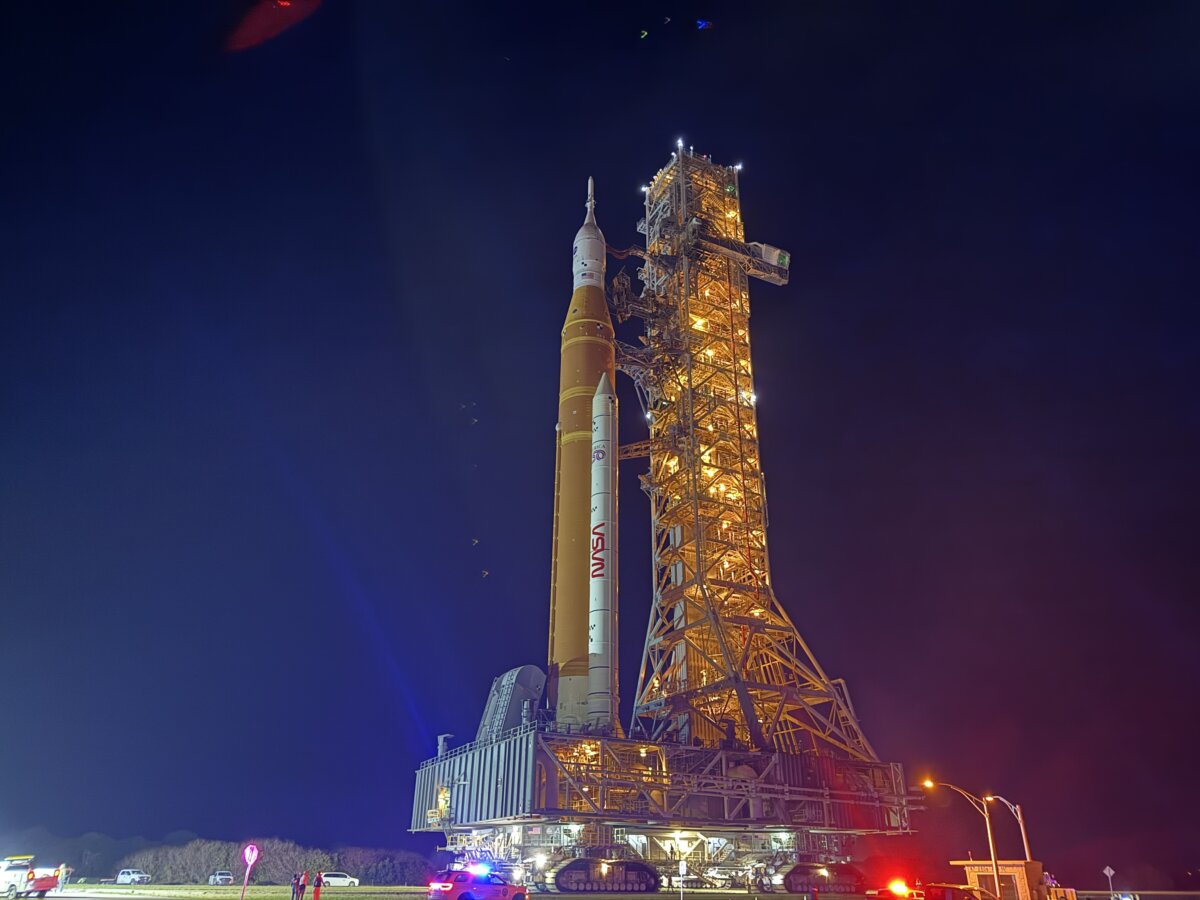

CAPE CANAVERAL, Fla.—Humanity’s first ride to the moon in more than 50 years inched its way back to the launch pad under the cover of night at Florida’s Kennedy Space Center early Friday, and carried with it NASA leadership’s official “Go” for liftoff as early as April 1.
That moon rocket, the Artemis II Space Launch System, began its nearly 12-hour journey from the Vehicle Assembly Building to its ultimate departure point, Launch Complex 39B, just after 12:20 a.m EDT on March 20.
It was first rolled out to the pad on Jan. 17, but had to return to the Vehicle Assembly Building on Feb. 25 for some repairs. The rocket re-emerged with those problems solved and having passed an extensive launch readiness review.
NASA leaders announced less than a week prior to the rollout that the rocket had been given the green light to potentially send the four-person Artemis II crew on their 10-day fly-by mission around the moon as soon as 6:24 p.m. EDT on April 1.
That crew—NASA astronauts Reid Wiseman (commander), Victor Glover (pilot), and Christina Koch (mission specialist), as well as Canadian Space Agency astronaut Jeremy Hansen (mission specialist)—began their mandatory pre-mission 14-day quarantine period at 5 p.m. CDT on March 19.
The quarantine is intended to limit the crew’s exposure to others and to help them remain healthy for their mission. The crew started quarantine in Houston and will transfer to Kennedy Space Center five days before launch and complete the quarantine there.
Once at the pad, work will commence on the rocket’s final preparations for launch. The previous rollout was followed by a wet dress rehearsal: a 50-hour run-through of pre-launch and launch-day operations that included fully fueling the rocket and its Orion crew spacecraft. However, mission leaders decided to skip the dress rehearsal this time around.
“We certainly want to test and always make sure that everything’s working. But, you know, we’ve now done a couple of wet dress rehearsals,” Lori Glaze, acting deputy associate administrator for NASA’s Exploration Systems Development Mission Directorate, said at a March 12 press briefing. “We’ve exercised the team. We’ve exercised the hardware.
“I’ll just tell you, from my perspective, when we tank the vehicle, the very next time, I would like it to be on a day that we could actually launch,” she said. “I would like to do it on launch day, and if we are able to successfully fully tank the vehicle, I want to be able to poll ‘Go to launch.’ So that’s where we are at this point.”
If the Artemis II mission is unable to launch on April 1, it will have other launch opportunities on April 2, 3, 4, 5, 6, and 30.
 Friends Read Free
Copy
Facebook
Tweet
Friends Read Free
Copy
Facebook
Tweet