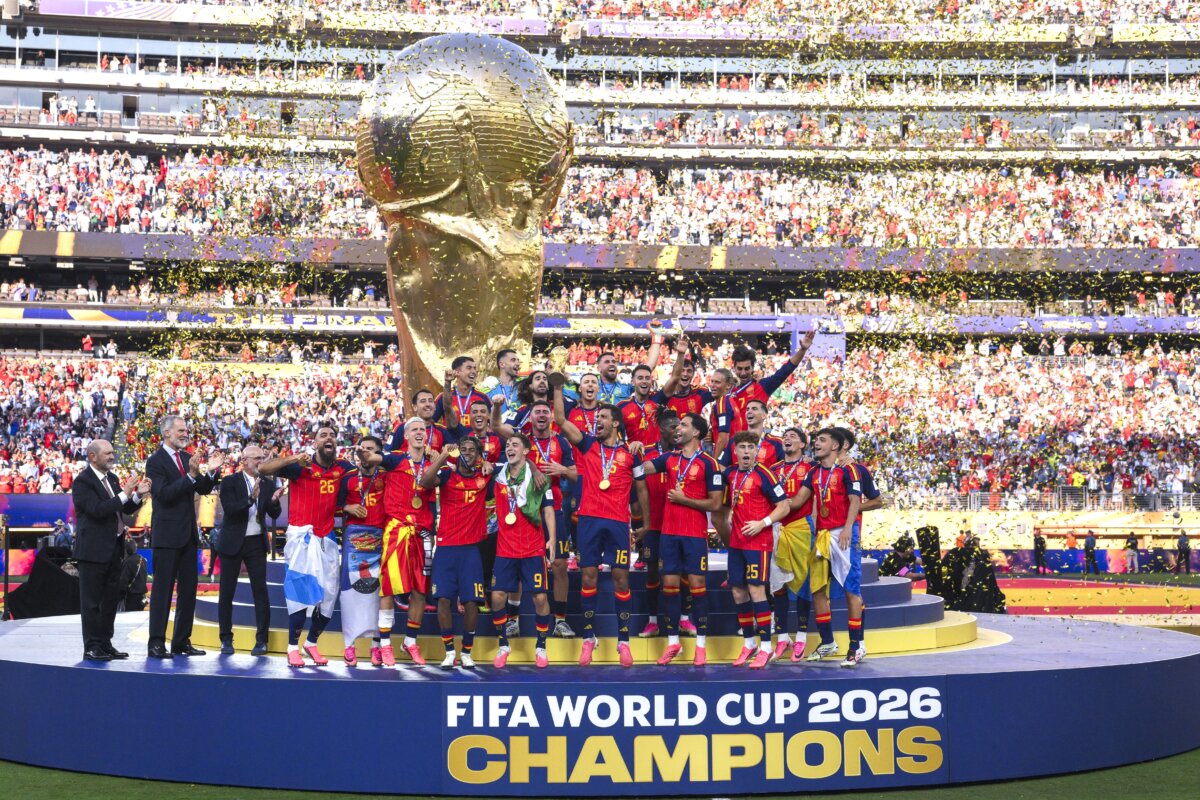

Spain can now boast of its Men’s National Team being crowned the 2026 World Cup champions after beating Lionel Messi and the defending champions, Argentina, 1–0 in a final match outside New York City on July 19.
The final brings to a close the largest and most inclusive World Cup in the tournament’s nearly 100-year-long history. Beginning on July 11, 48 teams from six continents met in Canada, Mexico, and the United States to play more than 100 matches.
This year broke attendance, goal count, and viewing records, delivering a lot of action, friendly fun, and controversy.
Here are some of the biggest takeaways from the tournament.
Most Goals, Viewers, and Attendees
The 2026 World Cup saw the highest goal count in the history of the tournament, with more than 300 goals scored from beginning to end.
France’s Kylian Mbappé led the way with 10 goals scored after leading his team to a third-place playoff against England in which France fell 6–4. With Messi and Argentina being shut out in the final match against Spain, Mbappé finished the tournament with the most goals, earning him his second consecutive World Cup Golden Boot. The Frenchman also surpassed Messi in terms of most career goals scored in World Cup competition, earning his 22nd in the third-place match.
Despite Mbappé’s best efforts, however, he did not set a new record for the most goals scored in a World Cup tournament. That record remains with Just Fontaine of France, who scored 13 goals in 1958.
And despite all of Messi’s other accolades throughout his career, the World Cup Golden Boot has always eluded him. However, he will go home having set a new record for the most career World Cup assists: 12.
From beginning to end, this World Cup was also the best attended in the tournament’s history and broke viewing records. More than 6.8 million people attended the more than 100 games spread out across 16 different cities across three countries.
When Team USA played its final match of the tournament against Belgium, more than 50 million tuned in, making it the most-watched non-NFL sporting event of the 21st century in the United States.
VAR’s Effect on the Matches
Also watching each match closely were the Video Assistant Referee (VAR) teams. Three to a match, it was their job to review the plays and assist or even correct the officiating team on the field.
Several matches featured delayed offside calls, last-minute changes from corner kicks to goal kicks, and foul confirmations that rescinded several goals throughout the tournament. The VAR was also used to review fouls that could or initially did result in yellow or red cards. This World Cup saw multiple instances in which a yellow card was not only rescinded but transferred to the other team because video review revealed that the player took a dive and was not fouled at all.
However, it was also used to determine that contact made by USA’s Folarin Balogun against a player from Bosnia and Herzegovina warranted a red card before any card was initially handed out. Situations like this, along with the overall delaying impact on the matches, gave the VAR a rather negative image in the eyes of the spectators.
Scotland and Cape Verde Steal the Show
But while some would argue that the VAR attempted to steal the show on the pitch, a debutant team from Cape Verde emerged to do just that. While they never secured a win during the tournament, the Blue Sharks were the only team to hold the new World Cup champions, Spain, to a scoreless draw, and they held the previous World Cup champions, Argentina, to a 1–1 draw through the full 90 minutes. Cape Verde would even go on to tie Argentina again, 2–2, during the 30 minutes of extra time before ultimately going down 3–2. The Blue Sharks also held Uruguay to a 2–2 draw and Saudi Arabia to a scoreless draw.
Perhaps more so off the pitch, the show was also stolen by Scotland’s fanbase, the Tartan Army. The Scots initially appeared to be a Cinderella story of their own, returning for the first time since 1998 and earning their first World Cup match victory against Haiti. But it was the Tartan Army who were the real stars of the World Cup, all but taking over Boston with bagpipes, beer tabs, and traffic cones. When they left for Miami to see their team be ultimately sent home in a loss against Brazil, Boston had made Glasgow its new sister city.
Several Coaches Fired or Quit
This tournament also became the end of the line for several coaches. Beginning with Tunisia sacking its head coach after losing its opening match against Sweden 5–1, more than a dozen coaches announced that they would not be returning to their national teams after the World Cup, either through termination of their contract or through resignation.
Those coaches include France’s Didier Deschamps, Germany’s Julian Nagelsmann, South Korea’s Myung-bo Hong, Mexico’s Javier Aguirre, and even Scotland’s Steve Clarke.
Team USA’s head coach, Mauricio Pochettino, was reportedly offered a four-year extension on his contract that would run through the 2030 World Cup, but he did not make a decision during this last World Cup.
Spain Wins on Record 7th Clean Sheet
Spain hoisted its second-ever World Cup after recording its record seventh clean sheet of the tournament. The Rojas only allowed one goal the entire tournament, the least amount of goals ever conceded in a World Cup. But before that, they set a world record for the longest amount of playing time by a goalkeeper in a World Cup without conceding a goal: 649 minutes.
Goalkeeper Unai Simón did not necessarily have to perform any miracles or stand on his head to keep his net free. His team’s defense stood in the way of most attacks, going so far as to only allow Argentina two shots in his general direction for the 120-minute match.
Spain also set a record for the longest unbeaten streak in any competition, be it the World Cup, European Championship, or an international friendly match, with 38 matches ending in either a win or a draw.
 Friends Read Free
Copy
Facebook
Tweet
Friends Read Free
Copy
Facebook
Tweet