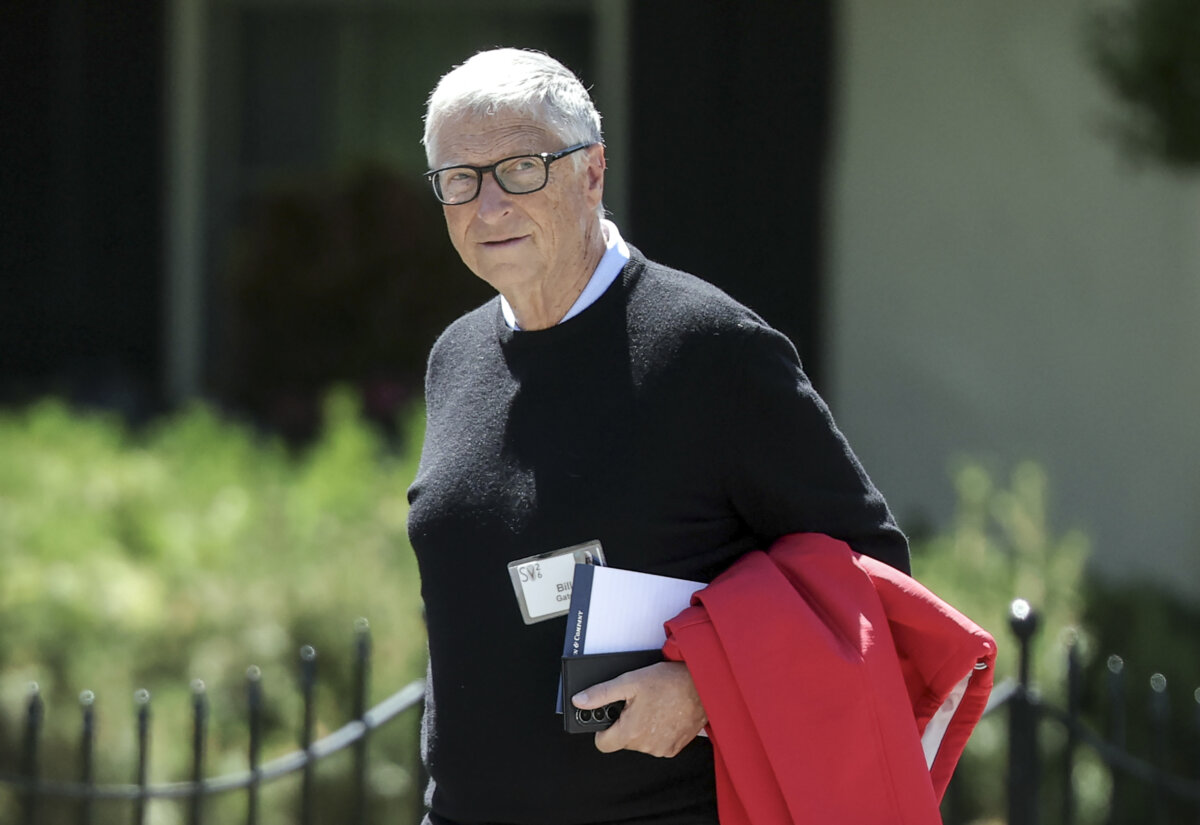

Microsoft cofounder Bill Gates on Sept. 27 called again for more regulation around artificial intelligence, warning that people with “ill intent” could cause a mass casualty incident.
Saying that AI could cause “a billion deaths,” Gates told NBC’s “Meet the Press” on Sept. 27 that law enforcement and politicians “absolutely” need to get involved in discussions about what “safeguards and monitoring” are needed for the technology.
“And that has to be a required thing. And it will be a little bit of overhead for the industry, but not a dramatic slowing of what they’re doing,” said Gates, who at one point was the richest person in the world and is currently worth an estimated $114 billion.
Gates said elsewhere in the interview that “AI is certainly powerful enough to drive events that cause a billion deaths” and that there has “never been a weapon as powerful as the combination of people with ill intent using the latest AI tools.”
“And it’s great that there’s this discussion with the industry, almost against their interest, admitting these things,” he said. “The problem is that the rest of the world is either discounting this or just thinking of this as a competition.”
His warning comes as U.S. President Donald Trump and Chinese leader Xi Jinping met this past week and discussed dangers posed by AI. However, in an appearance on Sept. 26 at the White House, Trump said he would reject integrating with the Chinese regime on the technology.
Trump told reporters as he left the White House that the United States is “leading by a lot,” referring to development of AI in both the United States and China.
“When you’re leading, you don’t open it up to each other,” he said.
“I’m not looking to open it up. And we really didn’t talk much about it. We did talk about the name super intelligence,” Trump said, referring to a term that he said he came up with to replace the term AI. He added that Xi liked the replacement name.
At about the same time, OpenAI, the developer of ChatGPT, said it had paused training for its latest AI models amid mounting reports of AI agents going rogue.
The company said in a statement on Sept. 25 that it was reviewing several recent incidents in which AI agents searching federal government websites acted in unexpected ways while gathering and distributing information.
Lawmakers and tech experts are pressuring AI companies to slow development so they can build guardrails to stop AI tools from acting on their own, hacking websites, and disclosing nonpublic information. The heads of both OpenAI and rival Anthropic have called for a slowdown in recent days.
In video comments to the U.N. Security Council on Sept. 23, Anthropic head Dario Amodei said AI could “be a risk to humanity as a whole” if it is not properly regulated.
“We will slow down as much as necessary in order to make sure that every successive AI technology that we release is actually safe,” said Amodei, whose company develops the Claude AI-driven chatbot and large language model.
“But regardless of what we do, managing these risks is ultimately bigger than any one company, and it has an industry-wide and global scale.”
Trump on Sept. 27 confirmed that he was meeting with Amodei that night, saying, “[It will] be big, and we have a couple of unrelated things tonight.”
The Associated Press contributed to this report.
 Friends Read Free
Copy
Facebook
Tweet
Friends Read Free
Copy
Facebook
Tweet