
Two naturalized individuals were recently sentenced by courts for false claims regarding their criminal backgrounds in order to secure American citizenship.
On Friday, the District Court for the Southern District of New York revoked the naturalized citizenship of Italian native Michael Pizzuti after the court determined he had “committed crimes involving moral turpitude and unlawful acts,” the Department of Justice (DOJ) said in an April 10 statement.
“From July 1998 through August 2000, Pizzuti dealt in counterfeit money, trafficked contraband cigarettes, and conspired to steal a truck and commit mail fraud. He was arrested and indicted for those crimes on December 5, 2001,” the DOJ said. Pizzuti was sentenced to 15 months’ imprisonment in March 2003.
In another criminal incident, “between May 2001 and September 30, 2001, Pizzuti violently extorted his financial advisor after discovering that the advisor was running a Ponzi scheme with Pizzuti’s money. Pizzuti broke into his house, held him at gunpoint, ordered him to maintain the Ponzi scheme until he had enough money to pay back Pizzuti’s investment, and then destroyed computer records to hide his crimes.”
In May 2002, Pizzuti appeared at the naturalization interview and falsely testified under oath that he had never been arrested and never committed a crime. Based on this testimony, authorities naturalized Pizzuti in July 2002.
Pizzuti was convicted in 2005 and later sentenced to 17 and a half years in prison for the 2001 violent extortion incident.
The court determined on Friday that Pizzuti’s crimes and false testimony prevented him from establishing the good moral character necessary to get naturalized.
Earlier on Wednesday, another naturalized citizen, a Connecticut woman from Bosnia and Herzegovina, was sentenced to a prison term of 30 months for lying about her criminal past to secure citizenship, the DOJ said in an April 9 statement.
Before coming to the United States, Nada Radovan Tomanic, 53, worked with a special unit in the Army of Bosnia and Herzegovina during the 1990s when the region was facing armed conflict.
During her time in the army, Tomanic allegedly took part in “severe physical and psychological abuse” of captured Bosnian Serb civilian prisoners, including torturing them and meting out inhuman treatments—actions that qualify as war crimes.
In 2012, when Tomanic applied for naturalization in the United States, she denied having served in a detention facility and falsely denied having committed a crime. On Nov. 10, 2025, Tomanic pleaded guilty to one count of procuring citizenship contrary to law.
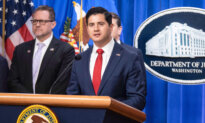
“Human rights violators are not welcome in the United States.” Assistant Attorney General A. Tysen Duva for the Justice Department’s Criminal Division said.
“Thanks to the courage of the victims, and the diligence and dedication of our prosecutors and law enforcement partners, the defendant has been held accountable for exploiting our immigration system and evading responsibility for her crimes.”
Screening of Applicants
The court decisions against Pizzuti and Tomanic come as the U.S. Citizenship and Immigration Services (USCIS) said in a March 30 statement that it had implemented several enhanced screening and vetting practices over the past months.
The agency said it was developing a “layered vetting plan” incorporating classified and unclassified information, expanded criminal history checks, identity verification, and other checks for applicants to plug any security gaps.
“Our ongoing efforts are designed to ensure that only eligible and vetted individuals are granted immigration benefits,” USCIS said.
Earlier in January, USCIS announced it had revised naturalization tests that applicants must officially pass to become American tests.
USCIS administers two tests to applicants, one that assesses civics knowledge and another that tests English language skills.
According to USCIS’ naturalization data, the agency welcomed 818,500 new citizens during fiscal year 2024. Over the previous decade, USCIS admitted over 7.9 million naturalized citizens into the United States. [data]
Mexico was the top source of people naturalized into the United States for fiscal year 2024, followed by India, the Philippines, the Dominican Republic, and Vietnam.
“The top five cities (including boroughs) where people who naturalized resided were (in descending order): Miami, Brooklyn, the Bronx, Houston, and Los Angeles,” USCIS said.
 Friends Read Free
Copy
Facebook
Tweet
Friends Read Free
Copy
Facebook
Tweet