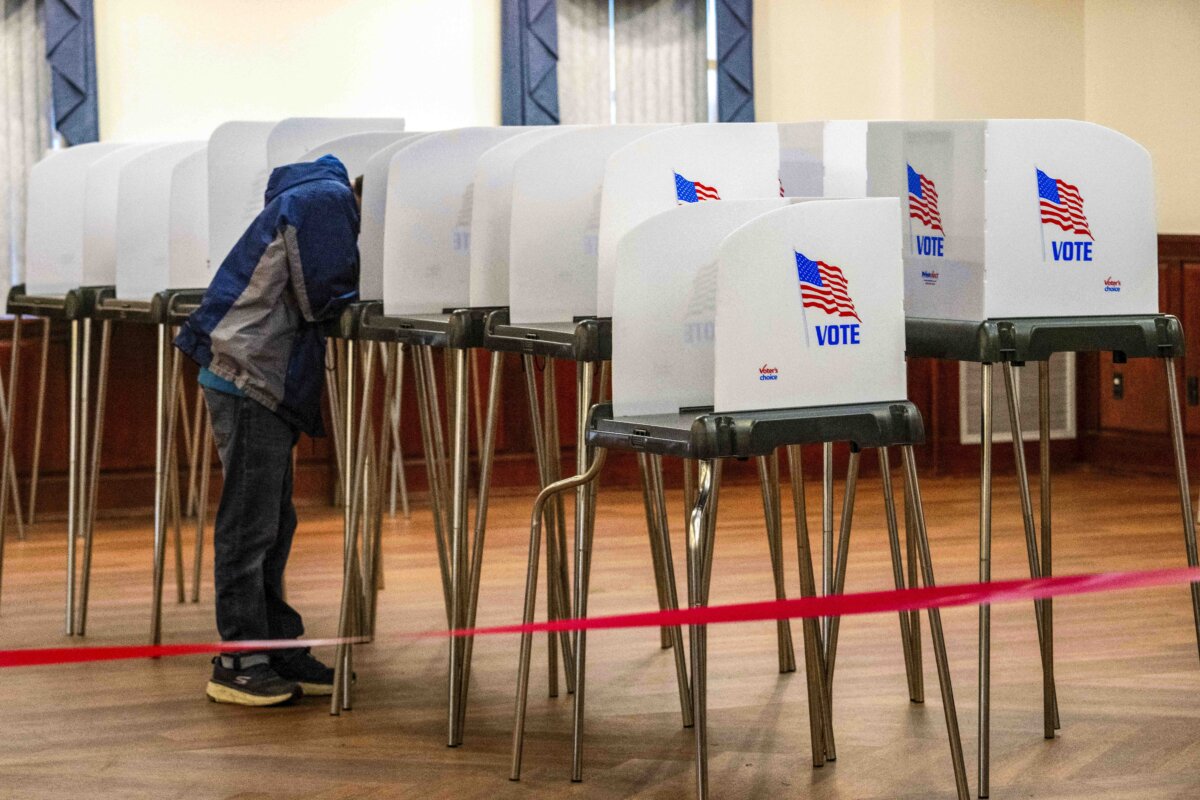

Four residents from Philadelphia have been charged with voting illegally in the 2024 elections while being noncitizens, according to the Department of Justice.
“The defendants, despite knowing that they were not United States citizens, knowingly voted in an election held in part for the purpose of electing a candidate for the office of President, Vice President, and Presidential elector,” the DOJ said in an Oct. 5 statement. Only U.S. citizens are allowed to vote in Pennsylvania under both federal and state laws.
Jamil Ahmad, 50, one of the accused, is a Pakistani citizen and a lawful U.S. permanent resident at the time of his vote, the DOJ said. The second person, Nighat Jamil, 47, is also a Pakistani citizen, while the third individual, Paulo Silva, 54, is a citizen of Portugal, both lawful permanent residents of the United States. The fourth defendant, Hacina Saadi, 48, is a French citizen and an illegal immigrant.
According to Title 18 of the U.S. Code Section 611, it is generally unlawful for an immigrant to vote in an election held to select a candidate for the office of president, vice president, presidential elector, member of the Senate or House of Representatives, delegate from the District of Columbia, or resident commissioner.
Under Pennsylvania law, only an individual who has been a U.S. citizen for at least a month can vote in the state.
If convicted, the defendants face up to a year in prison, fines, or both, the department said.
The Epoch Times was unable to reach the legal representatives of the defendants.
In another case, a lawful permanent resident from Cuba was arrested this week and charged with two counts of voting illegally in the November 2022 and November 2024 federal elections, according to the DOJ.
The individual was granted lawful permanent residency in 2009. However, before receiving residency, the person allegedly registered to vote in 2004 in Missouri. Over the past 20 years, the Cuban national allegedly voted in at least 15 elections, of which at least 13 were federal elections.
“When an individual who is not legally permitted to vote casts a ballot, it undermines the public’s confidence in our elections,” R. Matthew Price, U.S. Attorney for the Western District of Missouri, said in the statement.
“Free and fair elections depend on the integrity of our voting process and compliance with the law,” Price said. “Our office will aggressively enforce federal election laws and hold accountable anyone who interferes with the integrity of the electoral process.”
Section 611 Legal Challenge
The Trump administration is facing legal challenges as it takes action against noncitizens illegally casting votes in elections.
On Oct. 1, U.S. District Judge David Leibowitz in Florida dismissed a case against a Jamaican woman who had voted in a federal election despite being a noncitizen.
In the opinion, the judge said Title 18 of U.S. Code Section 611, which covers voting by immigrants, “is a voter qualification statute, and the Constitution does not authorize Congress to legislate voter qualifications for federal elections.”
“Except for very specific constitutional provisions … Congress has no power to say who can vote or who cannot vote in federal elections—that foundational power is reserved for the States, and limits Congress,” Leibowitz wrote.
The judge ruled that Section 611 was unconstitutional as applied to the Jamaican national and that the defendant “cannot be prosecuted for an alleged violation of an unconstitutional statute.”
Government lawyers had argued in a filing that while state governments have principal authority to administer elections in their own jurisdictions, the “Supreme Court has recognized that the Constitution provides that the federal government maintains authority over elections, including guarding the safety and integrity of congressional elections.”
The lawyers specifically pointed to a 1932 decision in which the Supreme Court held that the U.S. Constitution gave Congress the authority to supplement state regulations when it comes to elections.
In another case, the Supreme Court observed that by providing Congress with override authority over states, the framers of the Constitution had sought to “avoid states potentially abusing their power over congressional elections,” according to the filing.
Following the district court decision, the United States filed an appeal in the case with the Court of Appeals for the Eleventh Circuit.
The issue of noncitizen voting was highlighted by the Census Bureau in an Aug. 18 report, which suggested that thousands of noncitizens may have voted in the November 2020 general election.
Of the almost 160 million people who voted in the election, the bureau “determined with high confidence” that more than 128 million voter records belonged to U.S. citizens and that over 24,000 voter records were of noncitizens, according to the report.
Zachary Stieber contributed to this report.
 Friends Read Free
Copy
Facebook
Tweet
Friends Read Free
Copy
Facebook
Tweet