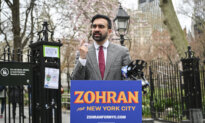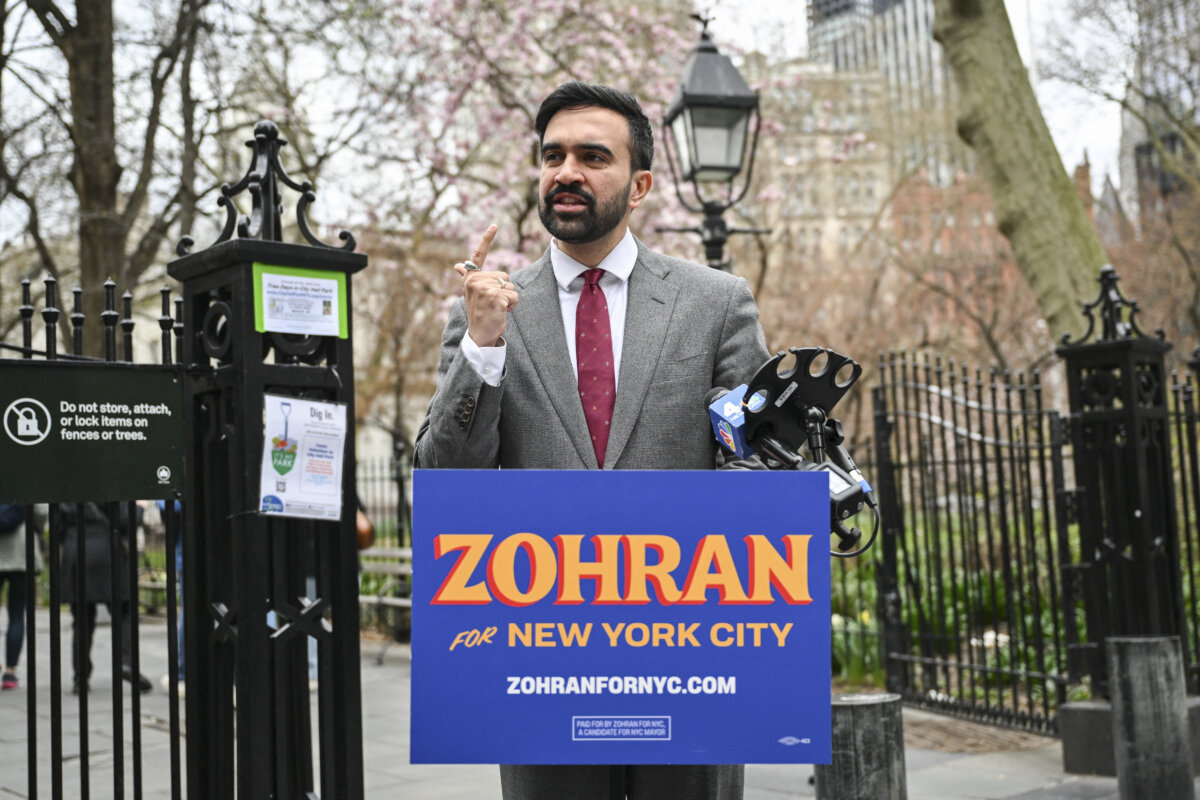
NEW YORK CITY—Zohran Mamdani, a 33-year-old self-described socialist, won the Democratic Primary contest for the 2025 New York City mayoral election, defeating former Gov. Andrew Cuomo. Even in a ranked-choice voting system, Mamdani’s lead in the first round of tallying—43.5 percent to Cuomo’s 36.3 percent—was so large that Cuomo immediately conceded.
Few predicted this would happen. In February, Mamdani, a Democratic socialist lawmaker, was written off as a nonfactor in the race with just 1 percent support, while Cuomo had 33 percent. In recent weeks, Mamdani dramatically closed the polling gap, but it was still expected to be a closer contest, with the race heading to multiple rounds of tallying to determine a victor.
An Indian Ugandan immigrant who became a U.S. citizen in 2018, Mamdani ran on an unabashedly progressive platform—of freezing rents, eliminating public bus fares, providing free child care and city-run grocery stores with low prices, and raising taxes on the rich—at a time when many Democrats are reconsidering left-wing politics, particularly after the 2024 U.S. presidential election.
Mamdani will now face incumbent Mayor Eric Adams, who is running as an independent, in the general election on Nov. 4. His primary victory offers several lessons about that next contest and politics in general.
Mamdani’s Turnout Success
Mamdani’s upset victory was a testament to his campaign strategy that relied heavily on social media. He overperformed in the first round—polls suggested that he would win only 34 percent at that stage. Full results are expected to be announced on July 1.
The Democratic socialist produced a series of creative videos about himself speaking charismatically and interacting with voters in public. These included videos of him speaking foreign languages, such as Hindi. Voters took notice.
“His entire candidacy has been very, very well-advertised, I think, to immigrants and people in general,” said Nikita Jain, a voter in Brooklyn who supported Mamdani.
“I think his PR team, whoever is doing his social media and stuff, is great. They’re super smart. I think they’re doing a really good job of reaching young voters,” said Sadia Hanif, a Queens resident who voted for Mamdani. “I haven’t been this excited about a candidate for a really long time.”
As he gained attention and support, Mamdani’s message was amplified by others, helping to boost traction and turnout. Progressive endorsers such as Rep. Alexandria Ocasio-Cortez (D-N.Y.), social media influencers, and organizers all spread Mamdani’s message online to reach his best demographics—younger voters and minorities in Brooklyn, Queens, and Manhattan.
They also shared instructions on where and how to vote, which was critical to turnout.
“I was really impressed by the candidates’ and local politicians’ efforts to educate folks on the space, especially AOC,” said Lee, a Manhattan voter who ranked Mamdani second and declined to give a surname.
Cuomo’s Future Uncertain
Cuomo’s loss doesn’t mean he’s out of the race. In May, he announced the formation of a new political party as a parallel vehicle for him to run in the general election. Even after he lost the Democratic nomination, he suggested that he might run.
“I want to look at all the numbers as they come in and analyze the ranked-choice voting. I will then consult with my colleagues on what is the best path for me to help the City of New York, as I have already qualified to run for mayor on an independent line in November,” read Cuomo’s statement on his website.
Cuomo would face a big uphill battle to win as an independent without the Democratic base, and it’s uncertain how he’ll affect Mamdani and Adams’s chances if he runs.
Some voters who spoke to The Epoch Times took issue with his character.
Cuomo resigned as governor in 2021 following an investigation that concluded he sexually harassed multiple women. Cuomo has denied the allegations and was never convicted of any criminal offense.
“Absolutely not,” said Desiree, a young woman voter in Queens who declined to give her last name, when asked if she ranked Cuomo on her ballot. “I don’t think someone like that should be leading our city.”
“There were credible allegations of sexual harassment from, I believe, nine women. … I don’t want a man capable of that to represent me in any capacity,” said Samantha Espella, a public defender who voted in The Bronx on election day.
In January 2024, the Justice Department found that Cuomo had harassed 13 women over eight years.
Win for Progressives, Loss for Pro-Israel Voters
Election night was good for progressive candidates. Apart from the mayoral election, several other city offices had primary races.
In the primary for public advocate, the second-highest ranked position in city government, incumbent Jumaane Williams, a progressive, was reelected with 71 percent of the vote. For the district attorney of New York County (i.e., Manhattan), incumbent Alvin Bragg Jr. easily won with 73 percent of the vote in a two-candidate contest.
Perhaps the biggest losers of the night were pro-Israel voters, who largely backed Cuomo. Mamdani’s past criticism of Israel’s war against Hamas in Gaza attracted vocal opposition from New York’s Jewish community. Cuomo sought to capitalize on this by courting rabbis and Jewish leaders for their endorsements.
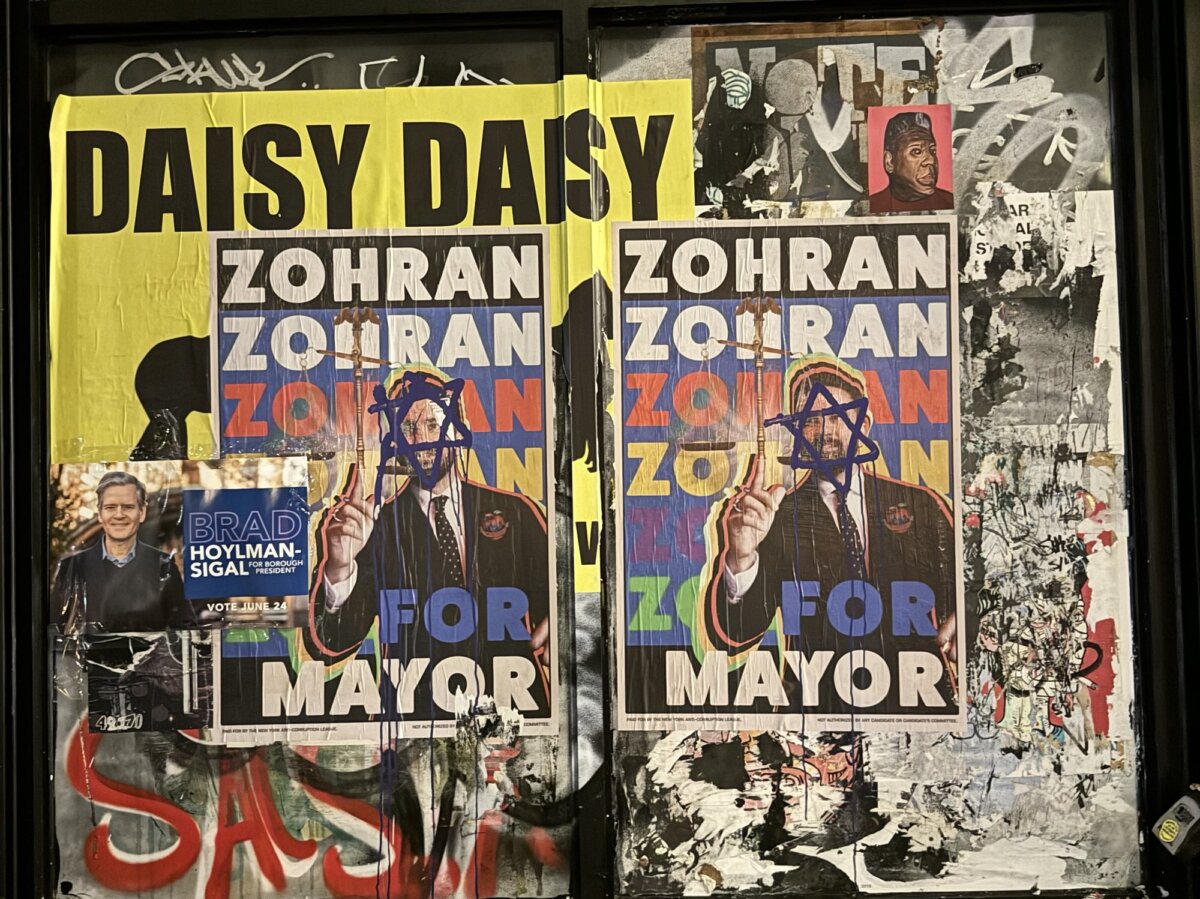
“The sole purpose that I showed up today was to not rank Mamdani,” said Zack Friend, who voted in Manhattan’s Upper East Side. “As a Jewish Israeli, I found it imperative, absolutely imperative, couldn’t be more important … to make sure that he does not get elected.”
Still, despite pro-Israeli opposition, Mamdani won and even carried Jewish-heavy Manhattan and Brooklyn, suggesting that rhetoric about the war in Gaza wasn’t decisive.
“Folks should be putting New York first and New Yorkers first,” said Desiree, criticizing the rhetoric from all candidates about Israel.
Mamdani Mastered Ranked-Choice Voting
New York City uses an unusual system for voting during primary elections, known as ranked-choice voting, where voters can rank candidates according to their preferences.
The first round of tallying counts all first-preference votes; if no candidate tops 50 percent support, then the lowest-ranked candidate is dropped and their votes are reapportioned according to their voters’ second preferences. The cycle continues until one candidate tops 50 percent support.
Ranked-choice voting has been confusing to some voters and disregarded by others. The Epoch Times encountered several voters in New York City who either didn’t know they could rank all candidates or refused to do so—usually involving an exclusion of Cuomo.
Mamdani’s campaign and allies were insistent on explaining ranked-choice voting to their supporters and instructing voters on how to rank candidates, such that they could strategically gain votes over multiple rounds.
“I was unaware that this was a thing, until I saw a Zohran campaign explanation [about it],” said Jain.
“I basically followed AOCs recommendations,” said Lee, saying that she ranked City Comptroller Brad Lander at the top, followed by Mamdani.
Mamdani and Lander cross-endorsed each other in the race, forming an alliance whereby their first-preference voters ranked the other candidate as their second preference. Lander received 11 percent of the first-preference votes, which—assuming his supporters followed instructions—would eventually give Mamdani the necessary 50 percent to win, a fact that prompted Cuomo’s immediate concession.
Cost of Living Paramount
Candidates discussed many issues such as crime, subway safety, and sanitation. The cost of living, however, was the centerpiece of Mamdani’s campaign.
“Zohran Mamdani is running for mayor to lower the cost of living for working class New Yorkers,” was the sentence emblazoned at the top of his website.
Mamdani’s campaign’s literature, social media content, and other advocacy all focused nearly exclusively on this issue, particularly on housing. His signature campaign was a city ordinance to freeze rental rates for nearly 2 million renters. His promise of city-run grocery stores also hit upon voters’ anxieties about food price increases.
“He seems to be very, very far-left-leaning, but I think that is what many people have been kind of [wanting], especially within the last couple of years,” said Jain. “We’ve all been kind of waiting for a candidate similar to Bernie to show up.”
Mamdani was endorsed by Sen. Bernie Sanders (I-Vt.), one of America’s leading progressive figures.
“The city’s affordability is one of the majority of concerns for the majority of New Yorkers, and … we’ve got to get more creative with how we do that. Both Mamdani and Lander have some great ideas,” said Espella, the public defender. “They deserve a chance to [show] how progressive politics can really work.”
 Friends Read Free
Copy
Facebook
Tweet
Friends Read Free
Copy
Facebook
Tweet