Thousands are expected to gather at the Lincoln Memorial on Aug. 28 for “March on Washington 2026: Defend the Vote,” a rally organized by Rev. Al Sharpton’s National Action Network and the family of the Rev. Martin Luther King Jr. to mark the 63rd anniversary of King’s “I Have a Dream” speech, according to the march’s organizers.
The original March on Washington for Jobs and Freedom, held Aug. 28, 1963, drew an estimated 250,000 people to the National Mall and is regarded as one of the defining moments of the civil rights movement, according to the National Park Service.
This year’s march comes weeks after the U.S. Supreme Court’s April 29 decision in Louisiana v. Callais, which narrowed the reach of Section 2 of the Voting Rights Act, according to legal analysis published by SCOTUSblog. Sharpton called the ruling “a bullet in the heart” of the voting rights movement and said the march is meant to signal that what he described as efforts to weaken ballot access “will not go unanswered,” he said in a statement.
Martin Luther King III, in a statement to The Associated Press, said: “Defending the vote means defending the foundation of our democracy. Sixty-three years after my father stood at the Lincoln Memorial, we are called to march again, not only in remembrance, but in action.”
Arndrea Waters King, in the same statement, called the event “a moral call to protect democracy for every generation.”
Nine states enacted a dozen new voting rules in 2026, including new document requirements for voter registration in South Dakota and Utah and narrower lists of accepted IDs in Florida and New Hampshire, according to a May roundup by the Brennan Center for Justice; six other states, led by Virginia, expanded access over the same period. Organizers said the trend, alongside Callais, indicated that voting rights are under sustained pressure ahead of the midterms.
Sen. Bernie Sanders (I-Vt.) and Rep. Alexandria Ocasio-Cortez (D-N.Y.) are also expected to join the march, tying voting rights to economic issues such as wages, healthcare, and housing costs, organizers said.
“The participation of Senator Sanders and Congresswoman Ocasio-Cortez sends an important message that progressive leaders are standing shoulder to shoulder with Black civil rights leadership,” Sharpton said.
‘A March to Carry a Narrative, Not a Cause’
The “Defend the Vote” framing draws pointed criticism from two prominent figures in the election-integrity movement, who argue the march exists to build a political narrative rather than to address a real threat.
“It’s a march to carry a narrative, not a cause,” Ken Cuccinelli, chairman of the Heritage Foundation’s Election Transparency Initiative, told The Epoch Times. He singled out the NAACP, a march partner, saying its opposition to voter ID puts it “on the wrong side” of its own constituents—“historically very sad,” he said.
He said organizers are “designing an entire event intended to be large scale around buttressing a narrative, just a political narrative that isn’t true,” and predicted the real target of the day’s speeches would be President Donald Trump.
“I think the point is to embarrass Trump in some way,” he said. “Every speaker will get up there and attack Trump.”
Cuccinelli, who has spent years building an election transparency operation that formally merged into Heritage this summer, said the accusation that he and other advocates want to “suppress the vote” is really an attack on his support for voter ID laws, a position he said is broadly popular, including among the voters organizers say they are marching for.
“If you told people who they’re trying to recruit for this march, ‘come march against voter ID,’ no one would show up,” he said. “So, they lied to them.”
A CNN poll reported by analyst Harry Enten in February found 76 percent of black Americans support voter ID requirements, alongside 82 percent of Latino voters and 85 percent of white voters.
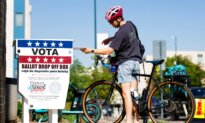
On mail-in balloting, Cuccinelli said he backs returning to what he called the traditional Virginia standard. Voting in person, with absentee ballots reserved for people who are sick, elderly, or otherwise unable to reach a polling place.
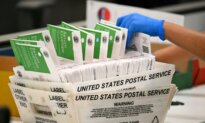
“Which I agree with 100 percent,” he said of that approach, which the Trump administration has also pushed. He also noted California’s June primary, in which roughly 150,000 mail ballots were rejected, including about 44,000 for signature mismatches, according to Cuccinelli’s own prior public remarks reported by The Daily Signal, and blamed the U.S. Postal Service for the state’s reliance on mail delivery to run elections.
“The post office wasn’t built to run elections,” he said. “It was built to send mail, and they’re not very good at that.”
Marly Hornik, CEO of the election-auditing nonprofit RealAmerica.vote, offered a similar critique in a separate interview with The Epoch Times, rejecting the idea that election integrity efforts echo historical voter suppression.
“It rejects the incredible progress made and focuses on retaining a system that’s based on division,” she said, arguing the dispute is about accountability rather than race. “It has to do with, basically, a progressive approach to governance, which is top-heavy and relies a lot on third-party management that is unaccountable to voters.”
Hornik has drawn national attention for a study concluding that a large number of votes cast in New York City’s 2025 mayoral election belonged to voters her organization characterizes as “blatantly unqualified,” a term she said has been reported elsewhere, inaccurately, as “suspicious.” Democratic socialist Zohran Mamdani won that race by 89,681 votes over Republican Andrew Cuomo, according to certified results from the New York City Board of Elections.
What They’re Watching For
Both Cuccinelli and Hornik framed the Callais ruling as the opposite of what march organizers describe. Where Sharpton called it an attack on voting rights, Hornik said it means “the Supreme Court has chosen to enforce voting rights equally” and rejects racially based justifications for gerrymandering.
“I think that’s what they’re reacting to,” she said of the march’s organizers.
Cuccinelli was skeptical that the coalition behind the march represents the people it claims to speak for. He pointed to a University of Georgia post-election survey of 1,253 voters after the 2022 midterms—held under the state’s 2021 voting law, SB 202, which Democrats had alleged would suppress Black turnout—that found zero percent of Black respondents rated their voting experience “poor,” with the group reporting the lowest rates of safety concerns and long wait times among all demographics surveyed.
Other researchers, including those at the Brennan Center for Justice, have separately said that the same law widened Georgia’s racial turnout gap in subsequent elections, a dispute Cuccinelli did not address directly.
“Empirical data, when it keeps cropping up, undercuts what they want to tell people integrity means,” he said.
The contrast heading into Aug. 28 is stark. Organizers are casting the march as a defense of hard-won voting rights against a rising tide of restrictions. Cuccinelli and Hornik are presenting it as a political spectacle that distracts from what they call the more urgent problem: an election system with too little verification, not too much. Both sides agree that the outcome of that argument and of the Nov. 3 midterm elections will shape how the next round of American elections is run.
The National Action Network and several March on Washington partners did not respond to requests for comment for this story.
 Friends Read Free
Copy
Facebook
Tweet
Friends Read Free
Copy
Facebook
Tweet