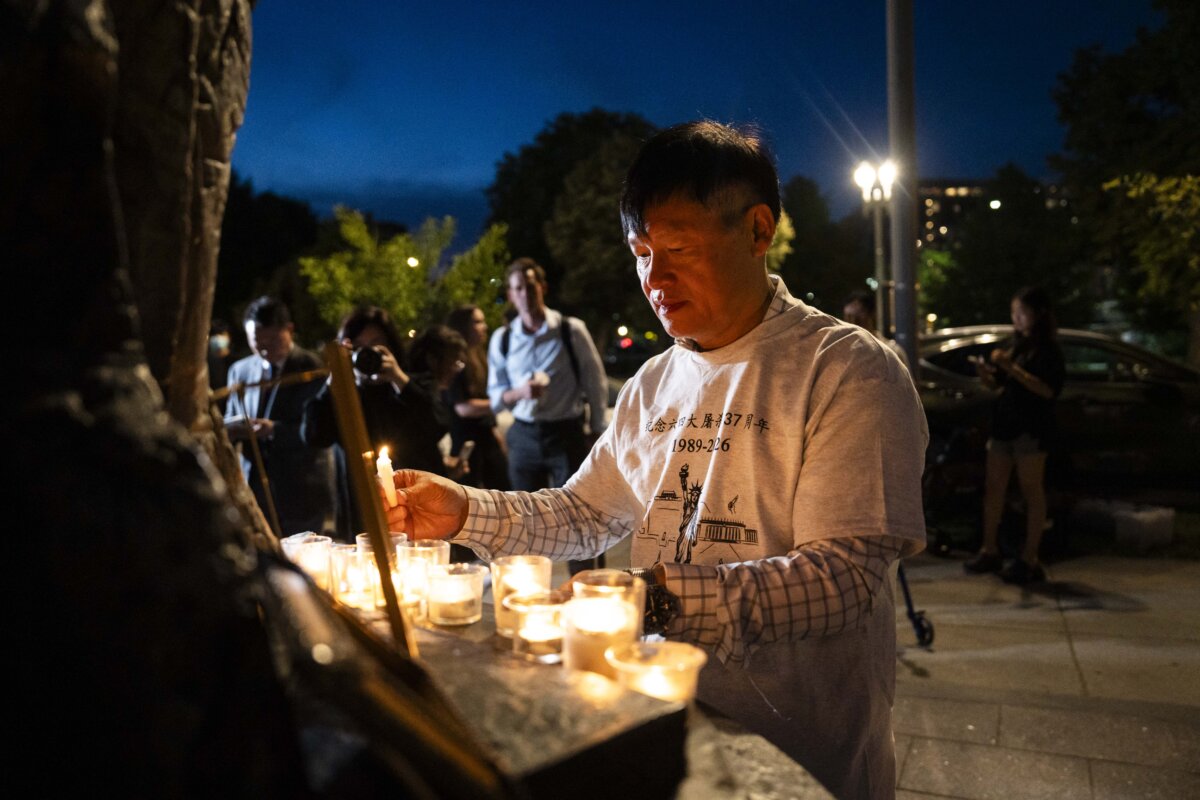

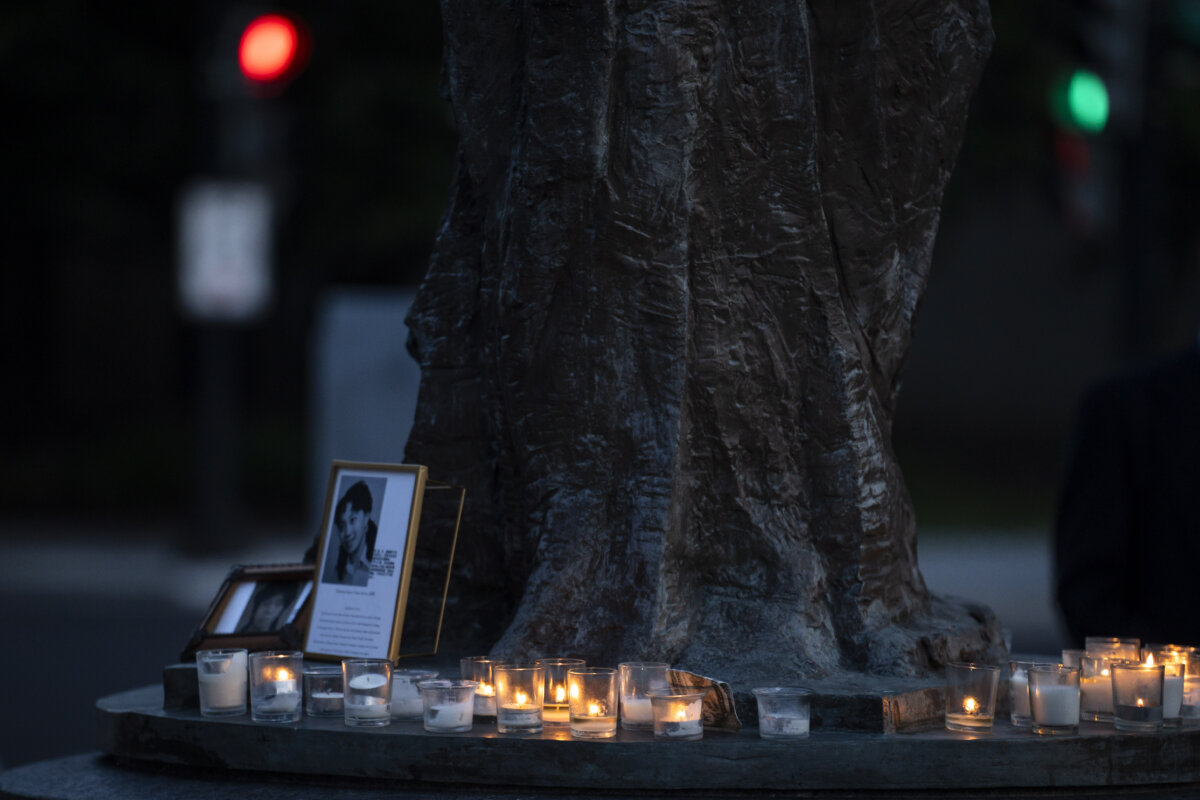
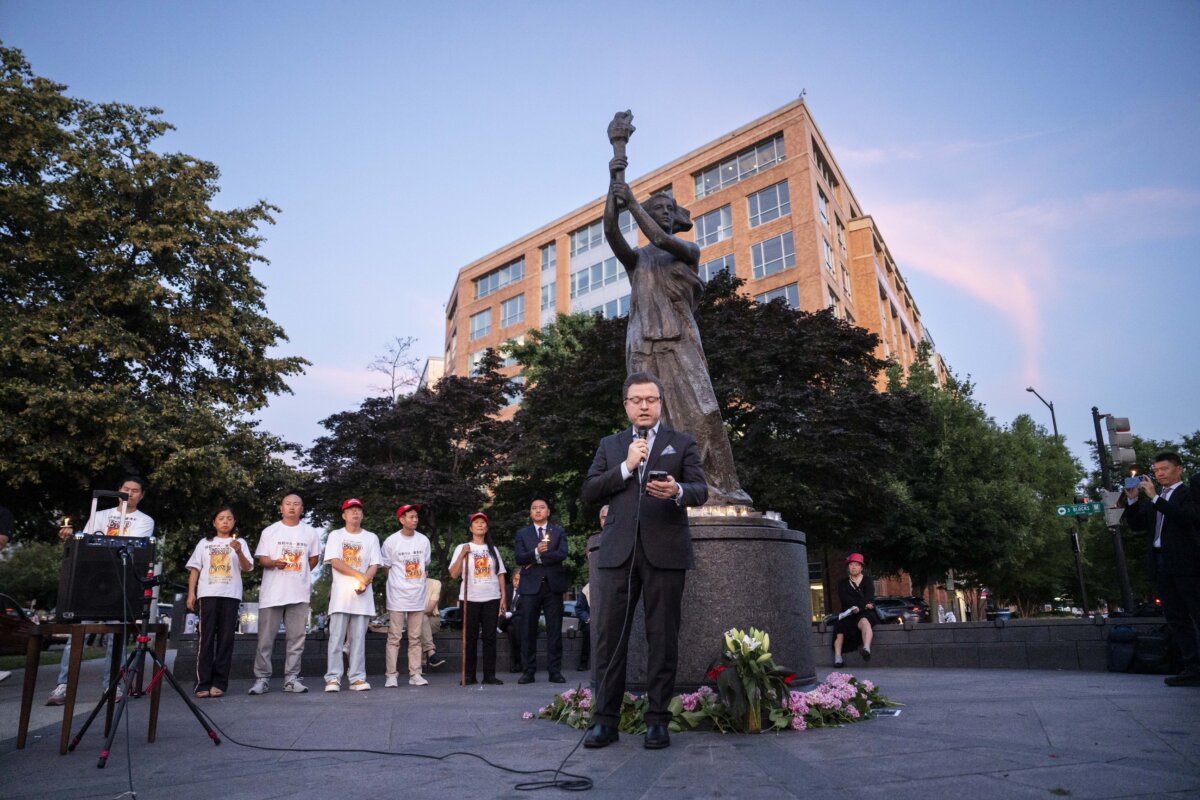
WASHINGTON—The air was still as candlelight flickered, forming a circle around a replica of the goddess of democracy that 37 years ago stood on Tiananmen Square.
Around the statue scattered pink hydrangea flowers and white lilies. On the granite pedestal, more candle flames swayed.
“To those who love liberty,” the inscription reads in part.
The vigil, hosted on the evening of June 4 by the Victims of Communism Memorial Foundation, honored pro-democracy protesters killed in Tiananmen Square for calling for greater political freedoms in communist China.
Thirty-seven years ago that day, thousands of people are estimated to have died under tanks and gunfire. The massacre remains a heavily censored topic in mainland China. Police nationwide step up surveillance and arrests around the anniversary each year.
By gathering now and remembering, the activist said, participants make clear that coercion and dictatorship cannot win.
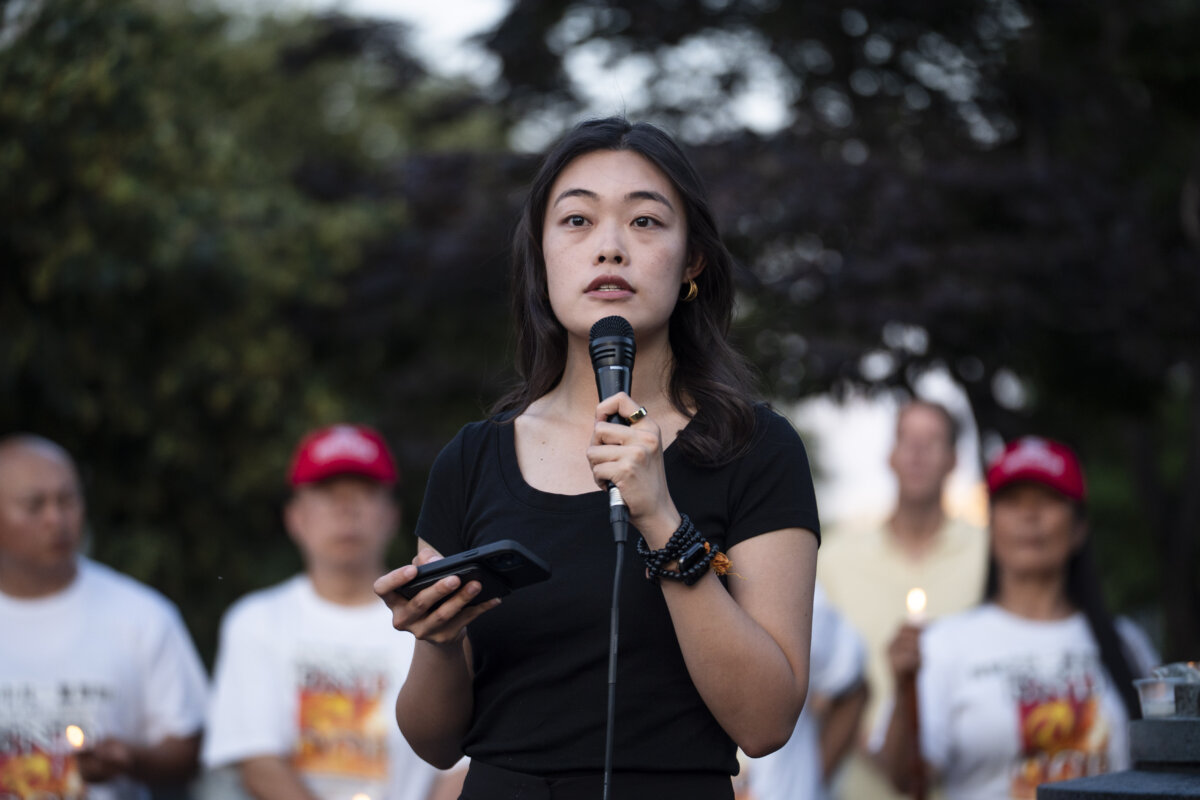
“We ourselves are the candles that the CCP cannot blow away. Our minds are the vigils that they cannot shut down,” Joey Siu, spokesperson for Amnesty International Hong Kong Overseas, said at the vigil. CCP is the acronym for the Chinese Communist Party.
Following the Tiananmen massacre, many protesters escaped to Hong Kong. Year after year for three decades since, tens of thousands of people thronged the city’s Victoria Park, lighting up candles in memory of the victims—until Chinese authorities snuffed out Hong Kong’s freedoms in 2020.
But the flame didn’t die.
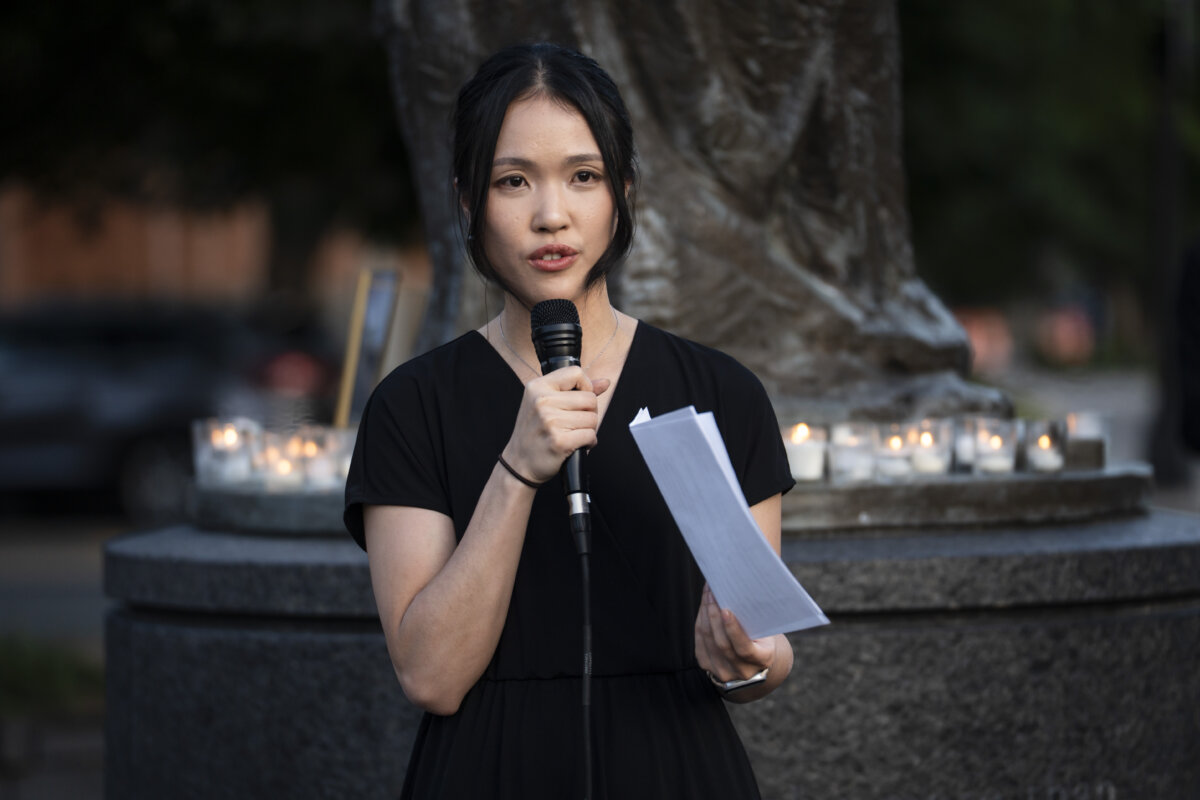
“It crossed an ocean, it found its way to this square, to this city, to this very night,” Frances Hui of the Committee for Freedom in Hong Kong Foundation said in a speech.
“Beijing made a calculation, they believed that if they could blow out the candles, they could blow out our memory,” she said. “It was wrong.”
Holding Up the Lights
Memory is a “very, very powerful vector,” which is why the Chinese authorities are trying hard to erase it, Siu told The Epoch Times.
Dozens of people have been arrested for commemorating the incident since a Beijing-imposed national security law, designed to suppress dissent, took effect in Hong Kong in 2020, Siu said. A Hong Kong court in May heard final arguments in a trial for two Tiananmen vigil organizers, with the verdict still pending.
Around the 37th Tiananmen anniversary in Beijing, police stepped up identity checks and closed access points to the square. Anyone entering key roads around the area had to show their identification card, locals told The Epoch Times.
Chinese authorities also intimidated sources who supplied to The Epoch Times a large tranche of photos documenting the 1989 pro-democracy movement, which the publication made public for the first time on the massacre’s anniversary.
The Tiananmen bloodshed, 37 years later, remains a vivid reminder that “the CCP does not care about its people,” Hui told The Epoch Times.
The regime would “go as far as putting their weapons against its own people, because they wanted freedom,” she said.
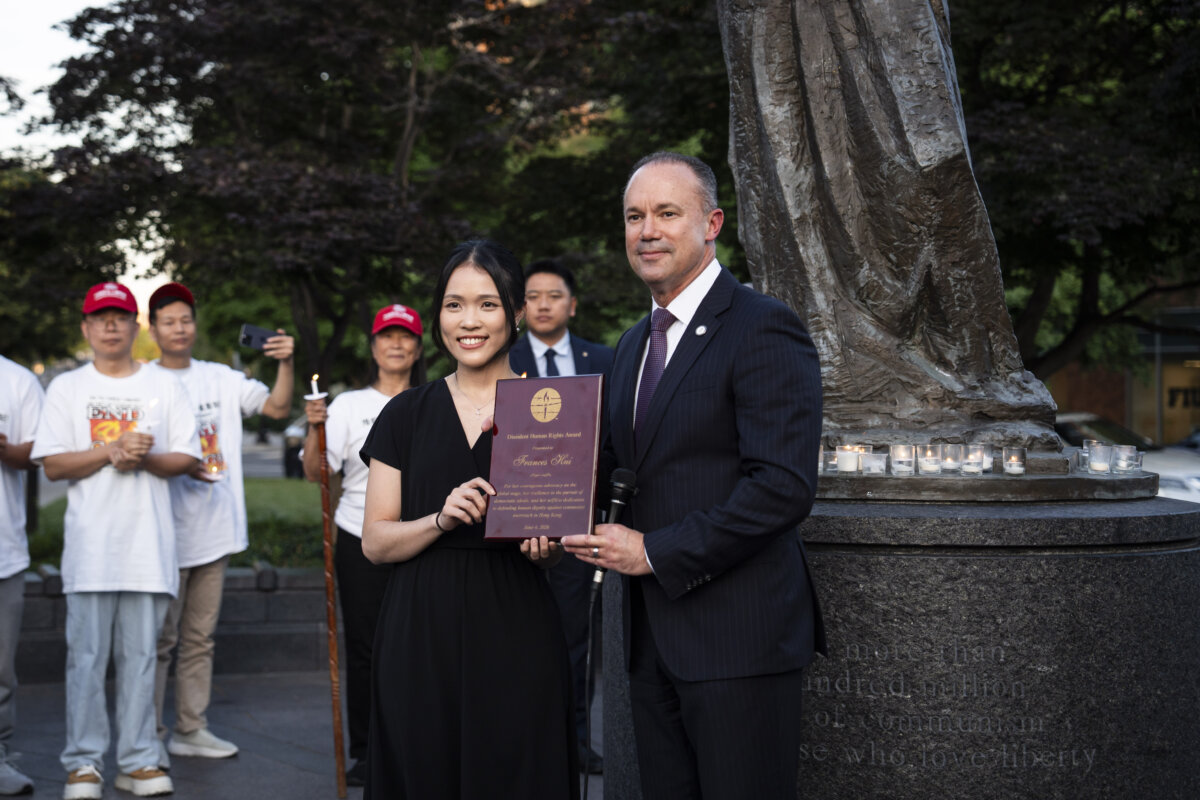
Hui was the honoree of the memorial foundation’s 2026 Dissident Human Rights Award at the vigil.
Eric Patterson, the foundation’s president, called her a “freedom champion,” noting that for her pro-democracy activism, Hong Kong authorities have put a HK$1 million bounty on her head.
Born 10 years after the Tiananmen massacre, Hui learned about the killing around the age of 10. That year, she went with her parents to the Victoria Park vigil, standing in a sea of lights and faces of people she never met, but who all went there for the same reason.
That freedom seemed ordinary then, but she knows now that “ordinariness” is a privilege that carries responsibility, she said in a speech.
She said getting the award was “deeply humbling.”
The accolade belongs not to her but to the students on Tiananmen Square, the 2 million Hongkongers who marched in 2019 against Beijing’s encroachment into their basic rights, and her friends now sitting in Hong Kong’s prison cells, she said.
She’s now here to “hold their lights up a little higher,” she said.
‘Chapters of the Same Story’
The vigil attendees say the fight is ongoing.
State-sponsored surveillance, intimidation, and persecution have grown on a global scale, as Beijing targets groups that refuse to align with Beijing’s agenda.
Jan Jekielek, senior editor for The Epoch Times, said decades of the U.S. policy of engagement has contributed to this trend.
As Washington tells itself the “comforting story that trade and money would change China” and liberalize the regime, the opposite happened, Jekielek said at the event.
“The Chinese Communist Party changed us,” he said. “It made us economically dependent on a system built on lies, on repression, and on brutality.”
And the persecutory machinery the regime uses on its targets—be it Falun Gong practitioners, Uyghurs, or House Christians—has only expanded as the world turned away, he said.
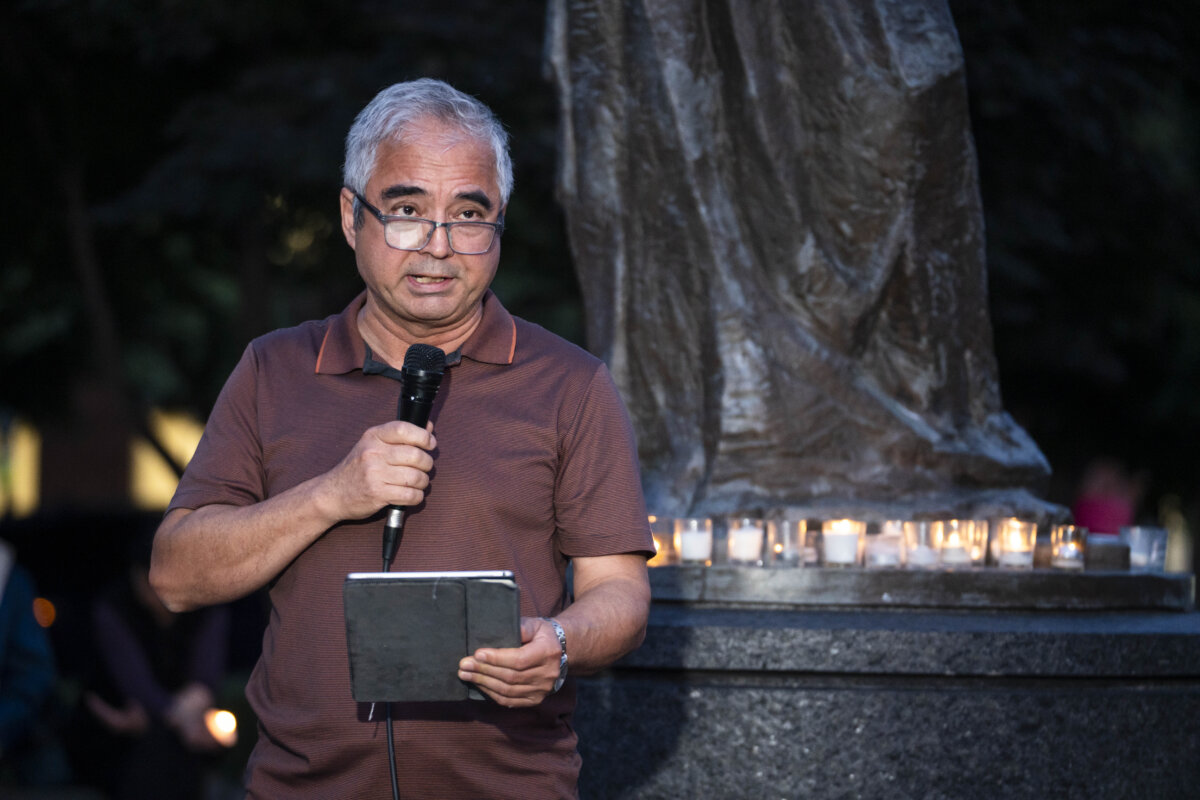
Ilshat Kokbore, research director at the Center for Uyghur Studies, echoed Jekielek’s point.
In 1989, Kokbore was a teacher, excited and hopeful that China would have a freer future.
“The Chinese Communist Party chose tanks over dialogue, bullets over reform, and fear over hope,” he said.
He added that the Tiananmen clampdown, and the mass suppression of Uyghurs in Xinjiang, are “chapters of the same story … the same political system that crushed peaceful demonstrators in chairman has developed increasingly sophisticated tools of surveillance, censorship, mass detention, and social control.”
Legacy of Tyranny
The massacre also got a spotlight in Congress.
Earlier in the day, a bipartisan group of lawmakers held a press conference honoring the victims of the massacre.
Rep. John Moolenaar (R-Mich.), chairman of the House Select Committee on CCP, said that the CCP chose to crush the student-led protests because it was “weak and scared.”
“Its broken ideology believes free expression must be oppressed. It does not have confidence in its ideas, it denies the existence of faith, and it censors the truth,” Moolenaar said.
Rep. Raja Krishnamoorthi (D-Ill.), the committee’s former ranking member, held up a board showing the “Tank Man,” an iconic photo of a white-shirted Chinese man standing in the way of advancing tanks.
“This is the picture of courage,” he said.

He then flipped the board over, revealing its blank side.
“This is what China wants you to remember about June 4, 1989: nothing—nothing,” he said. “No, we are not going to forget.”
To the regime, it all comes down to control, said Piero Tozzi, senior director for China policy at the America First Policy Institute.
“If you erase history, people are easier to control. They’re malleable if you make them content with pleasures of the moment,” he told The Epoch Times. “It distracts them.”
Arthur Liu, a student protest organizer in southern China’s Guangzhou city, escaped to Hong Kong and eventually found refuge in the United States. But even here, Chinese spies targeted his then-teenage daughter, a gold medalist for 2026 Olympic figure skating, posing as an International Olympic Committee official to pry for her passport information.
“The communist party’s history is a history of repression,” Liu told The Epoch Times.
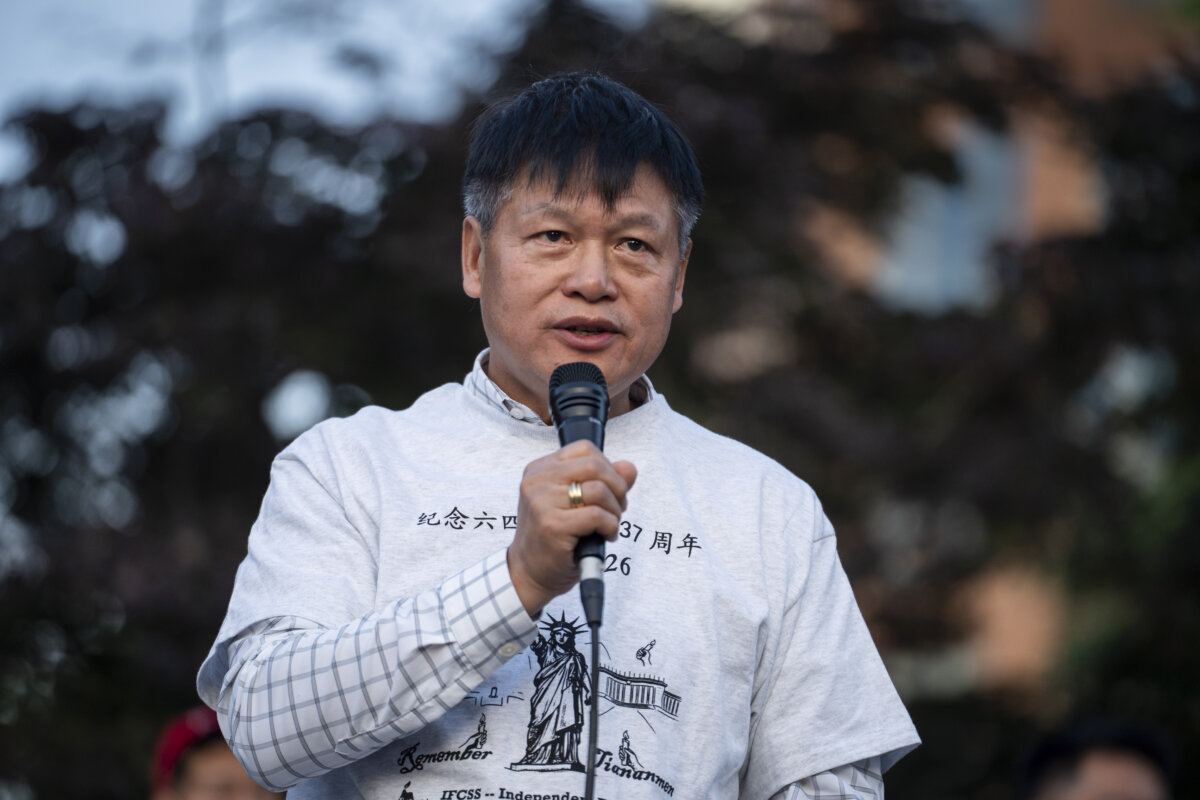
But the spirit of June 4 lives on, said Siu.
When authorities banned Victoria Park vigils, people wore black t-shirts on the streets, held candles, or simply stood outside the park, using what powers they have to creatively resist coercion, she said.
She said she hopes that the memories of the tragedy can now turn into fuel for actions.
It can be as small as lighting a candle at home, talking to friends about it, or sharing a story on social media, she said.
Small or big, she said, “just do something.”
Tozzi, like the others, believes in perseverance.
He recounted “Ozymandias,” a poem by Percy Bysshe Shelley describing a colossal statue built in tribute to a tyrant.
“Now it lies there in the sand,” he said.
“That’s going to be the legacy of Xi Jinping and other tyrants.”
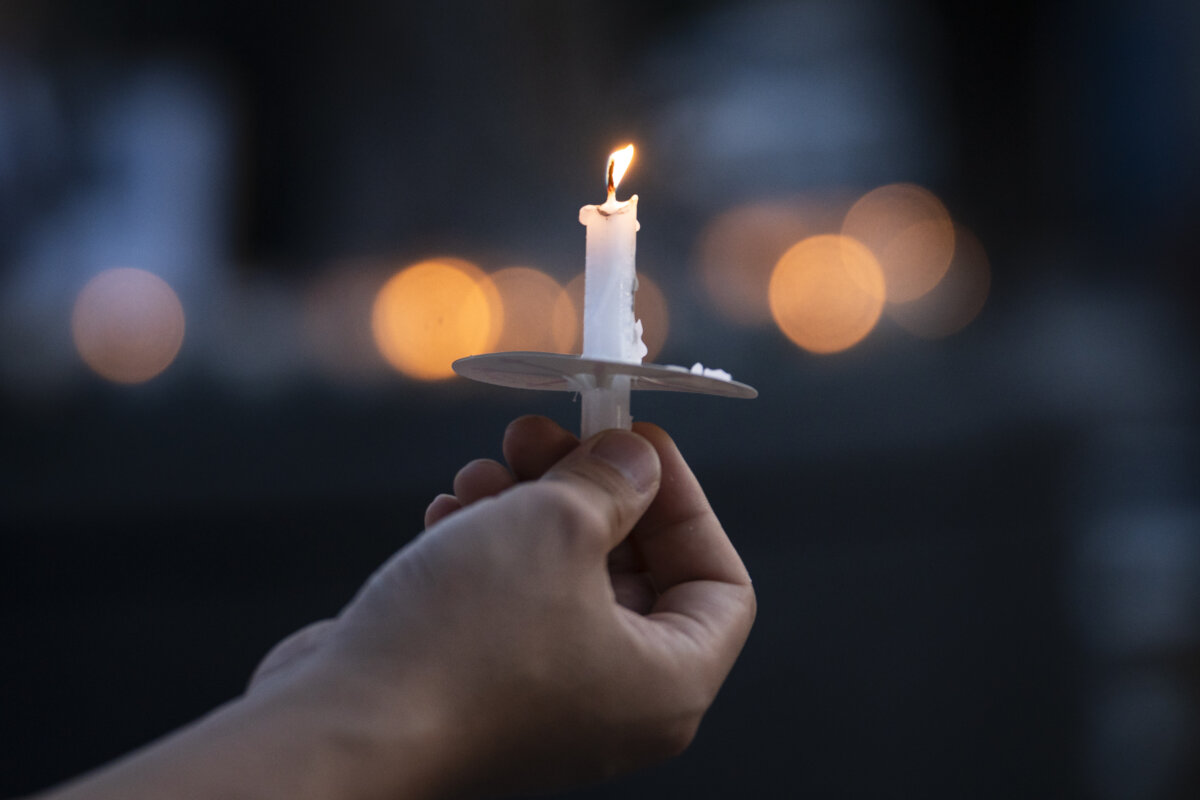 Tiananmen Square massacre candlelight vigil held at the Victims of Communism Memorial in Washington on June 4, 2026. (Madalina Kilroy/The Epoch Times)
 Friends Read Free
Copy
Facebook
Tweet
Friends Read Free
Copy
Facebook
Tweet