A divided federal appeals court ruled on July 7 that Florida’s restrictions on how public university professors could teach certain concepts about race, sex, and diversity violated the First Amendment.
In a 2–1 decision, the court upheld a judge’s order blocking part of the state’s Individual Freedom Act, also known as the Stop WOKE Act. The law banned the teaching of eight specific concepts associated with critical race theory, white privilege, and affirmative action.
The new ruling could have persuasive authority in challenges to similar state laws that target DEI (diversity, equity, and inclusion) policies in public schools and universities.
Critical race theory, a controversial ideology popular among academics, has varied interpretations. Its advocates generally say that racial bias is inherent in many parts of Western society, especially in legal and social institutions.
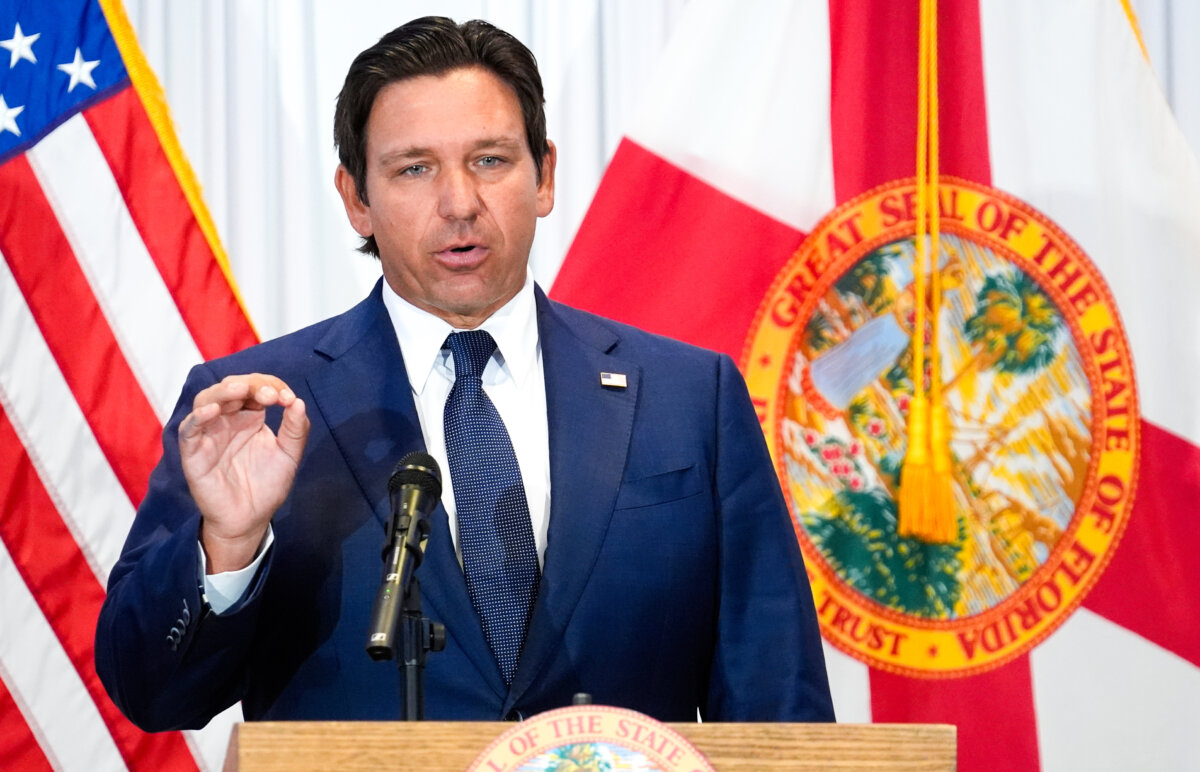
When signing the bill in 2022, Florida Gov. Ron DeSantis, a Republican, said: “No one should be instructed to feel as if they are not equal or shamed because of their race. In Florida, we will not let the far-left woke agenda take over our schools and workplaces. There is no place for indoctrination or discrimination in Florida.”
The statute prohibited instruction at public colleges and universities that “espouses, promotes, advances, inculcates, or compels” students to believe the eight concepts.
Among those concepts were that merit and colorblindness were racist and sexist, that one race or sex was morally superior, and that one’s race or sex made one inherently racist, sexist, or oppressive.
Other concepts included that people should be treated differently—or not—based on race or sex to promote equity and so-called social justice and that people are collectively guilty for past actions by others of the same race or sex.
The law permitted discussion of the concepts in neutral conversations as part of a course if presented in an objective way without endorsement.
Judge Britt Grant of the U.S. Court of Appeals for the 11th Circuit wrote for the majority, “If the First Amendment offers any boundary of protection at all for public university classrooms, this statute crosses it.”
She said that after professors challenged the law, the state searched for an existing case or doctrine to support its speech ban in universities but couldn’t find one. Instead, it fused public employee speech cases with government speech doctrine and created a new rule that if a government pays a professor’s salary, it has complete control over his or her speech in the classroom.
“That is not a blessed union,” she wrote. “Florida’s salary-for-speech rule is a breathtaking assertion of power to ban unpopular ideas from public discourse in the very places the State’s own statutes recognize as centers of inquiry—classrooms where students are trusted to puzzle through ideas that are good and bad, easy and hard, ideally getting ever closer to the truth.”
“The ideas Florida targets may well be noxious. Or maybe not,” she wrote. “Either way, in this context the First Amendment trusts students to figure it out for themselves.”
Grant previously ruled against the act in a separate lawsuit involving its application to private workplaces. She held that the state cannot ban mandatory DEI-related workplace trainings promoting the eight concepts.
Judge Barbara Lagoa issued a dissenting opinion, saying the majority overreached.
The majority is usurping the role of the state Legislature and reducing the First Amendment “to a reflection of judicial preference, regardless of the State’s interest in its classroom instruction.”
“If the government has a compelling interest in eradicating racial discrimination in a private university, how much greater is Florida’s interest in eradicating what it deems to be racial discrimination in its own classrooms?” she wrote.
Lagoa said people don’t need to agree or disagree with Florida that the viewpoints at issue constitute racial discrimination.
“We need only acknowledge that the State is allowed to decide what is endorsed by its professors in its own classrooms,” she wrote.
DeSantis criticized the court’s ruling, describing it as “judicial overreach.”
“State universities are funded by taxpayers and directed by elected officials and their appointees,” the governor wrote on X.
“The state has both a right and a responsibility to ensure instruction at these universities is consistent with the underlying mission and to exclude indoctrination and ideological agendas.
“Florida was correct to bar [critical race theory] and DEI. We also have a right to do so.”
Adriana Novoa, who teaches Latin American history at the University of South Florida, hailed the ruling in a statement.
“As a professor, I shouldn’t have to choose between teaching to the best of my ability or facing punishment,” said Novoa, a plaintiff in the lawsuit, who was represented by the Foundation for Individual Rights and Expression.
“This decision is such a relief to professors who care about their students and want them to become well-rounded and informed. It will allow me and countless other professors to teach our classes without government interference.”
Separately, President Donald Trump has tried to end DEI-related practices in the federal government.
Trump, who has called DEI initiatives “illegal and immoral discrimination programs,” issued executive orders 14151 and 14173 in January 2025 in an effort to eliminate DEI in the government.
“[These policies] threaten the safety of American men, women, and children across the Nation by diminishing the importance of individual merit, aptitude, hard work, and determination when selecting people for jobs and services in key sectors of American society,” the president said in executive order 14173.
 Friends Read Free
Copy
Facebook
Tweet
Friends Read Free
Copy
Facebook
Tweet