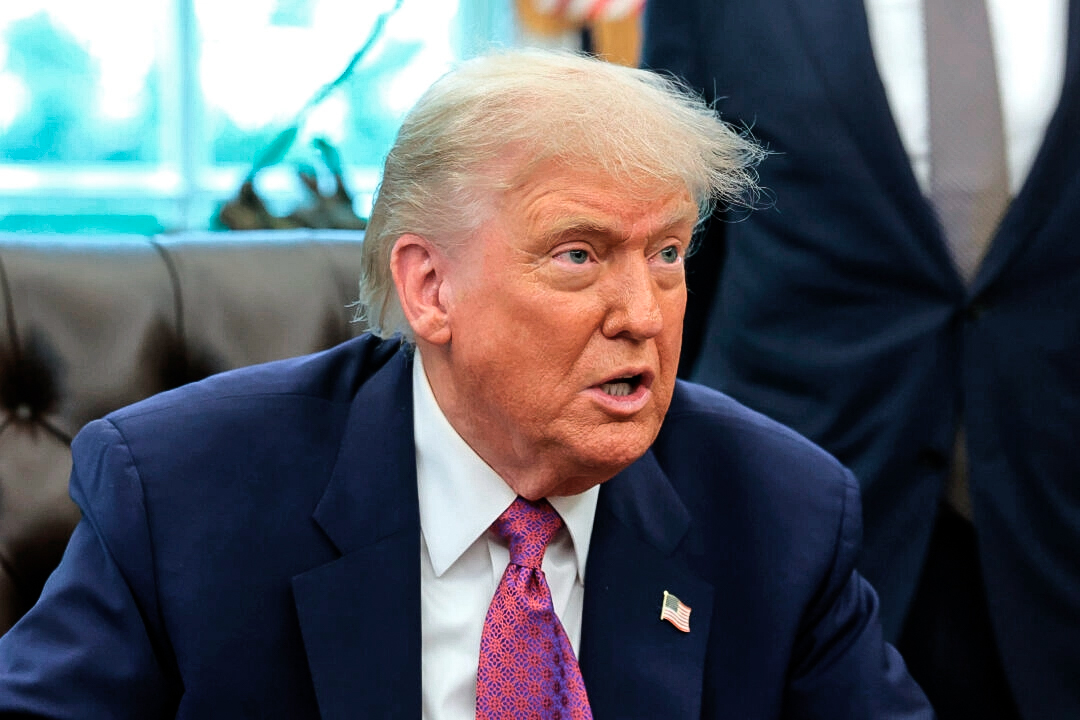

A federal appeals court on June 11 weighed President Donald Trump’s request to move his business records criminal case to federal court, potentially opening the door to tossing his conviction from 2024.
The oral argument came roughly a year after a jury found Trump guilty in state court on multiple counts of falsifying business records. Trump has maintained his innocence and argued the prosecution had multiple flaws, including using evidence of conduct protected by presidential immunity.
His attorney, Jeffrey Wall, argued that the U.S. Court of Appeals for the Second Circuit should transfer the case from state court and review how the Manhattan District Attorney’s Office prosecuted it.
The oral argument arose from Trump’s second attempt to transfer his case to federal court.
A federal judge had rejected Trump’s first attempt, and he tried again after the Supreme Court’s landmark decision on presidential immunity in July 2024. Wall told the judges that the Supreme Court’s decision, which came after the jury’s verdict, constituted the type of “good cause” that federal law says can justify a second attempt to transfer a case.
Even so, the same federal district court judge rejected his second attempt, and Trump appealed to the U.S. Court of Appeals for the Second Circuit. U.S. District Judge Alvin Hellerstein said in September that the Supreme Court’s decision did not alter his previous conclusion that payments to adult actress Stephanie Clifford “were private, unofficial acts, outside the bounds of executive authority.”
New York Supreme Court Justice Juan Merchan, who oversaw Trump’s trial in state court, used similar reasoning in December 2024 when he rejected Trump’s arguments about immunity. Trump had alleged that the prosecution wrongly used evidence that involved official acts and was therefore barred under the Supreme Court’s decision.
Writing for the majority, Chief Justice John Roberts said in July that juries cannot consider evidence concerning a president’s official acts. Trump said the prosecution violated this command by using certain evidence from his first term, including testimony from former White House staff.
That evidence, among many other reasons, is why Trump is asking for the appeals court to intervene and allow him to remove the case to federal court.
One of the three appeals court judges, Circuit Judge Raymond Lohier, indicated the court might send the case back to Hellerstein for further consideration. The case could nonetheless end up back at the appellate level after Hellerstein’s decision.
The charges Trump faced stemmed from a payment made during the 2016 presidential campaign and entailed alleged attempts to cover up the payment after entering office. At issue in the appeal is whether Trump’s case meets the criteria that federal law outlines for removing cases to federal court.
Trump’s attorneys have pointed to 28 U.S. Code Section 1442, which allows officers of the United States to remove cases if they’re related to an act “under color of” the defendant’s office. During oral argument, two of the judges seemed concerned about whether the law applied to restrictions on evidence.
Second Circuit Judge Myrna Pérez asked why that section of the law “focused on the charged conduct and whether the charges themselves are … relating to official acts.”
One of the laws at issue was 28 U.S. Code Section 1455, which limits the amount of time defendants have to file a notice of removal to federal court. It also allows a second notice based on issues that weren’t present at the time of the original notice, as well as “good cause”—both of which Wall said were met by the immunity-related issues that arose after the Supreme Court’s decision.
Steven Wu, who represented the district attorney, told the judges they should view the law as intended before sentencing.
“The reason the statute doesn’t permit removal after sentencing is because the purpose of removal under the federal officer statute is to make a threshold determination at the start of the case about where to hold the criminal trial,” he said.
He added that allowing for direct appellate review at the federal level would offend “fundamental principles of respect for state sovereignty over the criminal process.” For Trump, sentencing occurred in January but did not include any prison time. Wu also suggested that Trump failed to show “good cause” for removal because he waited about two months after the Supreme Court’s decision to attempt a removal to federal court.
Circuit Judge Susan Carney seemed skeptical of Wu’s arguments about Trump not having good cause for removal.
“The intervention of the Supreme Court’s decision and its comments on evidentiary matters related to presidential immunity was very late-breaking here,” she said.
She also seemed to push back on the idea that the end of a trial signaled the end of a removal possibility.
Correction: An earlier version of this report misstated the month Trump was sentenced. The Epoch Times regrets the error.
 Friends Read Free
Copy
Facebook
Tweet
Friends Read Free
Copy
Facebook
Tweet