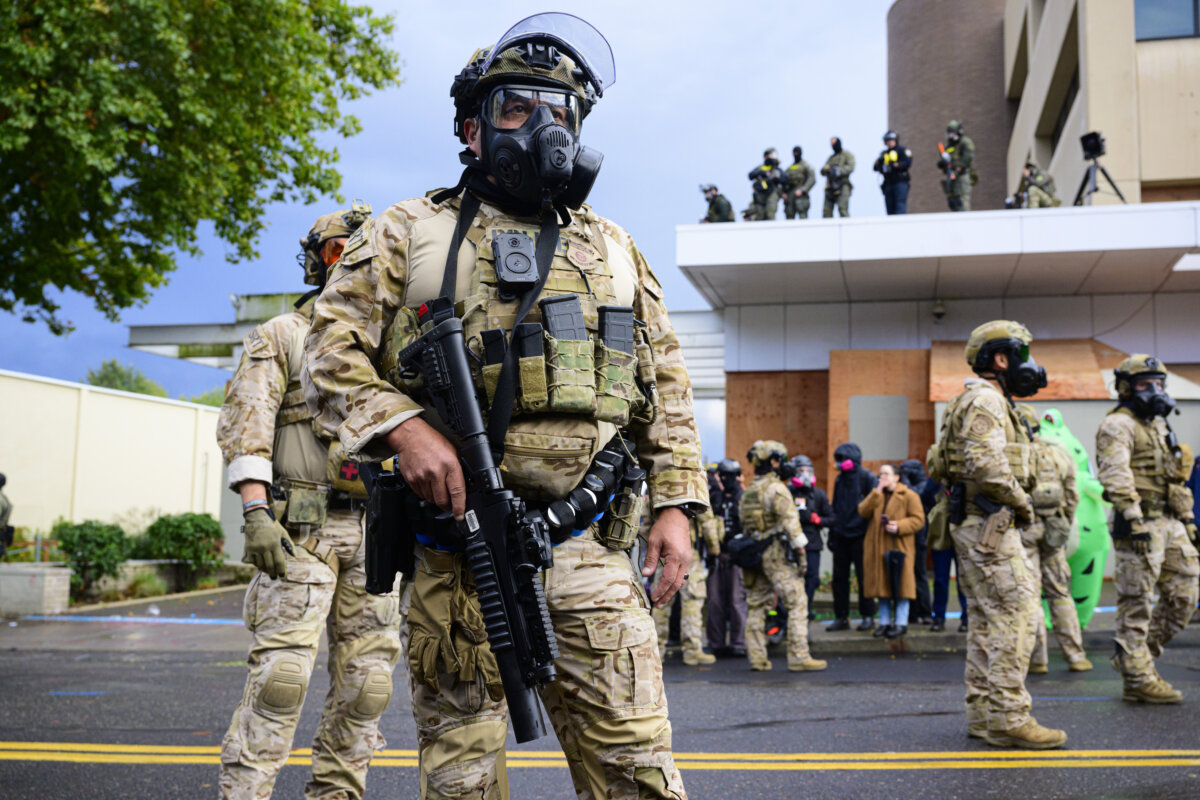

Attorneys offered closing arguments on Oct. 31 in a three-day trial over whether President Donald Trump validly invoked a federal law for using the National Guard in Portland, Oregon.
Under 10 U.S.C. Section 12406, the president can call into service National Guard members under various conditions—including a rebellion, danger of rebellion, or inability to execute the law. U.S. District Judge Karin Immergut is expected to issue a judgment as to whether those conditions were met.
In his closing remarks, Scott Kennedy, an attorney for Oregon, said crime at the ICE facility had abated in the months leading up to Trump’s Sept. 27 announcement that he would deploy the Oregon National Guard. While he acknowledged that there was crime in the area, he said the federal government didn’t face a rebellion and had enough resources that it didn’t need guardsmen to supplement federal officers.
Justice Department attorney Eric Hamilton highlighted how federal officers faced violence and harassment, along with refusals by the Portland Police Bureau to assist in certain ways that might be construed as assisting federal immigration enforcement.
He also argued that, at the very least, the judge had to show the president substantial deference when reviewing his determinations of whether the necessary conditions for invoking Section 12406 were met.
Trump attempted to deploy the Oregon National Guard after his September announcement, followed by attempts to deploy guardsmen from Texas and California. Immergut responded by blocking those deployments in temporary orders. Part of her reasoning was that the Justice Department hadn’t done enough to show that the federal government faced an actual rebellion.
The plaintiffs, which include the city of Portland and the states of Oregon and California, are asking Immergut to hold that Trump exceeded his authority under Section 12406. Immergut said after closing arguments that she would take the case under advisement. Her decision will likely wade into what federal officials and local police said during testimony.
Kennedy leaned on testimony from Portland Police commanders Franz Schoening and Brian Hughes, both of whom submitted declarations in favor of blocking Trump’s use of the National Guard.
Hamilton, the Justice Department attorney, cited testimony from ICE Field Director Cammilla Wamsley, who said that she supported federalizing the National Guard because it would remove some of the strain on her staff.
As of the trial’s end, the U.S. Court of Appeals for the Ninth Circuit had issued an order effectively blocking Trump’s deployment of the National Guard. In the past, it has issued differing rulings, including ones that benefited Trump’s use of troops in both California and Oregon.
One of its decisions criticized the way Immergut assessed the conditions in Portland. In an opinion on Oct. 20, it said the district court “clearly erred in characterizing the events in September leading up to and preceding the federalization order.”
It added that the district court had “substituted its own assessment of the facts for the president’s assessment of the facts.”
“This is the opposite of the significantly deferential standard of review that applies to the president’s decision,” it said.
Immergut’s rulings came amid several surrounding Trump’s use of the National Guard, which is a growing legal issue that has already provoked input from the Supreme Court. Trump has asked the justices to temporarily block a lower court order that prevents him from deploying troops to Chicago.
In both that case and the one in Oregon, questions emerged as to how judges should interpret one of the phrases within Section 12406. One of the conditions that allows presidents to call up the National Guard says he can do so whenever he “is unable with the regular forces to execute the laws of the United States.”
On Oct. 29, the Supreme Court said it would delay ruling on the Chicago case and requested additional briefing on the meaning of that “regular forces.”
At trial, Kennedy told Immergut that regardless of how she viewed that phrase, the federal government had not exhausted its options for defending the ICE facility. More specifically, he said the federal government could have called on different agencies to provide personnel to assist with security.
Much of Immergut’s decision could come down to the level of deference she affords Trump.
In June, the Ninth Circuit ruled in Trump’s favor when he fought another judge’s attempt to block his National Guard deployment in California. When it did, it said that courts could look at whether a president’s determinations reflect a “colorable assessment of the facts and law” and were determined with honest judgment.
Citing violence, disruptions to immigration enforcement, and a previous riot, Hamilton said there was clearly a colorable basis for the president’s determinations. Instead, he said, many of the disputes at trial were over the degree of violence or strain that officers faced in attempting to deal with protesters. Those questions of degree should be left up to a democratically elected president, he argued.
Meanwhile, Kennedy, attorney for Oregon, suggested to Immergut that the federal government was creating the very emergency it sought to fix by calling in the National Guard.
 Friends Read Free
Copy
Facebook
Tweet
Friends Read Free
Copy
Facebook
Tweet