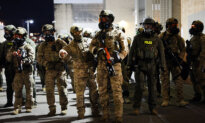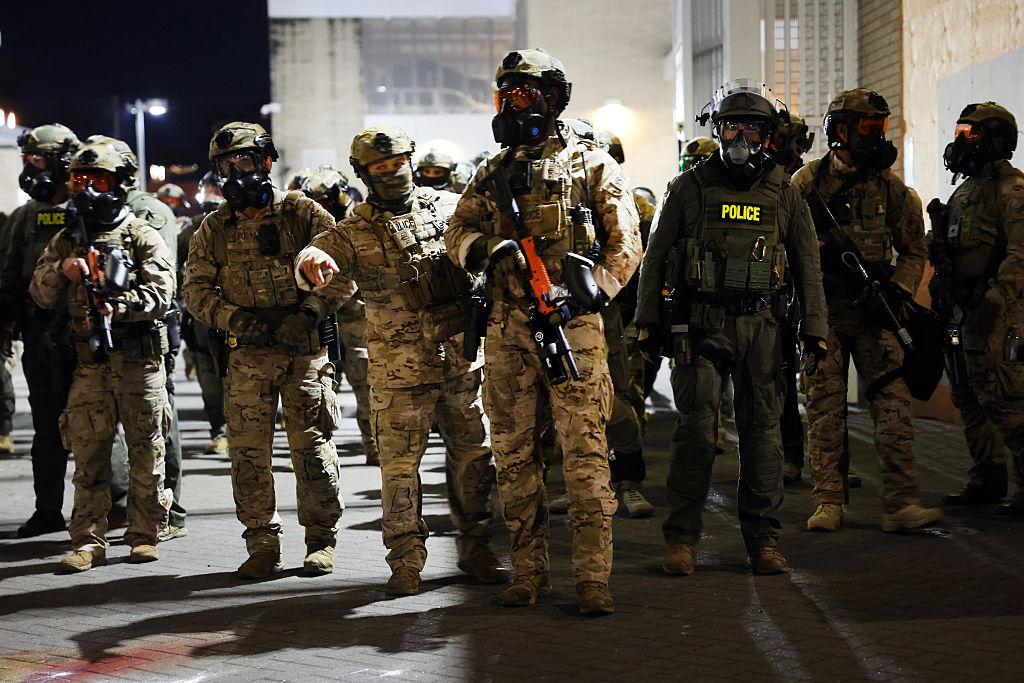

A trial is set to begin in Oregon on Oct. 29 over President Donald Trump’s decision to federalize and deploy National Guard troops to the state.
So far, two federal courts have blocked him from deploying troops under a law that allows presidents to federalize guardsmen if they face a rebellion or are unable to enforce the laws.
An appeals court later allowed the deployment while the case worked its way through the legal system. That order was eventually thrown out by the Ninth Circuit on Oct. 28.
The trial is expected to feature testimony and evidence surrounding conditions outside of an Immigration and Customs Enforcement (ICE) facility in Portland and whether additional assistance from guardsmen was needed to deal with crime in the vicinity.
Trump announced in September that he would deploy the National Guard to “war-ravaged Portland,” but was eventually halted by U.S. District Court Judge Karin Immergut.
After Trump attempted to use National Guard troops from California, Immergut expanded her order to prevent any National Guard troops from being deployed to Oregon.
In a pre-trial brief, the Justice Department stated that agents have encountered threats, violence, and other disruptive behavior at the ICE facility, while Portland police have failed to provide sufficient protection for federal assets.
“In the weeks and months preceding the president’s decision, agitators assaulted federal officers and damaged federal property in numerous ways, spray-painted violent threats, blockaded the vehicle entrance to the Portland ICE facility, trapped officers in their cars, followed them when they attempted to leave the facility, menaced them at their homes, doxed them online, and threatened to kill them on social media,” their brief from Oct. 27 read.
Apart from conditions in Portland, the Justice Department has also argued that Immergut lacks the authority to scrutinize the president’s determinations too heavily.
Instead, she should defer to his judgment as to whether conditions in the city worsened enough for him to deploy troops.
Attorneys for Oregon, Portland, and California argued that Trump’s use of the national guard was unnecessary and that his decision to deploy guardsmen inflamed tensions that had been declining in recent months.
In a brief on Oct. 27, they argued that Trump’s assessment of the situation in Portland was absurd and that it was outside the range of honest judgment.
While they acknowledged that the ICE facility was damaged, incidents involving assault and harassment occurred, but they weren’t enough to warrant Trump’s intervention.
“Unacceptable as these incidents were, they were not extraordinary,” the brief read. “[Portland police] responded and made arrests as appropriate.”
The states and Portland are expected to call officers from the Portland Police Bureau as witnesses.
“They will testify that, even going back to June 2025, the protests at the ICE facility were … largely unstructured demonstrations without a clear organizational structure,” the attorneys said.
For the Trump administration, the Justice Department said testimony would show the kind of intimidation and violence federal authorities were facing.
It’s unclear how Immergut will decide the case, but the U.S. Court of Appeals for the Ninth Circuit previously criticized her analysis of the situation in Portland.
In an opinion on Oct. 20, it said the district court “clearly erred in characterizing the events in September leading up to and preceding the federalization order.”
It added that the district court had “substituted its own assessment of the facts for the president’s assessment of the facts.”
“This is the opposite of the significantly deferential standard of review that applies to the president’s decision,” it said.
This case has contributed to a host of challenges to Trump’s use of the National Guard across the country.
In August, a similar trial took place in California over whether Trump had violated the Posse Comitatus Act, which generally prohibits the use of troops for civilian law enforcement.
After the trial, U.S. District Judge Charles Breyer said in September that the administration had violated that law—something the Justice Department denied.
The Supreme Court has yet to fully weigh in on the issue, but is expected to respond in a more tentative way to an appeals court block on Trump’s use of troops in Chicago.
 Friends Read Free
Copy
Facebook
Tweet
Friends Read Free
Copy
Facebook
Tweet