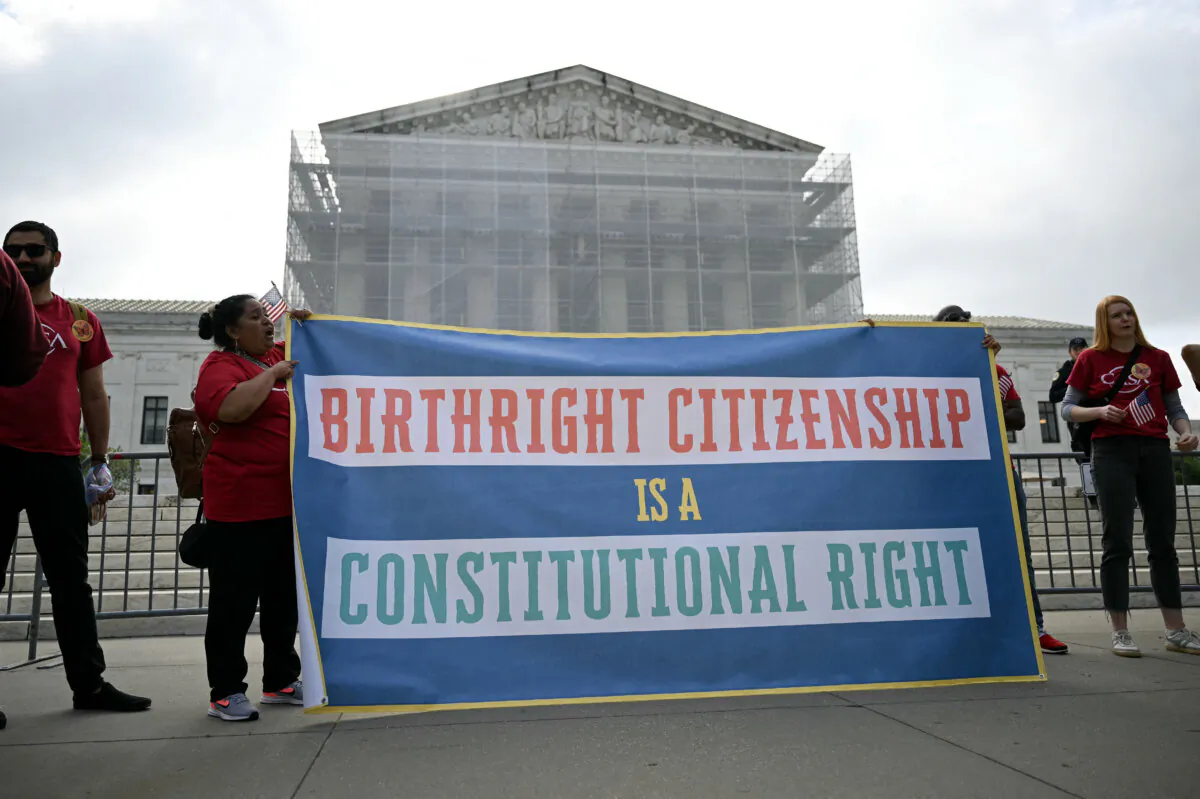

Attorneys are urging a federal judge in Maryland to use an alternative legal mechanism for granting a sweeping block on President Donald Trump’s birthright citizenship order after the Supreme Court ruled against the use of nationwide injunctions.
A conference on June 30 was the first set of public arguments in which attorneys and a judge attempted to wrestle with the implications of the Supreme Court’s decision just three days prior. Although the Supreme Court said nationwide injunctions were likely inconsistent with judges’ authority, it left open the possibility that plaintiffs such as the ones in Maryland could pursue broad relief through class actions.
In a class action, a plaintiff represents a larger group of people—a class—and seeks relief, such as an injunction, for that class. Shortly after the Supreme Court’s June 27 ruling, attorneys for immigrant organizations and pregnant women asked the federal court in Maryland to recognize a class of people made up of individuals who would be ineligible for birthright citizenship as a consequence of Trump’s order.
During the June 30 conference, U.S. District Judge Deborah Boardman repeatedly asked the administration whether it thought it could deport recently born babies of illegal immigrant parents. Justice Department attorney Brad Rosenberg said it was his understanding that the government couldn’t do that until 30 days after the Supreme Court’s decision.
That’s because Justice Amy Coney Barrett, who penned the majority opinion, said that she was halting the lower court injunctions on the president’s birthright order but would still grant a 30-day delay for the most important section of the ruling to take effect.
Rosenberg told Boardman that he was very confident in his understanding of the 30-day limit on deportations, but she required him to submit something in writing the following day. How the government responds, she said, will bear on how she proceeds with another potential block.
Granting the class certification request could raise additional questions about the Supreme Court’s decision and how plaintiffs in other cases can seek to block the administration’s policies. Rosenberg laid out several potential issues with the judge certifying the class plaintiffs had requested.
He also referenced Justice Samuel Alito’s concurring opinion, which was joined by Justice Clarence Thomas and directed courts to “scrupulous[ly]” adhere to the federal rules around class certification. It also warned that universal injunctions would “return from the grave” if judges refused to abide by those safeguards.
William Powell, one of the plaintiffs’ attorneys, told Boardman that Alito’s opinion was joined by only one other justice. Boardman could grant relief for the proposed class without first certifying it, Powell suggested. He pointed to the Supreme Court’s recent decision to tentatively block Trump’s deportations under the Alien Enemies Act.
Even though a district court had not certified a class of potential deportees, a majority of the Supreme Court appeared to block deportations for that putative class. That decision saw a critical dissent from Alito, who was joined by Thomas then as well.
At one point at the June 30 conference, Rosenberg argued that Boardman lacked jurisdiction to effectively replace her prior nationwide injunction with another block. That’s because the case had already been transferred to the U.S. Court of Appeals for the Fourth Circuit, which as a result had jurisdiction over the substance of her initial injunction. Boardman appeared unpersuaded, ordering expedited briefing and saying she was converting the plaintiffs’ request for a temporary restraining order into one for a preliminary injunction, which is more permanent.
There appeared to be some disagreement over what exactly the Supreme Court did in its June 27 decision. Barrett’s opinion temporarily halted the section of Trump’s order that establishes a policy of departments and agencies not issuing documents that recognize citizenship for certain people, including children whose parents are both illegal immigrants.
Another aspect of her opinion allowed the executive branch to follow Trump’s executive order to the extent that they would develop and issue public guidance on the government’s plan for implementation. That appeared to be a reference to Section 3 of Trump’s order, which directs agencies to issue guidance, among other things.
Powell expressed concern about a portion of that section that directs the secretary of state, attorney general, secretary of homeland security, and commissioner of social security to ensure their policies were consistent with the order. That portion, combined with a section expressing Trump’s view about the limitations of birthright citizenship, might lead to some kind of adverse enforcement for people like the plaintiffs, Powell suggested.
This case—known as CASA Inc. v. Donald Trump—is just one of several that resulted in nationwide injunctions on Trump’s policies.
The Supreme Court’s decision on June 27 did not rule on whether Trump’s birthright citizenship policy was unconstitutional but instead focused on the legality of nationwide injunctions. It also left some wiggle room for lower courts to adjust their orders while not making it entirely clear whether injunctions in cases brought by state governments would lose their nationwide scope altogether.
Boardman asked both sides on June 30 how one of those nationwide injunctions, which was issued by a judge in Massachusetts and also related to birthright citizenship, would affect the plaintiffs in Maryland. Rosenberg told her that the injunction may end up being narrowed. Powell similarly indicated the injunction could be narrowed and that the plaintiffs should receive immediate relief.
 Friends Read Free
Copy
Facebook
Tweet
Friends Read Free
Copy
Facebook
Tweet