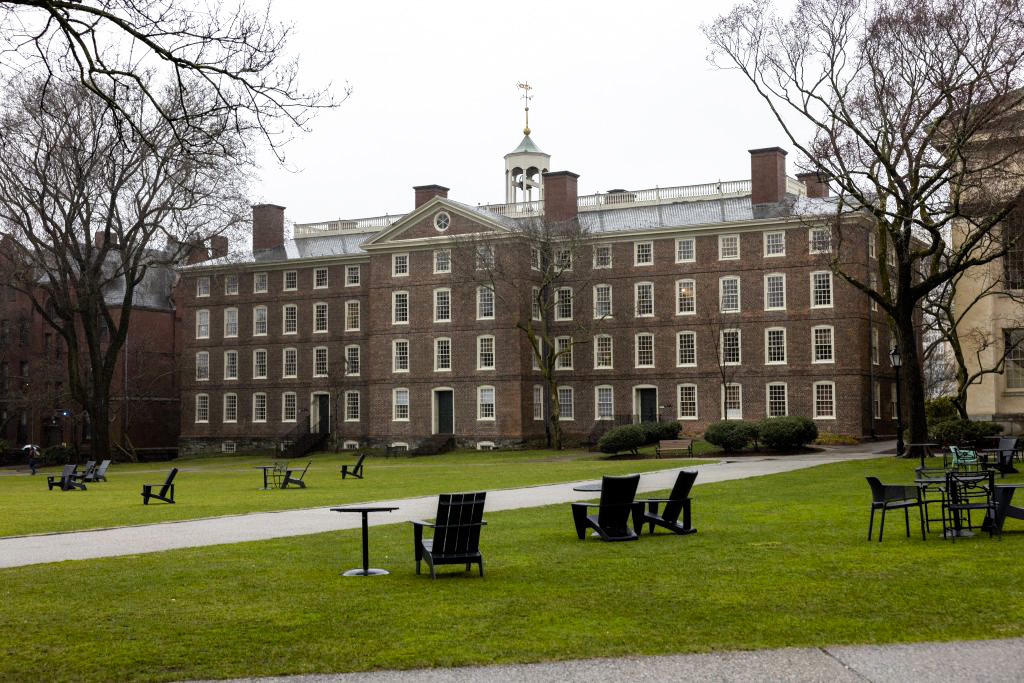

Brown University became the second of nine schools to decline the Trump administration’s Compact for Academic Excellence in Higher Education.
In an Oct. 15 letter to the White House, Brown President Christina H. Paxson said the agreement has “no safeguards for protecting academic speech” and would “restrict academic freedom and undermine the autonomy of Brown’s governance,” impeding her school’s ability to fulfill its mission as a research institution.
The compact offers financial incentives like preferred consideration for federal grants and looser restrictions on research overhead costs if the school promises to eliminate preferential treatment by race, freeze tuition rates for five years, require SAT scores in student applications, limit undergraduate admission of foreign students to 15 percent, maintain a policy of institutional neutrality on political and social issues, and accept all transfer credits from military members and veterans.
Massachusetts Institute of Technology announced its decision to decline the offer last week. MIT President Sally Kornbluth said the compact would restrict her university’s freedom of expression and academic independence, and is “inconsistent with our core belief that scientific funding should be based on scientific merit alone.”
In July, Brown signed a voluntary resolution agreement with the federal government following an investigation into civil rights infractions at the university, and committed to paying $50 million for state-level workforce development programs.
Paxson said under that July agreement with the Trump administration, Brown has already asserted its commitment to equality in admissions and hiring and renewed a mutually beneficial relationship with the federal government.
“I share this goal and strongly agree with the importance of sustaining a relationship that historically has made our country’s education and research enterprise the best in the world,” she wrote.
“Indeed, soon after the transition to the current federal administration, I affirmed that Brown would work with the government to find solutions if there were concerns about the way the University fulfills its academic mission. I remain committed to contributing to national conversations about principles for improving American higher education.”
Seven universities are still considering the offer, including Brown’s fellow Ivy League institutions Dartmouth and the University of Pennsylvania, in addition to Vanderbilt, University of Southern California, University of Arizona (Tucson), University of Texas (Austin campus), and University of Virginia (Charlottesville campus).
The Tucson City Council on Oct. 8 passed a unanimous resolution calling on local university leaders to reject the offer.
“Compliance only brings about much more push back from President [Donald] Trump and his political agenda,” said Tucson Mayor Regina Romero.
Education Department communications personnel are currently on furlough due to the government shutdown and were unable to respond to media inquiries.
 Friends Read Free
Copy
Facebook
Tweet
Friends Read Free
Copy
Facebook
Tweet