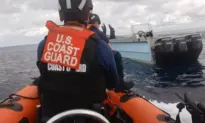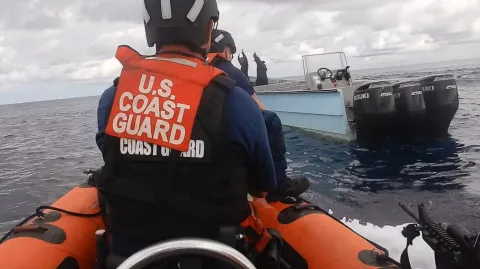

The U.S. Coast Guard (USCG) has seized more than 225,000 pounds of cocaine in the Eastern Pacific Ocean as part of Operation Pacific Viper since it was launched in August last year, the Department of Homeland Security (DHS) said in a June 17 statement.
“With 1.2 grams of cocaine being a potentially deadly dose, the total amount seized through Operation Pacific Viper equates to more than 93 million potentially deadly doses kept off of American streets,” DHS said. “Eighty percent of all seizures of U.S.-bound narcotics occur at sea, underscoring the impact of Coast Guard maritime interdiction efforts.”
Operation Pacific Viper is the Coast Guard’s accelerated counter-drug operation in the Eastern Pacific, through which significant amounts of illicit drugs are transported from South and Central America. The Coast Guard is surging additional assets for interdicting and seizing maritime drug shipments, including aircraft, cutters, and tactical teams.
The Coast Guard has over 76,000 personnel in service and deploys 137 rotary aircraft, 221 cutters, and 1,337 small boats. In 2024, the Coast Guard interdicted 165 metric tons (364,000 pounds) of drugs.
The DHS said that the milestone of 225,000 pounds was hit after the USCG Cutter Bear interdicted 7,707 pounds of cocaine, worth more than $419 million, while patrolling the Eastern Pacific last weekend.
The cutter’s helicopter crew detected and disabled two narcotics smuggling vessels, which led to the seizure. Six suspected narco-terrorists were arrested.
DHS said the interdiction shows the effectiveness of “aggressive, sustained counter-narcotics operations” along smuggling routes in the region.
“Operation Pacific Viper stands as a decisive force against narco-terrorists, sending an unmistakable message that we will not allow them to profit off the poisoning of our people,” said DHS Secretary Markwayne Mullin.
Drug Boat Strikes
U.S. military forces have conducted multiple strikes against drug trafficking vessels in the Eastern Pacific and Caribbean Sea since last year.
In a June 18 statement, the American Civil Liberties Union (ACLU) said the group, together with the Center for Constitutional Rights, will argue against the Trump administration’s “ongoing illegal boat strikes” at a district court in New York on June 24.
Since September last year, the administration has carried out strikes against 64 boats in the Caribbean, killing at least 210 individuals, which the ACLU alleged a “clear violation of domestic and international law.”
“The groups are asking the court to order the Trump administration to immediately release a still-secret legal opinion authored by the Justice Department’s Office of Legal Counsel that administration officials have repeatedly invoked as the purported legal basis for its ongoing lethal strikes campaign.”
In December, Pentagon press secretary Kingsley Wilson told the media that every strike against a drug boat run by designated terror organizations is done to protect U.S. national interests and defend the homeland.
The legality of these strikes has been vetted thoroughly by proper authorities, Wilson said.
“Our operations in the [Southern Command] region are lawful under both U.S. and international law, with all actions in compliance with the Law of Armed Conflict. These actions have also been approved by the best military and civilian lawyers up and down the chain of command.”
Meanwhile, the maritime drug interdictions are being complemented by drug seizures on land as part of the Trump administration’s crackdown on the influx of illegal narcotics.
On June 18, the Customs and Border Protection (CBP) announced that there was a “significant increase” in drug seizures nationwide in May, with the combined seizure of fentanyl, heroin, cocaine, and methamphetamine rising by 32 percent from a year ago.
CBP said it seized 56 percent more drugs this fiscal year through May compared with the same period in fiscal year 2024.
“Our robust enforcement policies are working, and we are delivering unprecedented results in border security, drug interdiction, and trade enforcement,” said CBP Commissioner Rodney S. Scott.
 Friends Read Free
Copy
Facebook
Tweet
Friends Read Free
Copy
Facebook
Tweet