



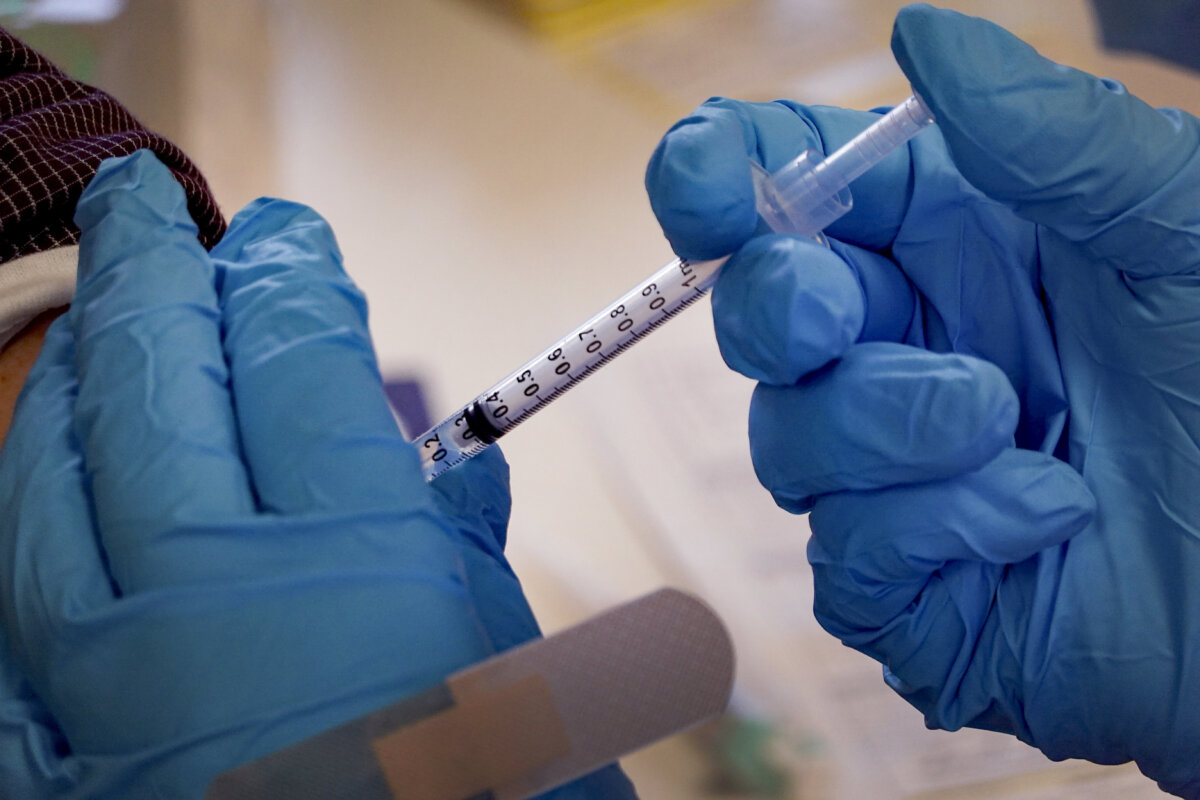
A paper coauthored by Centers for Disease Control and Prevention (CDC) scientists and blocked from the CDC’s quasi-journal has been published by the Journal of the American Medical Association.
Researchers with the CDC and other institutions in the paper, published on June 23, estimated that COVID-19 vaccination was 55 percent effective against hospitalization related to COVID-19 and 50 percent effective against COVID-19-associated emergency department and urgent care visits.
“Adults can reduce their likelihood of severe COVID-19–associated outcomes by obtaining a 2025-2026 COVID-19 vaccination,” Ruth Link-Gelles, an epidemiologist at the CDC, and coauthors wrote.
A spokesperson for the Department of Health and Human Services, the CDC’s parent agency, told The Epoch Times in an email: “The CDC protects the public’s health by providing accurate, transparent, and trustworthy information.
“This requires applying the highest standards of scientific rigor, especially when findings may influence clinical decisions such as immunization. We engage in scientific discourse on how best to measure vaccine effectiveness across all CDC publications.”
Dr. Jay Bhattacharya, the acting CDC director, declined to publish the paper in the Morbidity and Mortality Weekly Report, a quasi-journal run by the CDC, earlier in the year.
“The study uses a test negative design that will not produce an unbiased estimate of efficacy (and it’s impossible to say which way the bias will go),” Bhattacharya said at the time.
The observational study examined people admitted to medical facilities across the Virtual SARS-CoV-2, Influenza, and Other respiratory viruses Network, a collaboration between the CDC, data organization company Westat, and health systems such as Kaiser Permanente.
The study took people who went to emergency departments, urgent care facilities, or hospitals in the network from Sept. 3, 2025, to Dec. 31, 2025, and separated them into two groups. One group consisted of people who tested positive for COVID-19. The other tested negative.
Just 4.5 percent of the 85,725 people who went to emergency departments or urgent care facilities in late 2025 tested positive for COVID-19, and 206, or 5 percent, of those people had received a COVID-19 vaccine in late 2025. In comparison, 12 percent of the people who tested negative had recently received a COVID-19 vaccine.
That means that COVID-19 vaccination was estimated to provide 50 percent protection against emergency department and urgent care counters associated with COVID-19.
The researchers used the same method of estimating effectiveness against COVID-19-related hospitalization. Because a higher percentage of people who tested negative had received a vaccine, they pegged the effectiveness against hospitalization at 55 percent.
The study listed four limitations, including potential misclassification of patient vaccination status.
Several authors reported receiving grants from COVID-19 vaccine manufacturers such as Pfizer and Moderna. The CDC and Kaiser Foundation Hospitals funded the study.
In an accompanying editorial, Natalie Dean, an associate professor at the Emory University Rollins School of Public Health’s Department of Biostatistics and Bioinformatics, said that the test-negative design does have limitations, but can provide accurate estimates of effectiveness because patients testing negative for COVID-19 “can approximate the underlying source population from which the COVID-19 cases arose, allowing investigators to estimate vaccine effectiveness without establishing a full denominator.”
She noted that the design has been used for decades to estimate the effectiveness of influenza vaccines.
Dean was among those who spoke in support of test-negative studies during a CDC event brought together by Bhattacharya to debate the method.
Martin Kulldorff, a Department of Health and Human Services adviser, said during the event that using a control group for a test-negative study looking at COVID-19 vaccines in people who came to the hospital with a non-COVID-19 infection would not work.
“It could be that they come from a more frail population,” he said. “They’re more sensitive to infections and they know that and because of that they are recommended more strongly to get vaccinated.
“So it could be that those who come to the hospital for a different infectious disease, they are more frail and therefore they have a different probability of having been vaccinated. Has nothing to do with if the vaccine protects you against COVID or not. It just creates the bias. And the bias can go in either direction.”