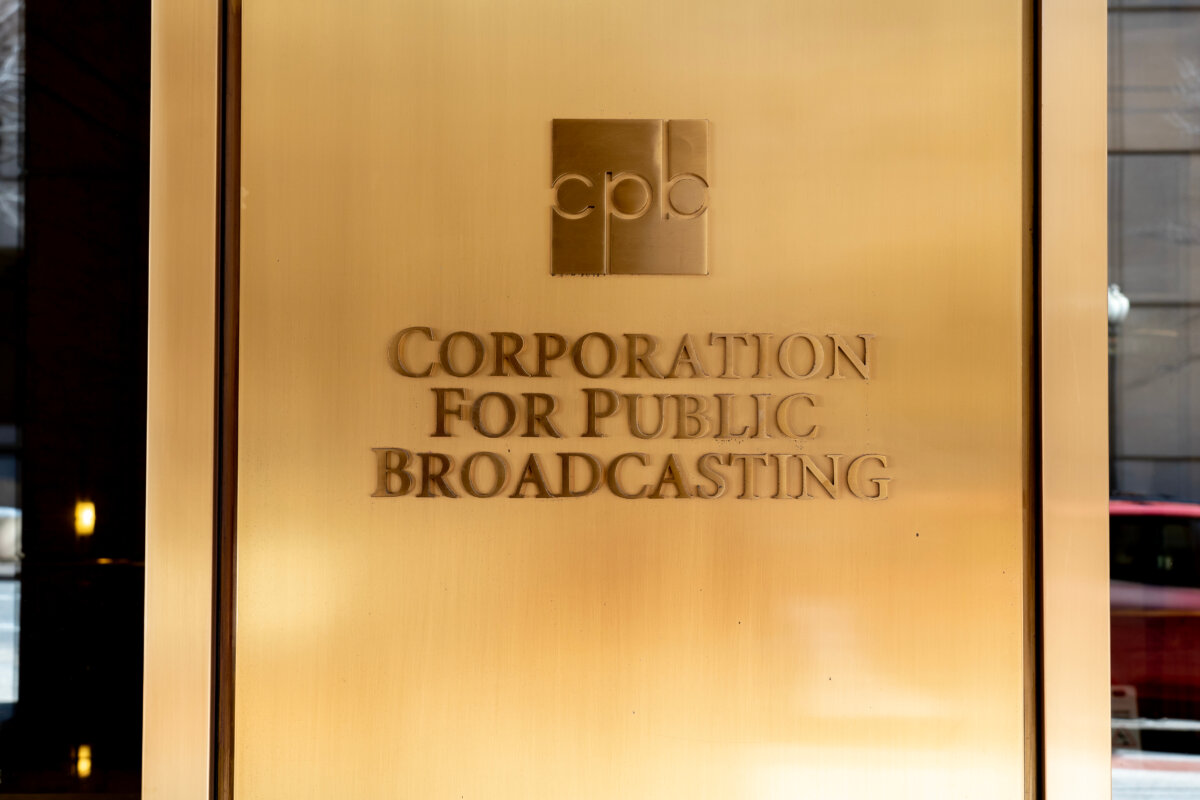

The nonprofit organization created by Congress to distribute funds to NPR, PBS, and other public radio and television stations across the country has formally shut itself down following massive federal funding cuts.
The Corporation for Public Broadcasting (CPB) announced on Jan. 5 that its board of directors voted to dissolve the organization after nearly 60 years in operation.
Patricia Harrison, president and CEO of CPB, said in a statement that the board took the step as it “faced a profound responsibility” after the Trump administration and Congress rescinded federal funding.
“CPB’s final act would be to protect the integrity of the public media system and the democratic values by dissolving, rather than allowing the organization to remain defunded and vulnerable to additional attack,” she said.
CPB was created by the Public Broadcasting Act of 1967 to support NPR, PBS, and more than 1,500 locally owned and operated public media stations. Its website describes itself as the “largest single source of funding for research, technology, and program development for public radio, television, and related online services.”
In recent years, public broadcasting has increasingly come under fire from critics who say it is biased against conservative Americans. Conservative commentators and policy advocates, notably the Heritage Foundation in its Project 2025 policy wishlist, repeatedly called for ending taxpayer funding for public broadcasters—calls that ultimately materialized in the first year of the second Trump administration.
“For years, American taxpayers have been on the hook for subsidizing [NPR and PBS], which spread radical, woke propaganda disguised as ‘news,’” the White House said in an April 2025 memo, listing instances where it said the two outlets exhibited left-leaning bias or produced content with little news value beyond promoting progressive ideas.
“Taxpayer funding of NPR’s and PBS’s biased content is a waste,” the memo said.
In May, President Donald Trump signed an executive order directing the CPB board to cease all funding to NPR and PBS, which he said had outlived their mandate and no longer deserve tax dollars.
“Which viewpoints NPR and PBS promote does not matter,” the order stated. “What does matter is that neither entity presents a fair, accurate, or unbiased portrayal of current events to taxpaying citizens.”
In July, Trump wrote on social media, urging Republican lawmakers to defund CPB in a $9 billion rescissions package, warning that anyone who “votes to allow this monstrosity to continue broadcasting will not have my support or endorsement.”
The Republican-majority Congress went on to cut $1.1 billion in funding from CPB, forcing the organization to halt most operations in August.
Ruby Calvert, chair of CPB’s board of directors, called the defunding “devastating.”
“Even in this moment, I am convinced that public media will survive, and that a new Congress will address public media’s role in our country because it is critical to our children’s education, our history, culture and democracy to do so,” Calvert said.
As part of what it said is an “orderly closure,” CPB will complete the “responsible distribution” of all remaining funds in accordance with Congress’s intent.
It will also provide support to the American Archive of Public Broadcasting to continue digitizing and preserving historic content. CPB’s own archives, which date back to its founding in 1967, will be preserved in partnership with the University of Maryland and made accessible to the public.
 Friends Read Free
Copy
Facebook
Tweet
Friends Read Free
Copy
Facebook
Tweet