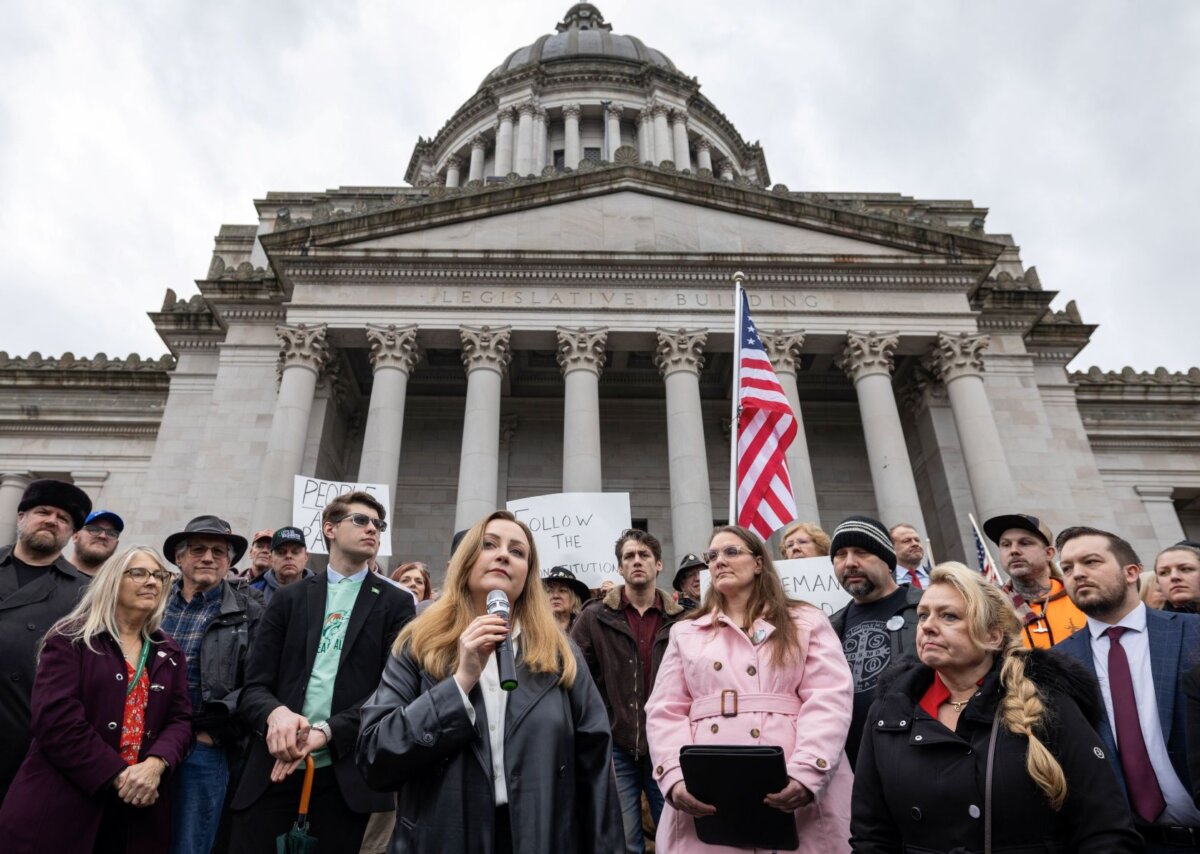
A federal judge has rejected a temporary restraining order requested by three conservative journalists who said the Washington State House of Representatives unconstitutionally blocked them from the state Capitol’s restricted press areas.
U.S. District Judge David G. Estudillo determined Tuesday that the House’s credentialing policy is reasonable and does not discriminate based on point of view.
The ruling stems from a lawsuit filed by Ari Hoffman, Jonathan Choe, and Brandi Kruse, whose requests for day passes to the House chambers’ wings and the press table during the 2026 legislative session were rejected.
The plaintiffs claimed the denials violated their First Amendment rights to gather news, as well as due process protections under the U.S. and Washington constitutions. They also argued the House wrongly delegated authority to the Washington State Capitol Correspondents’ Association (CCA), a private group that advises on credentials.
Hoffman, who reports for Seattle radio station AM 570 KVI and is a contributor to outlets including Newsweek, Fox News, and The Post Millennial, was refused access after speaking at a rally for the conservative group Let’s Go Washington on Nov. 16, 2025.
Choe, who writes for the website fixhomelessness.com and is a senior fellow at the Discovery Institute’s news wing, was rejected because her employer is a think tank.
Kruse, host of the Undivided Podcast and a former Fox 13 Seattle reporter, was denied entry after her appearances at Let’s Go Washington events on Nov. 23, 2025, and Feb. 3 this year.
Under House Rule 8, representatives of the press are generally allowed into the chambers, but they must have credentials to access restricted zones.
The CCA’s guidelines, on which the House relies, recommend credentials only for professional journalists whose primary income comes from reporting and who do not participate in campaigns, lobbying, or public policy development.
“We recommend issuing credentials only to professional journalists,” the guidelines state. “This means that reporting or shooting is your primary job, and that job is the source of most of your income.”
The guidelines add: “The Association will not support the providing of a credential to a person who is or may become engaged in campaigns, lobbying, or the development of public policy.”
Estudillo said the House press area is a nonpublic forum, where entry can be restricted based on subject matter or speaker identity if the rules are reasonable and viewpoint-neutral.
“Control over access to a nonpublic forum can be based on subject matter and speaker identity so long as the distinctions drawn are reasonable in light of the purpose served by the forum and are viewpoint neutral,” the judge wrote, citing Supreme Court precedent in Cornelius v. NAACP.
The judge saw no evidence of bias, underscoring the policy’s intention to preserve an independent press corps.
“The press must be independent from the government and from the political parties. … Blurring that line would raise questions about the motives of everyone in the press corps,” the CCA guidelines explain, which the judge cited in the order.
Plaintiffs applied for day passes in late January and early February but were rejected. Appeals were denied shortly after.
They filed suit in state court on Feb. 10, before removal to federal court. Estudillo found that due process was satisfied via notice of criteria and an appeals process, citing cases such as Sherill v. Knight. He also threw out the non-delegation claim because the House maintained final decision-making authority.
Estudillo ruled that the plaintiffs did not demonstrate they would succeed on the merits of their case or that irreparable harm would result if the court didn’t act immediately. The judge argued public interest favored the House’s interest in orderly, lobby-free proceedings.
“For the reasons that follow, Plaintiff’s motion is DENIED,” Estudillo wrote in the order.
The ruling permits the House to continue enforcing its policy. Jessica Goldman, the lawyer for the House, said they were confident that any further litigation would end with the same conclusion—that the press pass policy complies with the constitution and protects the lawmakers’ working space.
The plaintiffs’ attorney said the denials undermined diverse perspectives.
“My clients are the eyes and ears of the people in the legislative process. Their voices and opinions should not be excluded,” attorney Jackson Maynard said.
The Associated Press contributed to this report.
 Friends Read Free
Copy
Facebook
Tweet
Friends Read Free
Copy
Facebook
Tweet