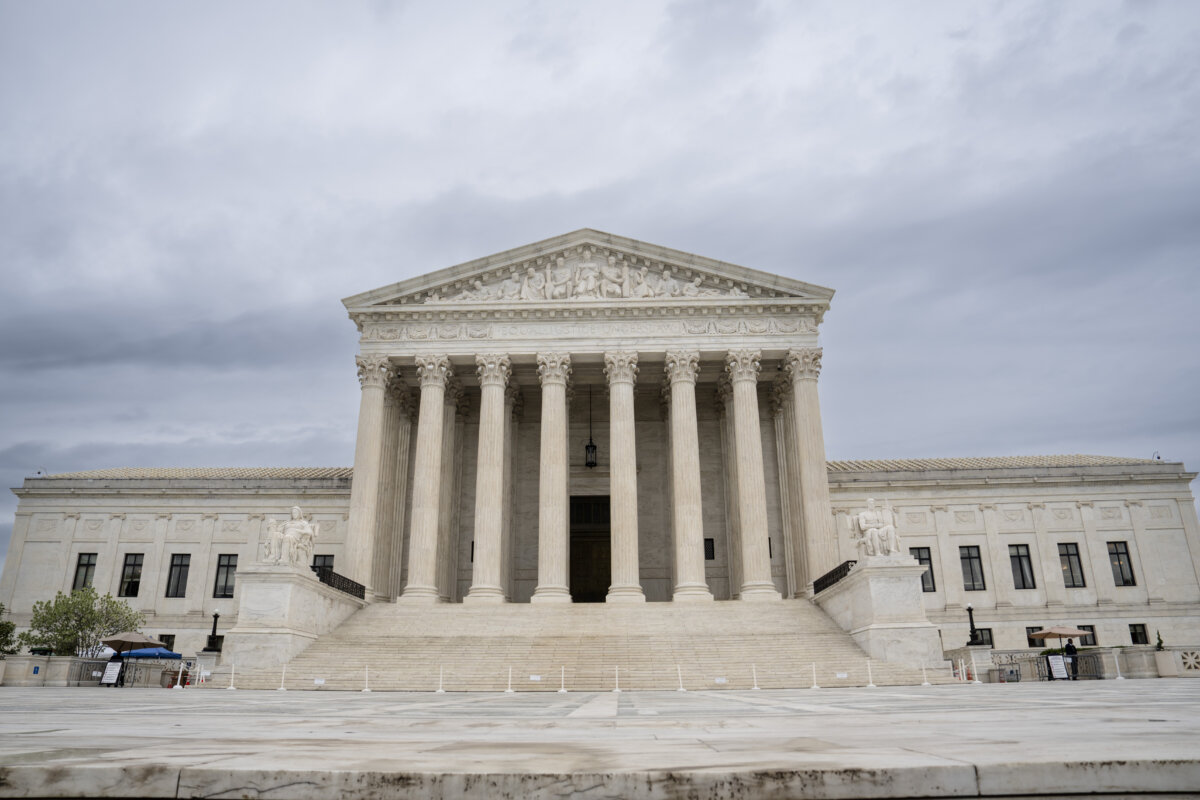

Virginia Democrats asked the U.S. Supreme Court on May 11 to block a Virginia Supreme Court ruling that invalidated the state’s voter-approved congressional map that gave Democrats a massive advantage.
“A stay is warranted because the decision by the Supreme Court of Virginia is deeply mistaken on two critical issues of federal law with profound practical importance to the Nation,” Don Scott, speaker of the Virginia House of Delegates, wrote in the filing.
“The decision below violates federal law in two separate ways. First, it predicated its interpretation of the Virginia Constitution on a grave misreading of federal law, which expressly fixes a single day for the ‘election’ of Representatives and Delegates to Congress.”
The Supreme Court has called for a response by May 14 at 5 p.m. ET.
The case thrusts Virginia into an unusual, mid‑decade redistricting showdown, as courts weigh whether lawmakers can remake House districts outside the normal post‑census cycle—with control of a narrowly divided Congress potentially hanging in the balance.
Virginia’s top court on May 8 threw out a new electoral map that had been crafted to flip four Republican-held U.S. congressional seats to Democrats, dealing a setback to Democratic hopes of retaking the U.S. House. Republicans also hold a majority in the U.S. Senate.
In a 4–3 decision, the Virginia Supreme Court rejected a Democratic-backed ballot measure approved by voters in April that reconfigured the state’s U.S. House map for partisan advantage.
Ruling in favor of a Republican challenge, the court’s majority found that Democratic lawmakers had not followed proper procedure last year when they rushed to approve the referendum in time to reach the ballot ahead of the November 2025 vote.
The Virginia Democrats, led by Scott, told the justices in a filing that the state court’s ruling has “deprived voters, candidates, and the Commonwealth of their right to the lawfully enacted congressional districts.”
The lawmakers cited a 2023 Supreme Court ruling that warned that state courts “may not transgress the ordinary bounds of judicial review such that they arrogate to themselves the power vested in state legislatures to regulate federal elections.”
In a process called redistricting, the boundaries of legislative districts across the United States are reconfigured to reflect population changes as measured by the national U.S. Census every 10 years. Redistricting traditionally has been carried out by state legislatures at the start of each new decade.
In the unusual mid-decade redistricting fight, Republicans now hold a clear advantage. The tit-for-tat battle began last year, when Trump pushed Texas Republicans to draw new district lines that aim to flip up to five Democratic-held seats to Republicans.
Democrats suffered a major blow when the U.S. Supreme Court struck down a key provision of the 1965 Voting Rights Act in a 6–3 ruling, opening the door for Republican-led states to redraw Democratic-held majority-black and majority-Latino districts.
Reuters contributed to this report.
 Friends Read Free
Copy
Facebook
Tweet
Friends Read Free
Copy
Facebook
Tweet