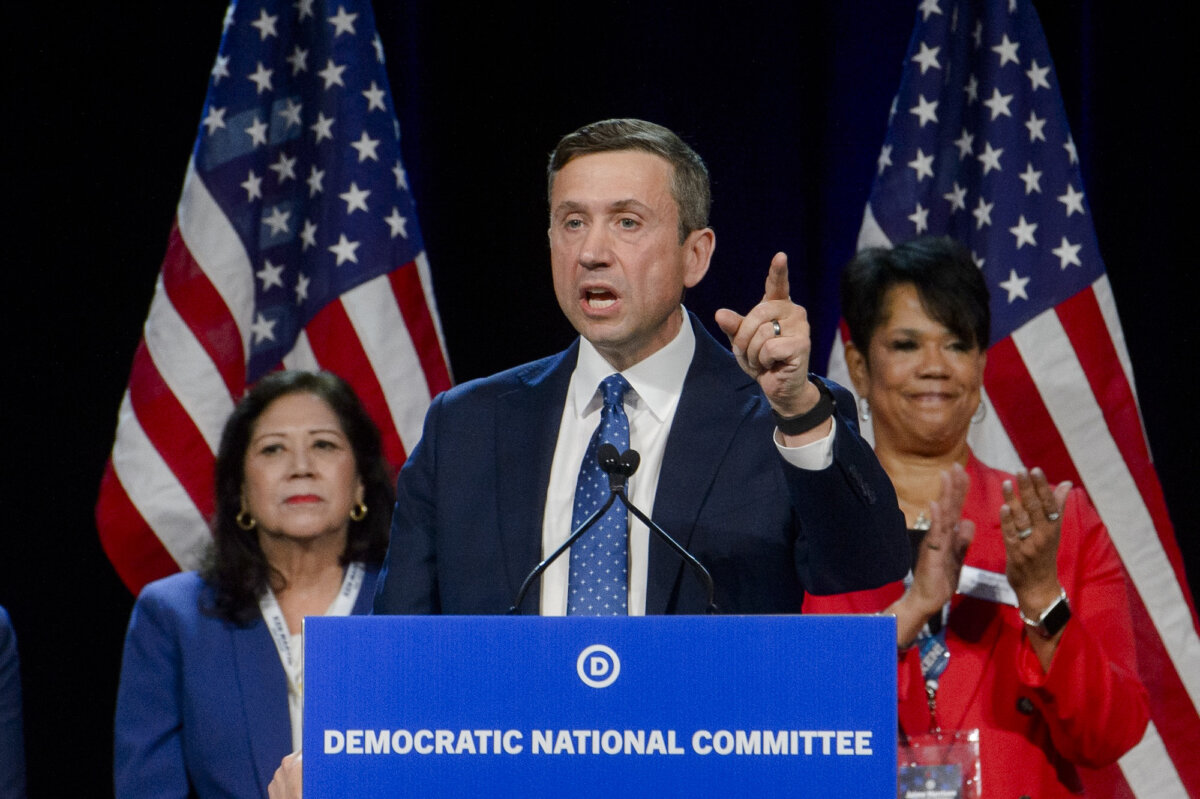

The Democratic National Committee is shifting resources into year-round organizing and voter registration while increasing monthly support for every state party, DNC chair Ken Martin said in a Sept. 30 conversation with former chair Jaime Harrison recorded at DNC headquarters.
“We just kicked off this week, our partisan voter registration drive,” Martin said.
He and Harrison both argued that the party stepped back from direct registration for two decades after the 2002 McCain–Feingold Act.
According to Cornell’s Legal Information Institute, this law meant national parties could no longer use unlimited donations to pay for voter registration or other party-building. Parties could still run registration drives, but they had to pay with money raised under the normal per-donor limits and publicly report the spending.
Because that pool is smaller, much of the work shifted to neutral nonprofits that can register people but can’t promote a party or candidate under the rules, something both men were critical of in the conversation.
Martin says the DNC has now outlined a strategy that allows party staff and volunteers to register voters and talk about Democratic candidates at the same time.
Martin also detailed an emphasis on new monthly transfers to state-level parties.
“So the red states are critical to this, because you’re never going to turn a red state purple to blue without an investment of time, energy, and money,” Martin said. “And so what we’re doing right now is every red state is going to get $22,500 a month, which is significant, and every other state is going to get $17,500 a month.
“In addition, the territories for the first time ever are going to be on equal footing with the rest of their state party counterparts.”
He said the DNC must compete beyond the limited scope used in recent cycles.
“In 2000, I helped run Al Gore’s campaign in Minnesota, and we had something like 20 battleground states that year,” Martin recalled. “In 2004, I ran Senator Kerry’s campaign in Minnesota, and we had, I think, around 16 battleground states. We’re now down to seven battleground states, and what that functionally means is that the largest of our investment goes to those seven battlegrounds.”
The goal, he said, is a “majority party strategy” that can win in 2025 and 2026 while laying groundwork for 2030 and 2032.
Year-round field work is central to that plan. Martin said Democrats cannot “wait until three months before an election to start having conversations with voters,” noting the committee launched organizing earlier than in past cycles and is pushing constant outreach rather than build-and-tear-down operations.
He linked the push to population shifts. Citing growth in the South, Martin said future paths to the presidency and congressional control will run through states that have not been consistent targets. He argued investment must start now, not “seven years” from now, if Democrats expect to compete there at scale.
Martin also emphasized support for state and local parties as the backbone of the plan. He credited earlier increases under Harrison and said the DNC is trying to “take something off the plate” of candidates so campaigns are not forced to rebuild from scratch each cycle. He said he has visited 32 states in his first seven months.
Alongside the operational reset, Martin urged Democrats to use power more aggressively if they regain full control in Washington. “We … better make sure that D.C. is a state, that Puerto Rico is a State, that we eliminate the filibuster rule,” he said, adding later on, “We can’t be the only party with one hand tied behind our back.”
Those comments highlight an internal debate over Senate rules and statehood that has divided Democrats in the past and has faced opposition from Republicans. Martin said that the stance is a response to years of stalled priorities and that voters expect results when a party wins.
The chair also previewed a showcase meant to rally activists and lift down-ballot candidates before the midterms. He said the Democratic Party will have a midterm convention, describing a weeklong event to highlight party values and the 2026 slate.
Harrison pressed Martin on morale and messaging. Martin said he sees an opening if Democrats pair steady organizing with a simple promise to help people “get ahead in life,” backed by policies that lower household costs.
Martin also returned to on-the-ground concerns as opposed to a change in messaging throughout the conversation to register voters, keep staff on the ground, and fund the state parties.
“We might win an election, but we won’t win the future” without a wider electoral map, Martin said. The committee’s plan, he added, is to keep the government-level fights in view while rebuilding the parts of the operation that talk to voters every day.
 Friends Read Free
Copy
Facebook
Tweet
Friends Read Free
Copy
Facebook
Tweet