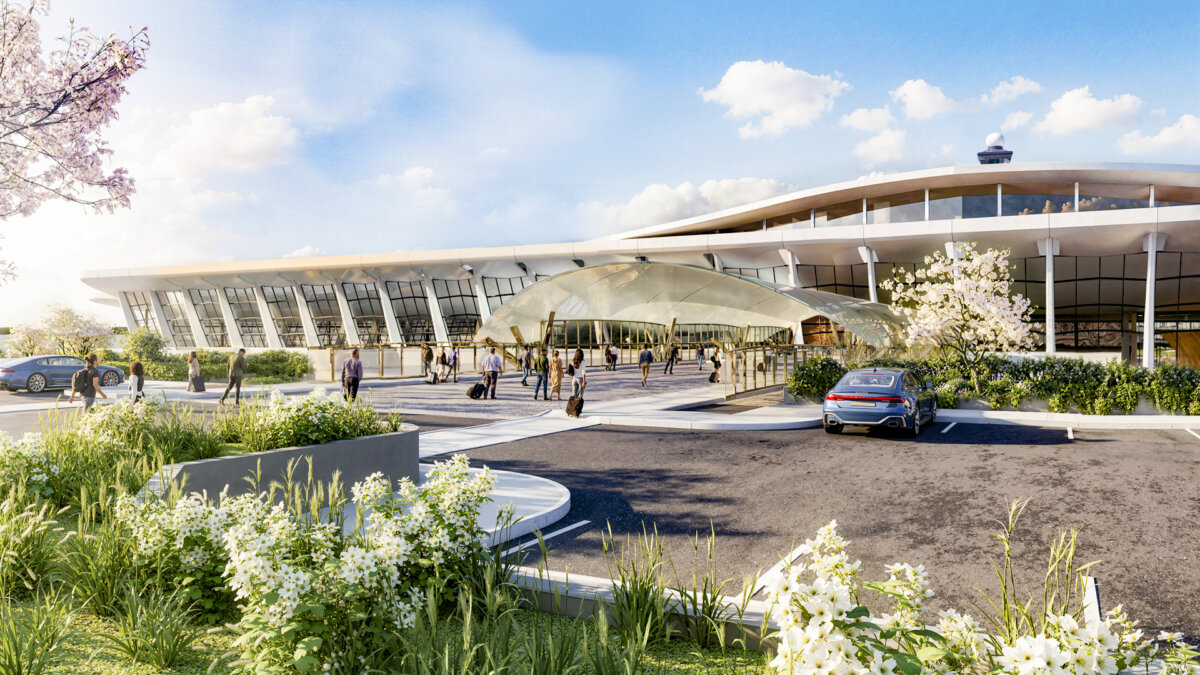

The authority that runs Dulles International Airport approved plans on Aug. 19 to spend an additional $15.5 billion on an overhaul being advocated by the Trump administration.
Construction is scheduled to run from late next year into the 2040s.
The board of directors of the Metropolitan Washington Airports Authority (MWAA) voted on Aug. 19 to adopt the proposal to remake the airport, which has been promoted by President Donald Trump and Secretary of Transportation Sean Duffy.
Dulles Airport, which opened in 1962, is one of three key air hubs that serve the Washington area. It reported that 29 million travelers passed through in 2025, an increase of 6.4 percent year-over-year, which was the fastest growth among the nation’s largest airports.
The new funding adds to the $4.4 billion in spending already approved by the MWAA board, bringing the total budget for the long-term renovation projects to just less than $20 billion.
Renovations are planned for five different sections of the airport, with some projects scheduled to overlap.
Featured prominently among the upgrades is the eventual retirement of the giant vehicles, often called “people movers,” that have transported millions of passengers across the tarmac from Concourses A and B to Concourses G and H.
The vehicles will be replaced by automated inter-terminal trains running through new tunnels.
Duffy announced the change on X with a video featuring one of the people movers growing wings and flying away to Sarah McLachlan’s song “In the Arms of an Angel.”
“Farewell to the legendary Dulles People Mover (1962–2026). Was it a bus? Was it a train? Nobody knew. Thankfully, your service will no longer be needed,” Duffy wrote.
The part of airport construction that would trade the aged trade movers for trains has an estimated cost of $3.75 billion, according to the MWAA board-approved proposal.
Other projects include the renovation of the main terminal at a cost of $6.2 billion, build-outs of Concourses G and H at $3.7 billion, and the demolition of Concourses C and D to be replaced by a much larger Concourse B at $2.26 billion.
White House spokesman Kush Desai said that when complete, the projects will ensure that the “gateway to our nation’s capital properly reflects American Greatness.”
Who Pays the Bill?
There is the question of who will pick up the tab. The MWAA has stated that it plans to issue revenue bonds, to be paid back from future earnings rather than obligation bonds, because the MWAA has no taxing authority.
Bonding is a common way airports finance capital projects. However, the scope of the Dulles project is more ambitious than most. Hartsfield-Jackson Atlanta International Airport is currently considering a $1.1 billion bond, which is considered large by industry standards.
“They’re proposing to do some good things at exorbitant cost,” Marc Scribner, a transportation policy analyst for the Reason Foundation, told The Epoch Times.
The Epoch Times reached out to the Department of Transportation and MWAA for more information on the financing plans but did not receive a reply by publication time.
Previously, Duffy held forth on some of the benefits of the renovation, including the “hundreds of new flights” that will help to spread out the project costs.
Some unspecified grants baked into the board-approved proposal account for about $150 million, which accounts for 1 percent of the additional spending authorized on Aug. 19.
If other sources of funding are unavailable, it will be Dulles passengers who are on the hook for the bulk of this, Scribner said, expressing concerns about potentially higher cost per enplanement.
Enplanement charges—such as landing fees, terminal rents, and gate charges—currently run less than $13 per passenger per trip.
Dulles plans to hike that, with MWAA President and CEO Jack Potter telling board members during an Aug. 19 committee meeting that charges are projected to increase to between $60 and $65 over the 12 to 15-year life of the project, local WTOP News reported. He refuted reports projecting an increase to $90.
Scribner said he hopes that the MWAA will “look at private financing options” to find a way to taxi around that.
 Friends Read Free
Copy
Facebook
Tweet
Friends Read Free
Copy
Facebook
Tweet