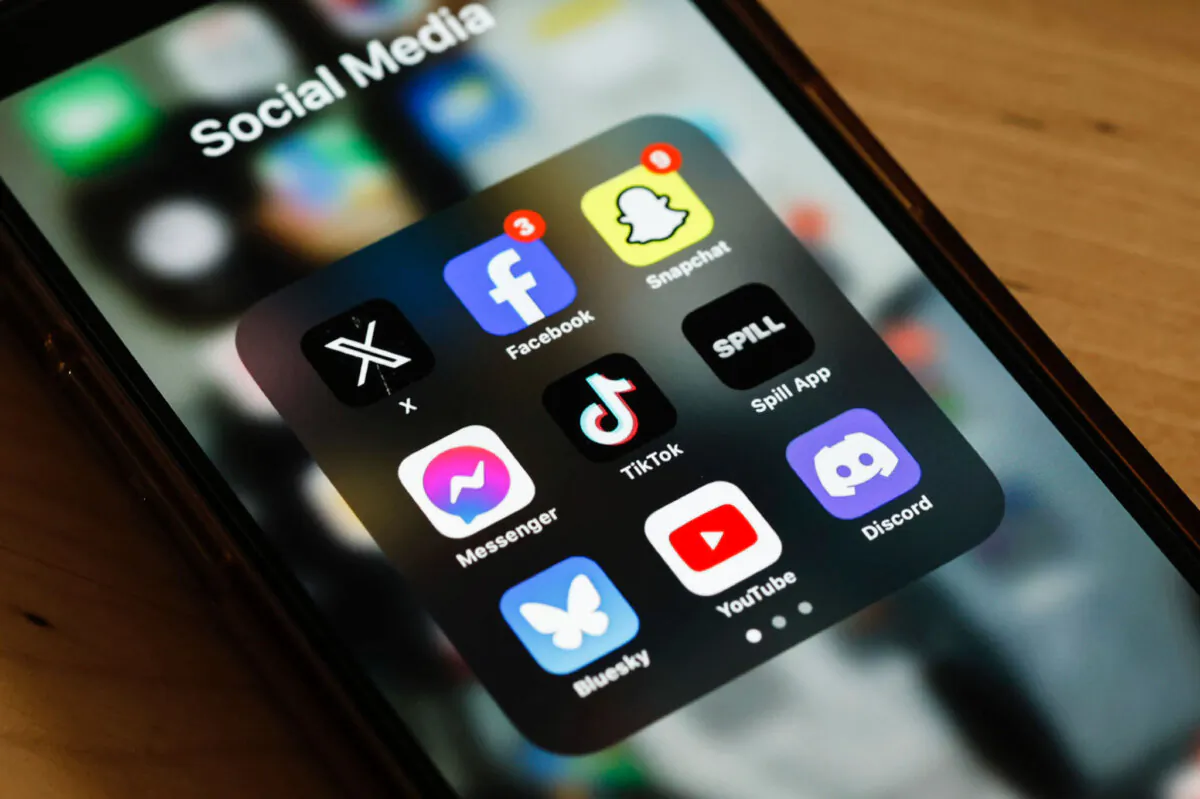

A federal judge has blocked Florida from enforcing major provisions of its 2024 law, which aims to curb social media addiction in young children by keeping them off those platforms.
In a June 3 order, Chief U.S. District Judge Mark Walker of the Northern District of Florida granted a preliminary injunction, siding with tech industry groups who argue the law is unconstitutional.
While acknowledging that parents and lawmakers have “sincere concern” about social media’s impact on children, Walker emphasized that the Florida law is not “narrowly tailored” enough to meet First Amendment standards, which he said empower parents to police their children’s social media use but set a high legal bar for governments to limit people’s access to social media.
“An established principle in the First Amendment context is that enabling individuals to voluntarily restrict problematic content at the receiving end is preferred over restricting speech at the source,” Walker wrote in a 58-page opinion.
“In this context, that means that parents are best positioned to make the appropriately individualized determinations about whether or when their children should use social media platforms, and if so, which platforms and under what conditions.”
The law in question would ban children under 14 from creating social media accounts, although it would allow 14- and 15-year-olds to join with parental consent. It would also require social media platforms to remove children’s accounts if requested by parents.
“Social media harms children in a variety of ways,” Florida Gov. Ron DeSantis said when he signed the law last March, saying that the legislation “gives parents a greater ability to protect their children.”
The law does not name any specific platform, but its criteria related to “addictive features” such as infinite scrolling, push notifications, and auto-play video would at least apply to Facebook, Instagram, YouTube, and Snapchat, according to Tuesday’s opinion.
The preliminary injunction is sought by the tech industry groups NetChoice and the Computer and Communications Industry Association, whose members include Meta, Google, and Snapchat owner Snap Inc.
“Like all Americans, Floridians have the right to access lawful speech without the government controlling what they say, share or see online,” Chris Marchese, director of NetChoice’s legal arm, said in a statement. “This decision marks a critical win not only for Floridians but also for preserving the vibrant marketplace of ideas online.”
The groups sued Florida last October. In March, Walker denied their initial request for a preliminary injunction, finding they had not established legal standing. The groups then submitted a revised complaint that no longer challenged the provision requiring platforms to remove a child’s social media account upon parental request.
In Tuesday’s opinion, Walker clarified that the state may still enforce that specific portion of the law.
“This Court simply recognizes that the First Amendment places stringent requirements on the State to avoid substantially burdening speech unless the State can show that doing so is necessary to achieve its significant interests,” the judge wrote.
The law was originally set to take effect Jan. 1, but the state agreed in November to pause enforcement while Walker considered the initial request for a preliminary injunction.
After Walker denied that request, Florida Attorney General James Uthmeier sued Snap Inc. for allegedly violating the 2024 law. That case is also pending before Walker.
The state is expected to appeal Tuesday’s decision to the Eleventh Circuit Court of Appeals. However, Walker has made clear in his opinion that he will not pause the injunction while the appeal proceeds.
The Epoch Times has reached out to Uthmeier’s office for comments.
 Friends Read Free
Copy
Facebook
Tweet
Friends Read Free
Copy
Facebook
Tweet