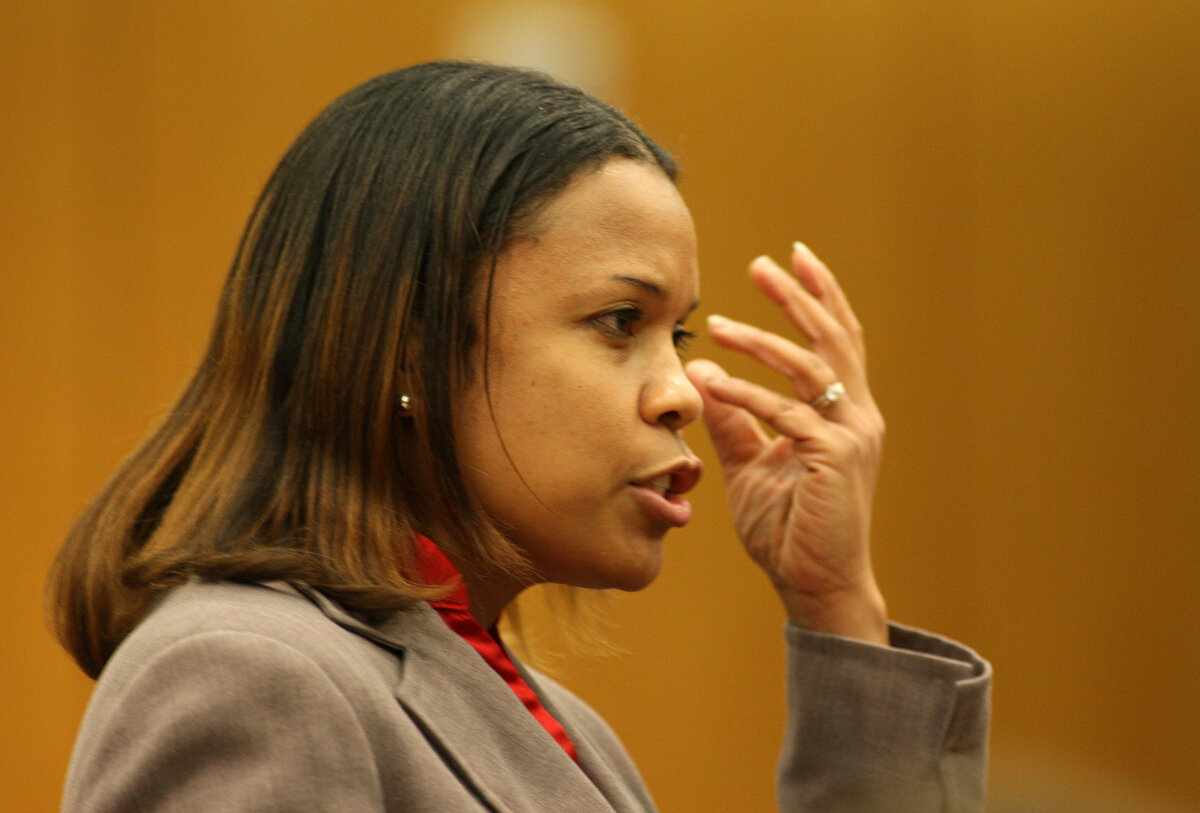

A federal judge in Georgia has formally recused herself from a federal election records case after the U.S. Department of Justice (DOJ) sought her voluntary ouster from the legal proceeding.
U.S. District Judge Eleanor Ross signed the order June 15, but it became public on June 16.
The DOJ had argued that Ross’s attendance at a political event in 2024 for Fulton County District Attorney Fani Willis, who prosecuted President Donald Trump for allegedly interfering with the 2020 presidential election, created the appearance that the judge was biased against Trump.
In December 2024, the Georgia Court of Appeals disqualified Willis from that state-level prosecution amid allegations of “an appearance of impropriety” related to her relationship with her former special counsel in the case, Nathan Wade.
The Georgia Supreme Court declined to review the ruling, leaving the disqualification intact. A replacement prosecutor then dismissed the remaining charges against Trump and his co-defendants in November 2025.
DOJ attorneys filed a notice with Ross on June 15 indicating that if she did not rule on the recusal motion by 5 p.m. on June 17, they planned to lodge a petition with the U.S. Court of Appeals for the 11th Circuit to compel her removal from the case.
Ross was nominated by President Barack Obama, a Democrat, and confirmed by the U.S. Senate in November 2014.
The DOJ filed the underlying lawsuit under the federal Civil Rights Act of 1960 to obtain the unredacted statewide voter registration list from Georgia Secretary of State Brad Raffensperger. The department has said it needs the list to investigate the state’s compliance with the voter list maintenance requirements established under two federal statutes—the National Voter Registration Act and the Help America Vote Act.
Trump, a Republican, has long alleged that election improprieties in Georgia contributed to his loss in that state in the 2020 presidential election.
In its recusal motion, the DOJ said Ross should remove herself from the case because of reports identifying her as a federal judge who was privately reprimanded by the 11th Circuit for attending what investigators described as a partisan political event connected to Willis.
Without identifying Ross by name, a judicial council found that a judge ran afoul of judicial conduct rules by attending what it called a campaign event for a Democratic district attorney candidate who was “best known for prosecuting a Republican President” over alleged interference in the 2020 election. Her attendance, confirmed by media reports, could undermine public confidence and leave an appearance of bias in the Trump administration’s lawsuit, the motion said.
In her new order, Ross said the apparent connection between her and Willis could make people think she shares Willis’s views on election-related matters.
Ross acknowledged the second argument the DOJ made in its motion, which was that a reasonable observer would interpret her attendance as “an endorsement of Willis’s actions while in office,” and question her impartiality to decide “a case in which [Trump’s] Department of Justice seeks voter rolls in an effort to ensure election integrity.”
The court “concludes that recusal is appropriate for the second reason the United States advances,” she wrote.
Ross wrote that although the judicial council said her attendance at the Willis campaign event may have “only [been] for the purpose of reuniting with former colleagues,” she could not “discount the potential” that “an objective observer [could] perceive that the undersigned supports Willis’ position.”
“Therefore, out of an abundance of caution for the potential perception of bias, the undersigned will disqualify herself from further proceedings in this case,” she wrote, quoting a Supreme Court precedent that said, “What matters is not the reality of bias or prejudice but its appearance.”
Separately, Ross was reprimanded by the 11th Circuit Judicial Council last week for conducting an extramarital affair with a high-ranking law enforcement officer in her judge’s chambers within earshot of staff. She sent letters to several of her former law clerks apologizing for what she described as her “harmful, offensive, and unprofessional behavior.”
Tom Gantert, Jack Phillips, and Reuters contributed to this report.
 Friends Read Free
Copy
Facebook
Tweet
Friends Read Free
Copy
Facebook
Tweet