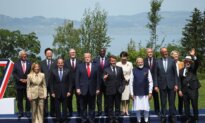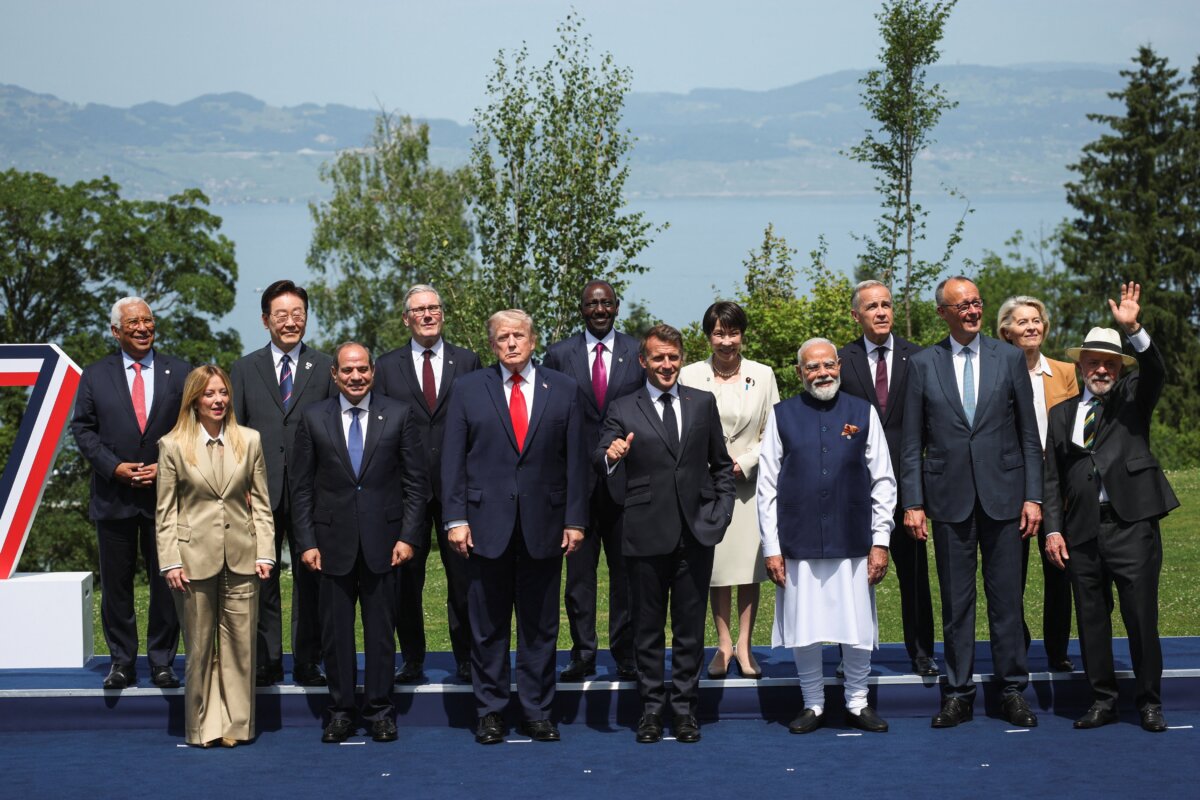
GENEVA—U.S. President Donald Trump participated in a series of high-level meetings on June 16, the first full day of the summit of the G7 group of leading industrial nations in Évian-les-Bains, a lakeside town in eastern France.
He joined a roundtable discussion with Ukrainian President Volodymyr Zelenskyy and held bilateral meetings with the leaders of Qatar and the United Arab Emirates to discuss the Iran deal and the situation in the Middle East.
The day’s program concluded with a cultural performance and a social dinner.
Here are key takeaways from the first day of the summit, which focused on Iran and Ukraine.
Trump Defends Iran Deal
Throughout the day, the U.S. president defended the Iran agreement, brushing aside doubts that the memorandum of understanding (MOU) had achieved little.
“Iran will never have a nuclear weapon, and it says it loud and clear,” Trump said during a press appearance with Qatar’s Emir Sheikh Tamim bin Hamad Al Thani on the sidelines of the G7 summit.
“They’re not going to develop it, they’re not going to buy it, and they’re not going to do anything with it. And if they do, they suffer unbelievable consequences.”
Trump did not say what the United States would do if Tehran violated the agreement.
“I won’t even tell you the consequences, but the consequences are the ultimate consequences,” he said.
After U.S. officials outlined the deal’s terms on June 15, critics voiced their concerns on television and online, saying that the MOU merely secured a 60-day reopening of the Strait of Hormuz and nothing more.
In Congress, the president’s opponents and some of his allies responded with skepticism.
“I am somewhat concerned that Iran’s view of the agreement seems different than what the American negotiating team is claiming,” Sen. Lindsey Graham (R-S.C.) wrote on X on June 14.
He noted that U.S. law requires any nuclear deal with Iran to be sent to Congress for review and a vote.
When asked whether Tehran could immediately begin selling oil under the MOU, a senior U.S. official told The Epoch Times: “This is a performance-based agreement. Iran can only access any benefits of the MOU if they abide by all of the points they agreed to.”
The official stated that Tehran must prove that it is meeting all its obligations, including not developing nuclear weapons, neutralizing its enriched material, and allowing ships to move freely through the Strait of Hormuz.
All Eyes on Trump
Iran’s closure of the Strait of Hormuz during the war has disrupted the global energy markets. The European Union was hit hard by the conflict, which raised fears of stagflation, meaning high inflation and low economic growth in many countries of the bloc.
Before meeting with Trump, French President Emmanuel Macron expressed optimism about the reopening of the waterway during a television interview with TF1 on June 15.
“I don’t want to get into the details and there are some appendices that will be finalized on [June 19],” Macron said, referring to the MOU.
He said the international community must ensure that it becomes “a lasting reality.”
The French leader also said he hoped that there would be no tolls on the Strait of Hormuz and that oil prices would not rise again.
Brent and WTI oil prices continued to fall on June 16, reaching their lowest levels in three months.
It is unclear how much of the agreement details Trump shared with other G7 leaders during his meetings on the second day of the summit.
When asked about the details of the MOU, Trump told reporters that he preferred to have “a formal setting” to announce the deal soon.
“I’ll probably have a press conference and read it to you word by word, so that the press covers it accurately,” he said.
Meeting With Zelenskyy
Trump said he wants to focus on Ukraine now, saying that Iran will soon be “back in the rearview mirror.”
“We had a very good meeting,” Trump told reporters after a roundtable with Zelenskyy and other G7 leaders. “Russia should make a deal. Russia has lost tremendous amounts of people and so has Ukraine.”
Before the roundtable, Trump also held a private discussion with Zelenskyy.
“I’m going to do whatever I can,” Trump said, referring to ending the war in Ukraine.
When asked whether he would increase sanctions on Russia, Trump said the United States could reinstate sanctions now that the Strait of Hormuz is reopened.
“Soon we’ll be able to do that, because the oil is now flowing,” Trump told reporters during a bilateral meeting with Emirati President Sheikh Mohamed bin Zayed Al Nahyan on the sidelines of the G7 summit.
“We took sanctions off because obviously we’re not looking to impede the U.S., so we’re in a position to do that soon,” Trump said.
Washington eased sanctions on Russia in March, permitting purchases of Russian seaborne oil to address the energy supply shortage caused by the war in Iran.
The Treasury Department later extended the sanctions waiver, which is set to expire on June 17.
Tom Ozimek contributed to this report.
 Friends Read Free
Copy
Facebook
Tweet
Friends Read Free
Copy
Facebook
Tweet