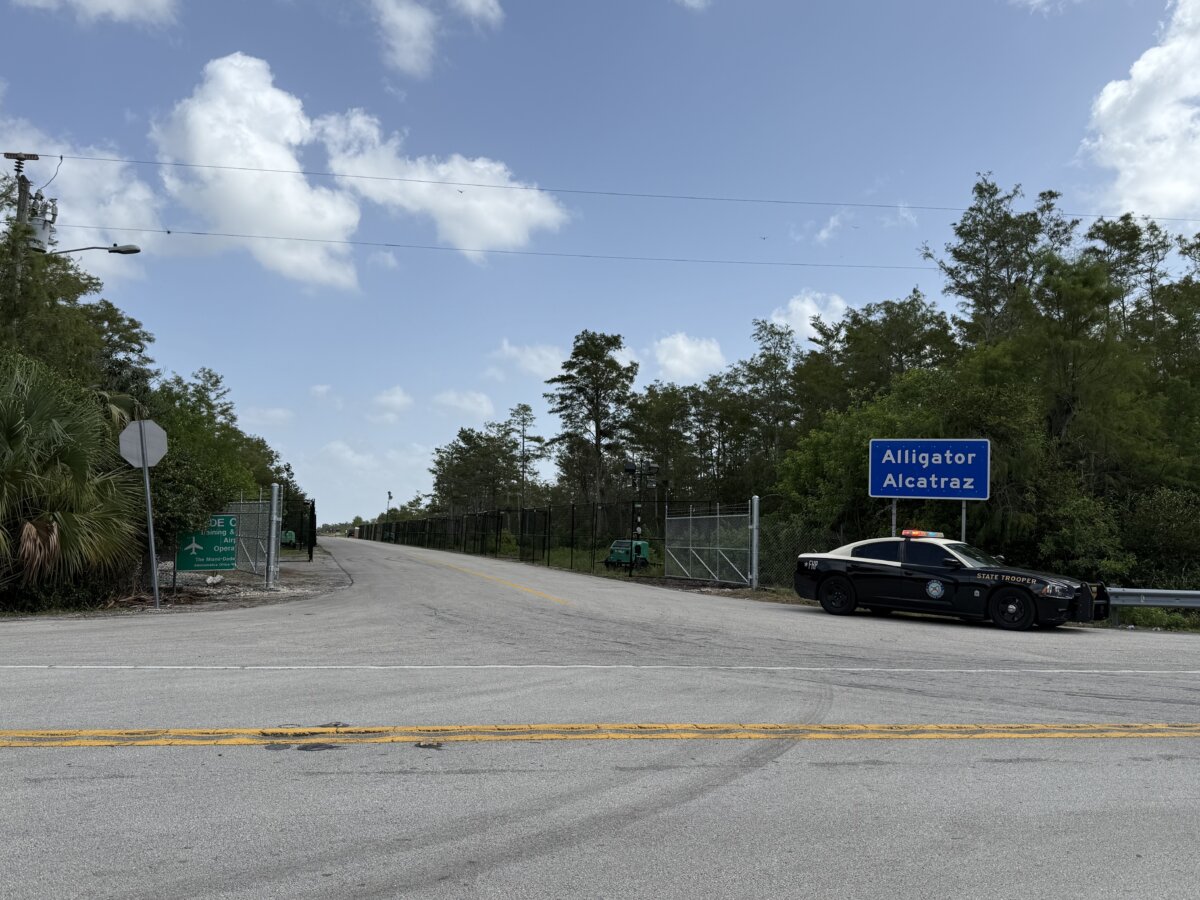

A federal judge on Aug. 7 ordered a temporary halt to any further development at Florida’s “Alligator Alcatraz” immigration detention center.
District Judge Kathleen Williams of the U.S. District Court for the Southern District of Florida ordered that workers be prohibited from adding any new developments to the facility—such as new filing, paving, or infrastructure—for the next 14 days. The facility will continue to operate and hold Immigration and Customs Enforcement detainees in the meantime.
Florida’s all-in-one detention, processing, and deportation facility for illegal immigrants, built on the Dade-Collier Training and Transition Airport, opened on July 1, eight days after state officials said development began.
Development plans were proposed and executed by the Florida Division of Emergency Management under executive director Kevin Guthrie, who used emergency powers granted to him by Gov. Ron DeSantis after they were greenlit by Homeland Security Secretary Kristi Noem.
Using temporary structures rated to withstand a Category 2 hurricane, the facility was built solely on pre-developed land, and instead of expanding the footprint, operators relied on a stream of trucks to bring in fuel and potable water and dispose of all waste.
In order to expedite construction, Florida’s state government took over the facility from Miami-Dade County after efforts to buy the airstrip outright before construction failed.
Friends of the Everglades and its coplaintiffs alleged in their lawsuit that development of the area had skipped a mandatory review process and that “very little information” had been provided to the public.
“This project has been rushed through with zero analysis of the impacts of all the vehicles and the thousands of people that will be detained or work on the site,” co-counselor Alisa Coe from Earthjustice said during a news conference on July 1.
Four counts were filed against the county, state, and federal defendants over the rapid construction and operation of Alligator Alcatraz. According to the plaintiffs, the defendants violated the Administrative Procedure Act by failing to undergo a judicial review of their actions and violated the National Environmental Policy Act by failing to issue an Environmental Impact Statement and provide time for public comment.
The state and federal defendants rebuked the plaintiffs’ claims, stating that Florida acted on its own to plan and develop the site with its own funds upfront, using state emergency powers and pre-established federal immigration authority.
The defendants denied that any federal funding has been paid to Florida for the construction of the facility, and argued that state agencies are not subject to the National Environmental Policy Act or the Administrative Procedure Act. They said the plaintiffs have not shown evidence that the facility will cause harm.
The judge said on Aug. 7 that Alligator Alcatraz was at a minimum a joint partnership between the federal and state governments.
The Associated Press contributed to this report.
 Friends Read Free
Copy
Facebook
Tweet
Friends Read Free
Copy
Facebook
Tweet