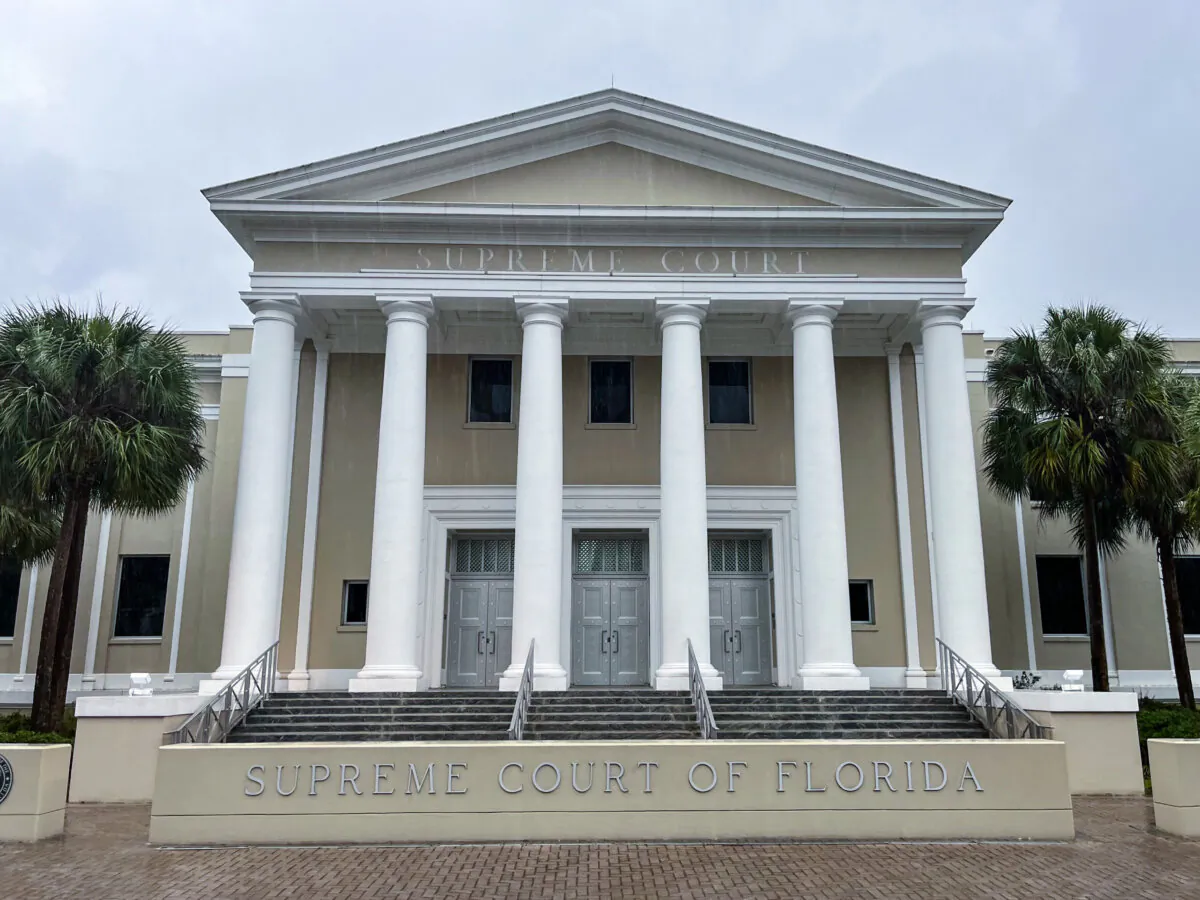

Florida has become the second state to no longer require aspiring lawyers to hold degrees from law schools accredited by the American Bar Association (ABA).
The Florida Supreme Court, which sets standards for admission to the bar, said on Jan. 15 that the state should move away from a system in which students cannot take the bar exam—the gateway to practicing law—unless they graduate from an ABA-accredited law school.
Specifically, the court said that in addition to the ABA, it will now recognize any accrediting agency approved by the U.S. Department of Education for legal education. With the high court’s approval, Florida may start reaching out to alternate accreditors starting in October.
For now, though, the ABA remains the only federally recognized accreditor for law degrees.
“The rule changes create the opportunity for additional entities to carry out an accrediting and gatekeeping function on behalf of the Court,” the majority opinion reads. “The Court’s goal is to promote access to high-quality, affordable legal education in law schools that are committed to the free exchange of ideas and to the principle of nondiscrimination.”
Justice Jorge Labarga was the lone dissenter. In a dissenting opinion, he said the ABA “has developed incomparable expertise in the accreditation process” and “has cultivated unmatched proficiency in dealing with Florida law-school-specific issues that would require decades for any successor to develop.”
“As is the case with any large entity engaged in providing service to the public, refinements can always be made,” he concluded. “However, replacing an established entity with an unknown alternative is detrimental in the context of disputes.”
Florida Gov. Ron DeSantis praised the court’s decision as a “good move” in a post on X.
“The (highly partisan) ABA should not be a gatekeeper for legal education or the legal profession,” he wrote.
Florida Attorney General James Uthmeier echoed that view, calling the ruling a “good start” toward breaking the ABA’s grip on who gets to take the state’s bar exam.
The Texas Supreme Court made a similar decision earlier in January, but took a different approach by appointing itself as the primary accreditor of law schools in the Lone Star State. The high courts of Ohio and Tennessee are also weighing steps to reduce the ABA’s oversight of lawyers in their states.
In response to a request for comment, the ABA stressed that the Florida ruling simply means that the Supreme Court “acknowledges that other accreditors may also be recognized in the future.”
The association added that its Council of the Section of Legal Education and Admissions to the Bar “will continue to improve its standards and promote the benefits of a national accreditation system for students, employers, law schools and the states themselves.”
Over the past year, the ABA has come under increasing criticism as the federal government has waged a campaign against diversity, equity, and inclusion (DEI) initiatives in both the public and private sectors, which the Trump administration has characterized as “illegal and immoral discrimination.”
At the center of the criticism is an accreditation standard that calls on law schools to demonstrate “a commitment to diversity and inclusion.” Critics say the standard effectively forces a DEI agenda into legal education.
In an February 2025 letter to ABA leadership, U.S. Attorney General Pam Bondi called the standard unconstitutional and urged the organization to strike it down immediately and entirely. If the ABA does not eliminate its DEI standard, she warned, the organization could face punitive action from the U.S. Department of Justice and risk losing its status as an accrediting body.
“Even without an explicit mandate requiring law schools to actually have diverse faculties and student bodies, any requirement that law schools demonstrate ‘a commitment to diversity’ is deeply problematic,” Bondi wrote.
The ABA has since put enforcement of the standard on pause until August 2025. As criticism has intensified, the ABA said in November that it was launching a “core principles review” that will include an assessment of its standards for law schools.
The review “will focus on identifying any standards or rules that need to be changed to better align with our core principles and values,” David Thies, chairman of the ABA’s Council of Legal Education and Admissions to the Bar, said at the time.
It is also aimed at ensuring “that our existing standards do not unnecessarily impose burdens or cost, but rather allow sufficient flexibility to allow law schools to appropriately innovate, while still ensuring a baseline of quality,” according to Thies.
 Friends Read Free
Copy
Facebook
Tweet
Friends Read Free
Copy
Facebook
Tweet