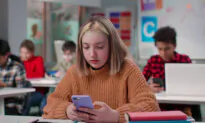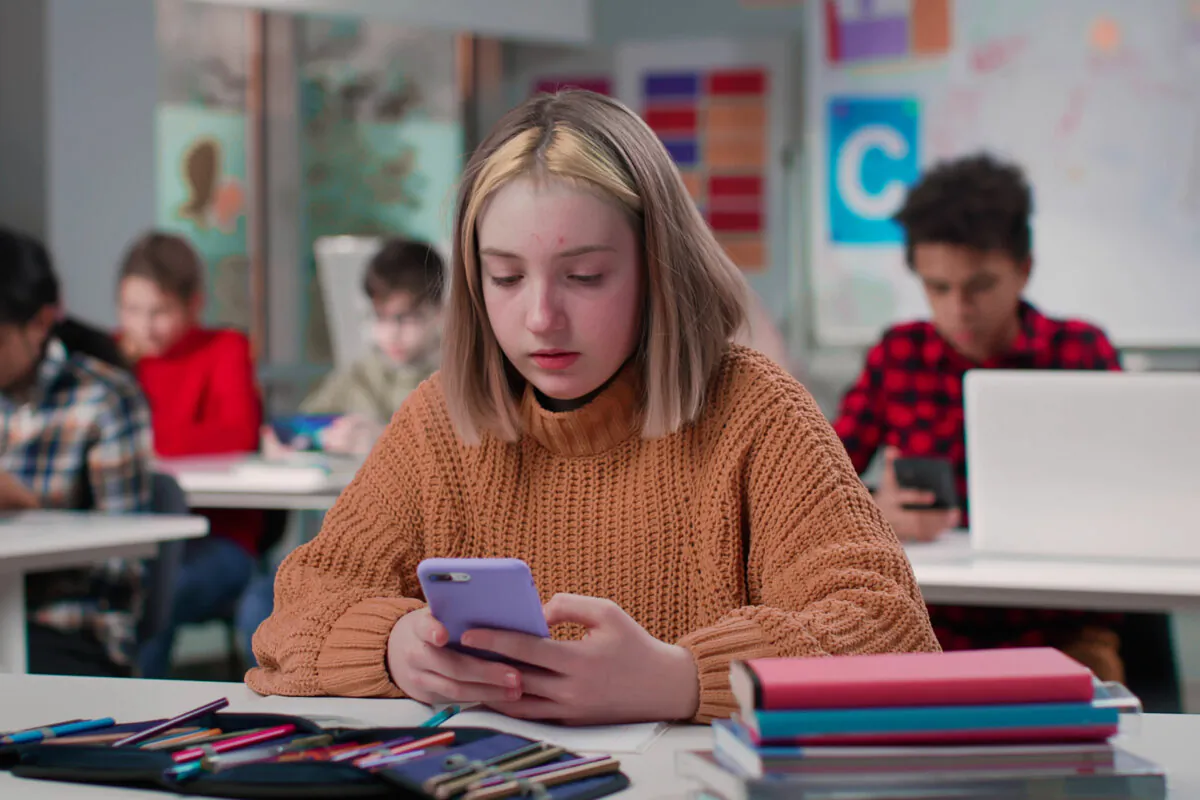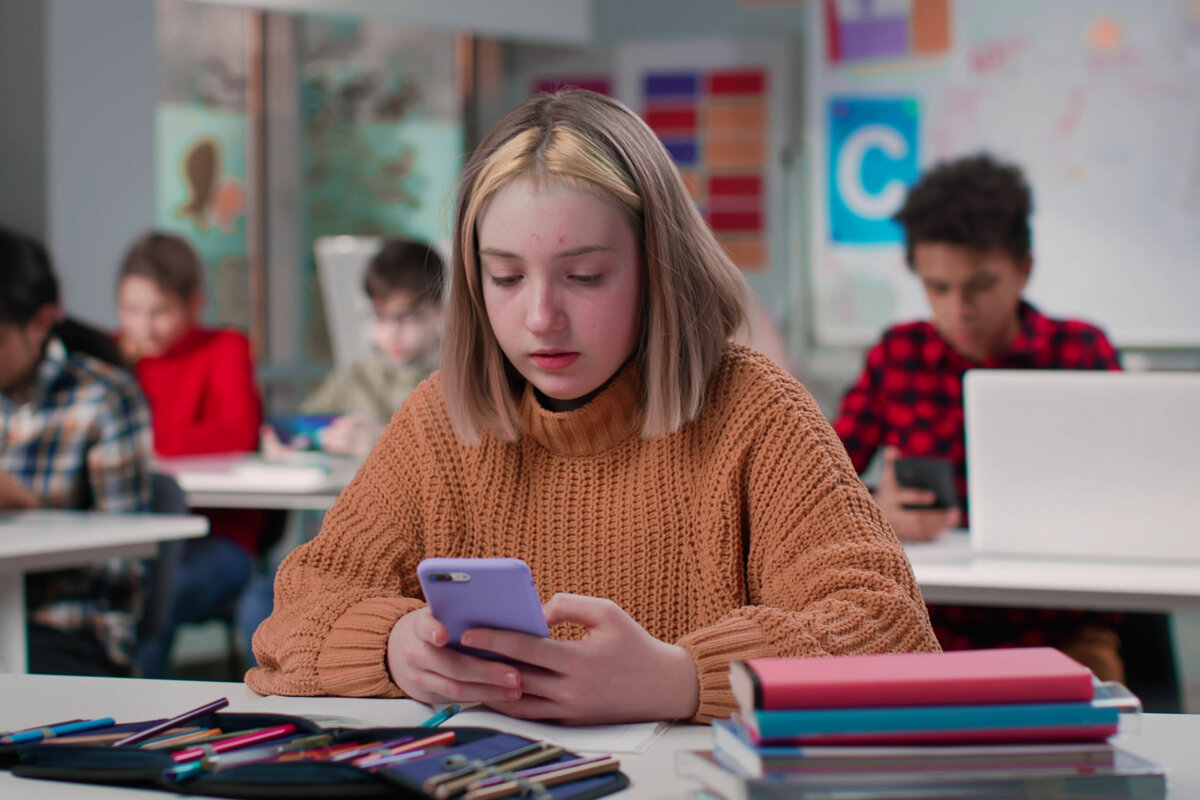

Preliminary research on the Sunshine State’s cell phone ban in public schools indicates mostly positive results.
The study, conducted by the RAND Corporation and the University of Rochester and published by the National Bureau of Economic Research earlier this month, indicates a slight increase in Florida’s test scores, as well as a reduction in unexcused absences.
Florida’s law, a bell-to-bell ban in addition to restrictions on social media use on school-issued devices, took effect in May 2023 and served as a model for legislation that other states implemented. The research covers two academic years.
The findings are encouraging for the 29 other states that restrict cell phones in public schools, as a national survey of teachers and school administrators will conclude in July.
Many students resisted the new policy in its first year, the Florida study found. In 2023–2024, the in-school suspension rate increased by 20 percent and the out-of-school suspension rate by 12 percent, but both rates declined dramatically in 2024–2025.
“The challenge that educators face then is to minimize these short-term adverse effects until a new status quo without cellphones is established in schools,” the study reads.
Test scores also improved last year. The study noted an increase of 1.3 percentile points. A percentile is a metric used to indicate a ranking. Students in the 75th percentile, for example, scored lower than 25 percent of students in their group but higher than 75 percent of students.
The study did not list a starting percentile point to indicate how Florida’s middle and high school students compared to another group. The figures were based on state English Language Arts (grades 3–10) and math (grades 3–8) assessments.
While the study noted that unexcused absences across the state declined by 7.4 percent over the two-year period, it did not elaborate on why a cell phone ban would decrease the likelihood of a student skipping class.
The ongoing nationwide Phones in Focus survey, conducted by the University of Pennsylvania and commissioned by the National Governors Association, indicates that 20,000 respondents so far favor stricter schoolwide cell phone restriction policies.
The Journal of the American Medical Association published an Oct. 13 research report that correlated lower scores in memory, vocabulary, and reading assessments to increasing social media use in early adolescents over four years.
School administrators and education policy experts say cell phone use and online device use for entertainment value are clearly to blame for declining academic outcomes nationwide.
“[Students] are physically present but cognitively absent,” Alex Baron, middle school principal of E.L. Haynes Public Charter School in Washington, said during a recent panel discussion hosted by the American Enterprise Institute. He added that the primary purpose of his building’s metal detector is to remove phones, not weapons, from the classroom.
Virginia Gentles of the Defense of Freedom Institute said parents also need to restrict phone and electronic device use at home and encourage their children to read and converse much more often. She also said public schools have only exacerbated students’ lack of engagement by providing every child with a laptop computer, which has the same internet browsing capabilities as a smartphone.
“Maybe change the culture and try these other technologies,” she said during the AEI event, holding up a flip phone. “Get your kid off of smartphones.”
 Friends Read Free
Copy
Facebook
Tweet
Friends Read Free
Copy
Facebook
Tweet