A state senator and career educator, a video game composer, and a fourth-generation cattle rancher have won their June 9 Nevada Republican congressional district primaries and will challenge incumbent Democrats for three Las Vegas-area U.S. House seats in November.
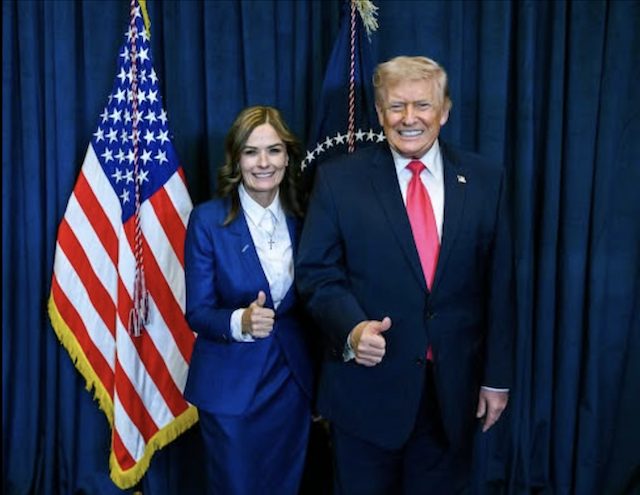
State Sen. Carrie Buck, endorsed by President Donald Trump in April, easily outpolled four party rivals in a race called before 9 p.m. PT to secure the GOP ballot berth in Congressional District 1 (CD 1) to take on eight-term Rep. Dina Titus, who brushed aside nominal opposition in her preliminary.
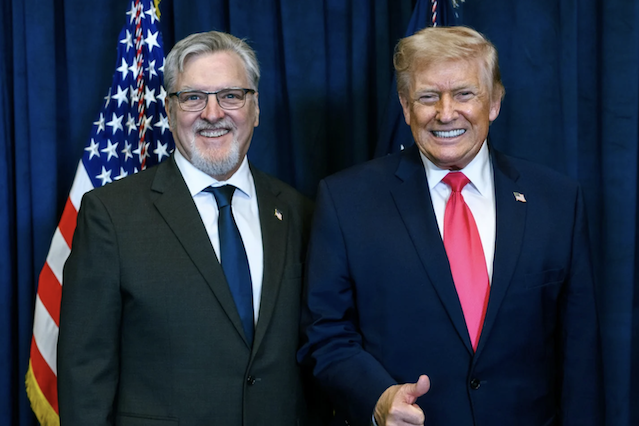
“Halo” composer Marty O’Donnell, also endorsed by Trump in April, was declared the winner before 9 p.m. PT with 77 percent of the tally counted. When the race was called, he had 43.8 percent of the ballots cast, nearly 5,000 votes more than developer Tera Anderson, a 2024 Las Vegas mayoral candidate, who had 24 percent, with former U.S. Ambassador Dr. Jeff Gunter and neurosurgeon Dr. Aury Nagy far behind.
O’Donnell will face four-term incumbent Rep. Susie Lee, who survived a primary challenge and must now defend her seat in a district Trump won in 2024.
Cody Whipple, a local high school football star and operator of a family-owned Pahranagat Valley cattle ranch, rolled past attorney Ronda Kennedy in their CD 4 GOP primary. The race was called at 9:38 p.m. PT with 54 percent of the vote tallied and Whipple leading Kennedy by nearly 40 percentage points. He will face five-term incumbent Rep. Steve Horsford, unchallenged in his primary, in November.
In CD 2, which spans 65,000 square miles across central and northern Nevada and is the longtime GOP stronghold in the purple state, financial adviser and Iraqi War veteran David Flippo, riding a Trump endorsement, held a narrow lead over state lawmaker James Settelmeyer as at 9 p.m.PST in what was the state’s featured June 9 primary battle, pitting Republican rivals against each other in a deep red district where the winner is heavily favored to advance in the general election. The Associated Press has not yet called the race.
But the November focus will be on the three Southern Nevada congressional districts built around Clark County, which are among 26 Democrat-held House seats the National Republican Congressional Committee has targeted as “prime pick-up opportunities” in the 2026 midterms. Winning at least one of these Las Vegas-area seats—after a succession of increasingly tight races—would significantly improve GOP odds of retaining if not boosting its current 217–212 House majority.
Republicans believe they have momentum in unseating at least one of the Las Vegas-area Democratic House incumbents. Since 2020, the number of registered Democrats has declined by more than 70,000 in Nevada while Republicans have gained 16,000 enrolled voters. Democrats entered 2026 actually trailing the GOP on Jan. 1 in registrants before regaining the advantage by nearly 10,000 voters, 666,031 to 656,502, the state’s Secretary of State Office reported on May 1.
The Clark County Elections Office reported May 18 that 443,162 Democrats, 362,378 Republicans, and 608,425 nonpartisans were among the county’s 1.5 million registered voters eligible to vote on June 9 primary ballots for governor. Incumbent Republican Gov. Joe Lombardo will face Democratic Attorney General Aaron Ford, both cruising to easy party preliminary wins—16 state senate slots, and 31 state assembly seats, as well as in city and county commission, school board, and water and power district contests.
The nearly 1.1 million of Nevada’s 2.45 million registered voters not eligible to cast ballots in June’s closed primaries will ultimately determine who wins in November. The state’s nonpartisan voting bloc, Nevada’s majority electorate since mid-2023, constitutes nearly as many voters in Clark County as the combined Democratic and Republican enrollments.
A GOP Breakthrough?
With CD 1’s boundaries since 2022 stretching east and south to include suburban and rural areas to the previously compact-blue Las Vegas district, Republicans have erased a nearly 2-to-1 Democratic voter bulge to single-percentage points in 2022 and 2024, but attempts to dislodge Titus have come short.
Buck, a former school principal who represented those suburban areas in the state senate, including Henderson and Boulder City, will challenge the nine-term incumbent after outpacing 2024 candidates Save Education-Save America founder/CEO Jim Blockey, appliance repair company owner and stand-up comedian Michael Boris, and two others in their Republican primary.
Buck’s May 20 Federal Elections Commission (FEC) filing documents her campaign had raised $1.2 million, spent $824,000, and had $393,941 cash on hand while Titus enters the general election race with $1.25 million raised, 311,402 spent, and more than $1 million in the bank.
CD 3, which spans southwest Las Vegas to the southern tip of the state, has also been steadily shifting red since 2020, with Cook Political Report and Larry J. Sabato’s Crystal Ball rating it “likely” or “leaning” Democratic despite Trump winning the district in 2024 and both calling its previous two House races, narrowly won by Lee, “toss-ups.”
O’Donnell, who finished fourth in his 2024 CD 3 GOP primary run as a Trump critic, earned the president’s nod in 2026 by pledging to support his agenda, and is expected to give Lee another “toss-up” battle in what was once Nevada’s “most swingy” congressional district, where Republicans won six of 10 elections before 2014, but none since.
According to May 20 FEC filings, O’Donnell’s campaign had raised $3,336 million—including his own $3 million loan—spent nearly $1.14 million, and had almost $2.19 million in the bank, while Lee had raised $3.86 million, spent $1 million, and had $466,650 cash in her coffers.
Trump did not endorse a CD 4 GOP primary candidate. The district was reconfigured after the 2020 Census by the state’s Democratic-led legislature to be more favorable to Democrats and, specifically, more favorable for Horsford.
After winning the North Las Vegas-centric district in 2012 and then losing his 2014 reelection bid, Horsford reclaimed the seat in 2018 and has held it since, with an assist beginning in 2022 by state lawmakers who, in making CD 4 a bit bluer, inadvertently made southern Nevada’s other two congressional districts more purple and more competitive for Republicans.
Whipple, a Lincoln County rancher who attended Virginia Tech on a football scholarship, garnered the district’s rural vote—a contingency that represents 20 percent of the state’s registered Republicans with a strong primary turnout presence—in edging Kennedy, who led the team of lawyers that won a U.S. Ninth Circuit Court of Appeals ruling affirming that the closure of gun stores during the COVID-19 lockdown was unconstitutional.
According to their May 20 FEC filings, Whipple’s campaign had raised $750,000–including a $300,000 personal loan–and had $290,000 cash on hand after spending $461,000, far more than the $90,000 Kennedy spent in a campaign financed by her $350,000 loan. Horsford, unchallenged in a primary, has already spent $1.7 million in defending his seat and reported $1 million in the bank as of May 20.
 Friends Read Free
Copy
Facebook
Tweet
Friends Read Free
Copy
Facebook
Tweet