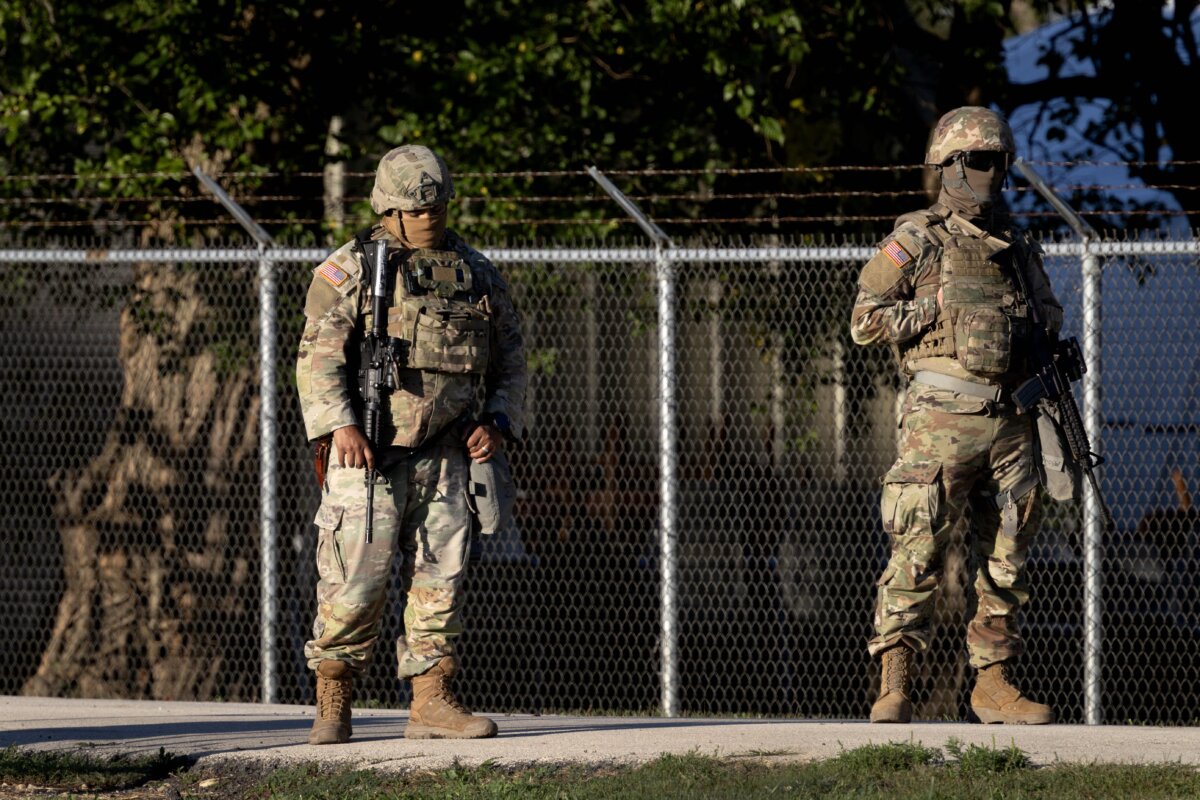

Some Texas National Guard troops deployed to Illinois have been removed from duty and replaced after failing to meet military compliance standards, in one of the first public enforcement actions under War Secretary Pete Hegseth’s renewed focus on height, weight, and physical fitness requirements across the force.
“Standards are back” at the Pentagon, Hegseth wrote in an Oct. 13 post on X. He shared a headline from an article in Task & Purpose that cited a Texas Military Department spokesperson as saying that a “small group” of the 200 National Guard members deployed to the Chicago area have been replaced after being found to be noncompliant with certain military requirements.
The action was taken after photos of arriving Guard personnel at a Chicago airfield, published by ABC News and widely circulated on social media, sparked criticism earlier in the week over apparent weight issues and questions about whether new fitness rules would be enforced.
The Task & Purpose report did not indicate which specific standards the guardsmen were found not to have met, and the Texas Military Department did not respond to a query from The Epoch Times seeking clarification.
Days earlier, the National Guard Bureau issued a statement on fitness standards for mobilization, which requires all service members to meet “service-specific height, weight and physical fitness standards at all times,” citing a commitment to “excellence and lethality.”
“When mobilizing for active duty, members go through a validation process to ensure they meet requirements,” it stated.
“On the rare occasions when members are found not in compliance, they will not go on mission. They will be returned to their home station, and replacements who do meet standards will take their places.”
Hegseth has made the restoration of strict, combat-oriented standards a key policy objective since taking office earlier this year. In a Sept. 30 memorandum on military fitness standards, he ordered all services to adopt “high, uncompromising, sex-neutral standards rooted in combat effectiveness,” including mandatory fitness testing and body-composition enforcement using streamlined height-and-waist measurements.
Active-duty troops must complete two fitness tests per year, while National Guard and Reserve members are required to pass one annual test, according to the memo. High performers may receive limited exemptions, but failure to meet baseline standards can trigger withheld promotions or administrative separation, with Hegseth calling fitness a “core competency” of the United States’ fighting force.
“My goal is unmistakable,” Hegseth wrote in that directive. “Our core fighting formations must not just meet the standard—they must embody it.”
In a separate speech to senior commanders at Quantico, Virginia, recently, Hegseth said every combat arms position would return to the “highest male standard only,” adding that “this job is life or death, standards must be met.”
“If women can make it, excellent. If not, it is what it is,” he said. “It will also mean that weak men won’t qualify—because we’re not playing games. This is combat.”
Each military branch maintains its own fitness standards, and Hegseth’s overhaul seeks to bring them in line with combat requirements.
The Army, which encompasses most National Guard personnel, adopted the Army Fitness Test in 2025, replacing the older combat fitness model. The five-event test comprises deadlifting, hand-release pushups, a sprint-drag-carry drill with a weighted sled, an abdominal plank, and a two-mile run. Soldiers in 21 designated combat specialties are subject to an even stricter tier, with no adjustments for age or sex.
The Navy’s physical readiness test continues to rely on pushups, a forearm plank, and an endurance event such as a 1 1/2–mile run or swim, although commanders may impose higher standards for operational units. The Air Force maintains a test built around a 1 1/2–mile run, situps, and pushups, along with body composition requirements tied to waist-to-height ratios.
 Friends Read Free
Copy
Facebook
Tweet
Friends Read Free
Copy
Facebook
Tweet