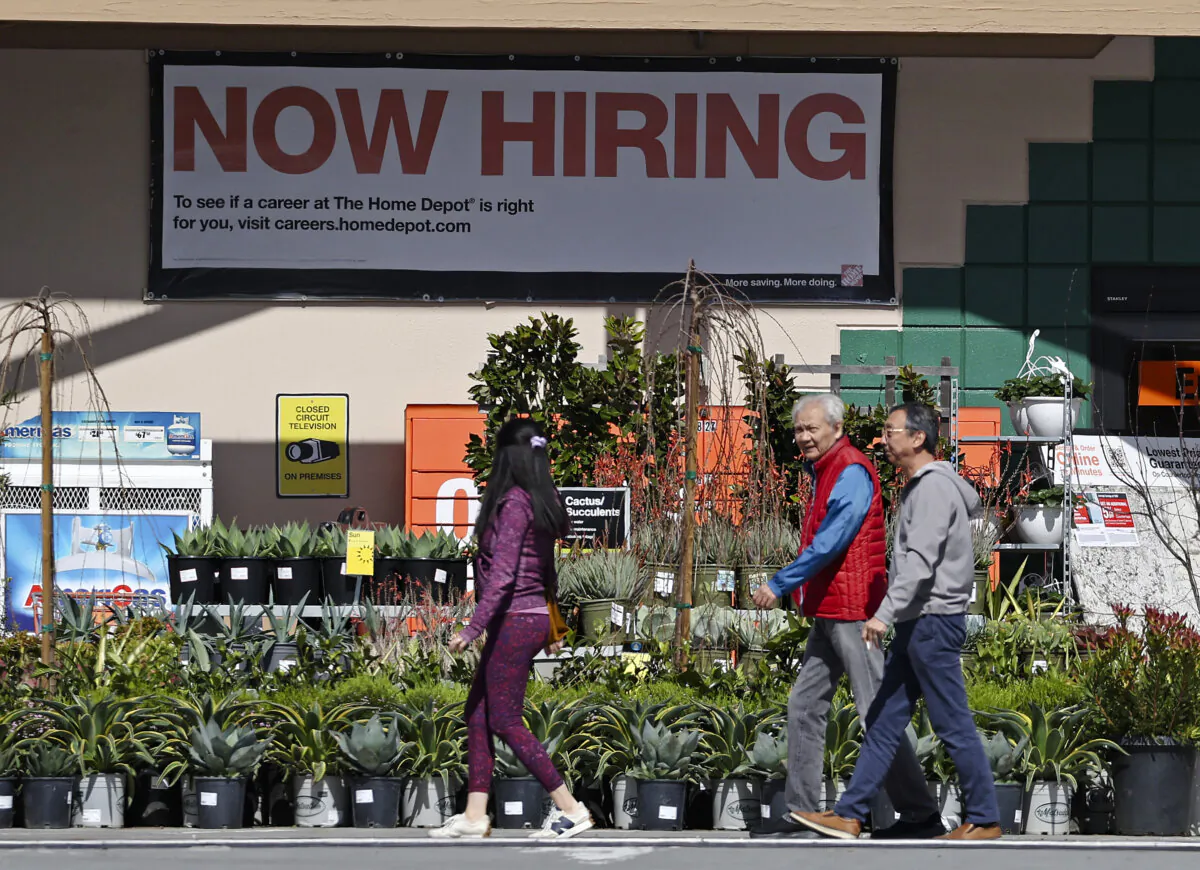

The long‑described stable but stagnant U.S. labor market showed signs of warming up in March, with hiring momentum continuing, according to new Bureau of Labor Statistics data released on May 5.
The number of hires rose by 655,000 from the previous month to 5.554 million. March’s reading was also above the 5.333 million registered the same time a year ago.
The increase was driven primarily by professional and business services (165,000), as well as accommodation and food services (124,000). Hires in transportation, warehousing, and utilities also rose, by 108,000.
Conversely, federal government hires declined by 7,000.
The total hiring rate—hires as a share of total employment—also edged up to 3.5 percent, from 3.1 percent in February.
Economists typically use this measure to gauge how quickly employers are adding workers compared to the size of their workforce.
Overall labor demand eased slightly in March but topped market expectations.
Job vacancies dipped by 56,000 to 6.866 million, from the upwardly revised 6.922 million reported in the previous month, the bureau said in its Job Openings and Labor Turnover Summary.
The consensus forecast penciled in a 6.84 million reading.
The drop was driven almost entirely by professional and business services, with job openings declining by 318,000 in the sector. This decline was partially offset by a jump of 98,000 in the finance and insurance industry.
April Jobs Report
For the past year, economic observers and monetary policymakers have generally described current employment conditions as being stuck in a “low-fire, low-hire” environment. The narrative may need to change as hiring levels are steadily improving.
The U.S. economy added 178,000 new jobs in March, far higher than economists had anticipated.
Additionally, private companies added an average of 39,250 jobs per week in the four weeks ending April 11, according to payroll processor ADP.
A fresh snapshot of the job market will be published on May 8 when the April nonfarm payrolls report is published. The early consensus forecast calls for 60,000 new jobs and an unemployment rate holding steady at 4.3 percent.
The energy shock from the 10-week-old war in Iran may have constrained hiring last month, says Joseph Brusuelas, chief economist at RSM US.
“One should expect hiring to remain constrained as businesses, hit by higher energy costs, take a more cautious approach on their payrolls,” Brusuelas said in a May 5 note.
“Aside from the price shock, the underlying causes of the restrained pace of hiring continue: bad demographics, tight immigration policies, the end of labor hoarding by large firms and the nascent impact of artificial intelligence that is bolstering corporate productivity.”
A higher-than-expected jobless rate, meanwhile, could trigger anxiety in the broader financial markets, says Jay Woods, chief market strategist at Freedom Capital Markets.
“This could signal that we are indeed in the midst of a gradual rise in unemployment,” Woods said in a note emailed to The Epoch Times. “Thus, the potential need to cut further to ebb the tide in the labor market will square off against a rising inflation number.”
Recent research by Dallas Federal Reserve economists suggests the breakeven rate is close to zero, which would keep the unemployment rate in check.
In a March 31 report, they noted that lower immigration and shifts in labor force participation might “have pushed the monthly break-even employment growth lower than previously thought.”
Quits and Layoffs
While hiring could be showing signs of improvement, the data suggest layoffs remain low.
From February to March, the number of layoffs and discharges was little changed at 1.9 million. However, layoffs and discharges climbed by 272,000 over the past year.
Last week, initial jobless claims—the number of Americans filing applications for unemployment benefits—fell sharply below 200,000 to levels unseen since 1969.
“While layoff announcements from tech giants Microsoft and Meta have traders concerned that these recent numbers may indicate even more widespread layoffs ahead, it is not showing up in the data at this time,” Woods said.
Scores of tech companies have announced plans over the past month to reduce headcount.
Cryptocurrency exchange Coinbase said on May 5 that it will cut about 14 percent of its workforce, citing artificial intelligence (AI) and market volatility.
Chegg, CrowdStrike, and Pinterest have been some of the other tech companies that announced job cuts, attributing their decisions to AI.
Despite the recent wave of layoffs, employees have signaled confidence that they could find new work in today’s labor market.
Job quits rose by 125,000 to 3.171 million in March, from an upwardly adjusted 3.046 million in the prior month, according to the latest Bureau of Labor Statistics data.
The quits rate—a measure of voluntary job leavers as a share of total employment—ticked up to 2 percent from 1.9 percent.
Economists rely on quits data to gauge workers’ confidence in locating new employment opportunities.
 Friends Read Free
Copy
Facebook
Tweet
Friends Read Free
Copy
Facebook
Tweet