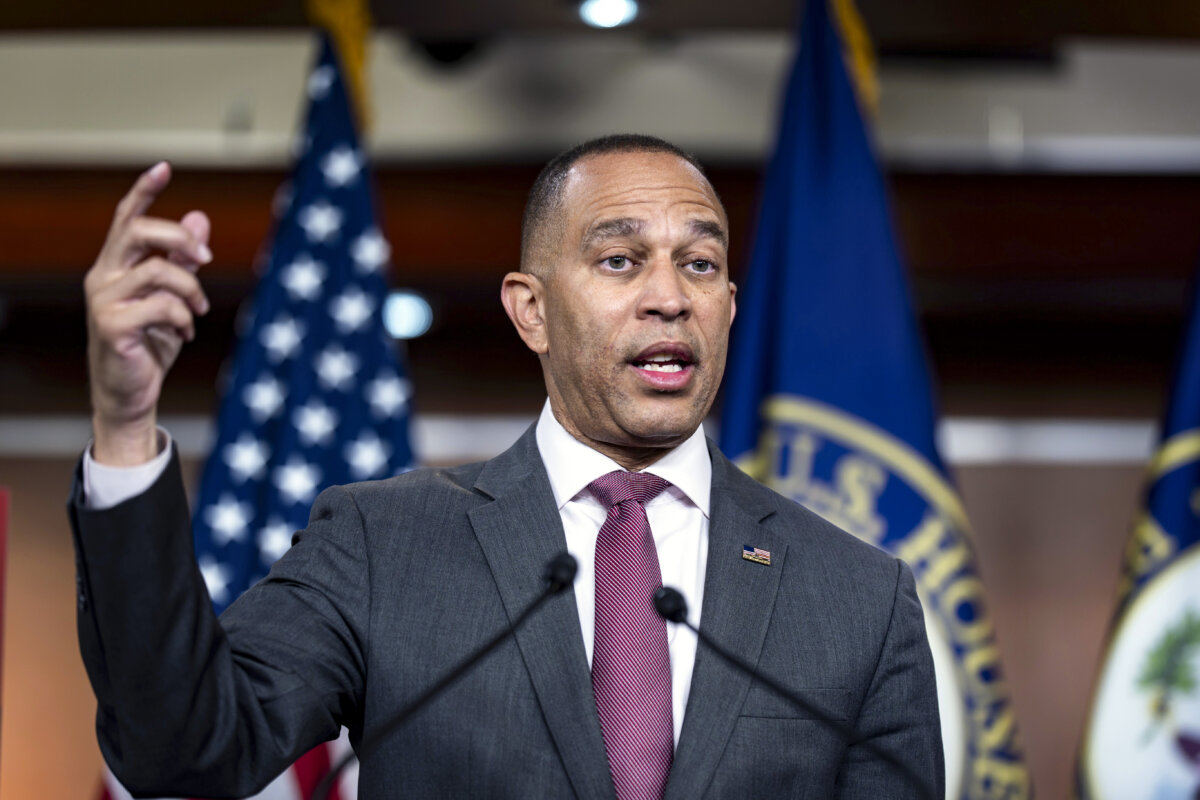

House Minority Leader Hakeem Jeffries (D-N.Y.) said on Aug. 16 that he does not personally support Medicare for All and does not support the agenda of the Democratic Socialists of America (DSA), drawing an immediate and public disagreement from a member of his own caucus on the same broadcast.
Asked on NBC’s “Meet the Press” whether he would vote for or against Medicare for All as Democratic leader, Jeffries said, “No, I think as you’ve indicated in your question to me, it’s not legislation that I currently am co-sponsoring or that I support.”
Host Kristen Welker noted that Jeffries co-sponsored Medicare for All legislation from 2013 to 2021 and has not done so since becoming Democratic leader. Jeffries confirmed that, saying, “I haven’t cosponsored the Medicare for All legislation that has been introduced over the last several years.”
He said Democrats should first reverse Republican healthcare policy rather than replace the system.
“I do think we need to figure out how to fix our broken healthcare system and then build something better once we repair the damage that has been done,” he said.
He pointed to the extension of Affordable Care Act tax credits and cuts to Medicaid.
Welker also played a clip of former Chicago mayor and President Barack Obama’s chief of staff Rahm Emanuel saying of Democratic Socialists, “You’re not Democrats. You’re a separate party,” and asked Jeffries whether Democratic Socialists belong in the Democratic Party.
“I don’t support the DSA agenda as has been articulated by the DSA itself,” Jeffries said.
He added that individual members who win Democratic primaries and then win in November will be part of the House Democratic Caucus, which he said would include progressives, New Democrats, and Blue Dogs.
He was more specific on two of the movement’s positions.
“I do not support defunding the police. I do not support open borders,” Jeffries said.
Asked whether he would bring a vote to abolish U.S. Immigration and Customs Enforcement (ICE) to the floor if Democrats win the majority and he becomes speaker, Jeffries did not commit to one.
He said he backs “dramatically reforming ICE,” an end to masked agents, body cameras, judicial warrants before home entry, and state and local prosecution of agents who break the law. He said House Democrats have voted against providing the government with additional funding for immigration enforcement “until we actually see dramatic, bold, and transformational reform.”
The split echoes a broader divide within the party. During a meeting of the Democratic National Committee last week, the party passed two competing resolutions—one calling for the abolition of ICE, and another calling for reform.
Emanuel returned to the subject on CNN on Aug. 17. Host Wolf Blitzer read him Jeffries’s answer and asked who can unify the party.
Emanuel said the 2028 nominee will set the party’s direction, and repeated his challenge to the DSA: “Run on your own ticket. If you’re confident people want it, we’ll see you in November.”
“If you think they want defunding the police, letting prisoners out, I’ll see you in November on the ballot,” he added.
He said both wings of the party share a diagnosis.
“There’s a pragmatic wing, there’s a progressive wing. We both agree,” Emanuel said. “The system is rigged against families that go paycheck to paycheck and try to make ends meet.”
Rep. Ro Khanna (D-Calif.) appeared later in the same program and took the opposite position on key issues.
“Medicare for All is arguably the most important priority,” Khanna said.
“It would save money, and it would save lives.”
He cited a recent Yale study that found the policy could save $1 trillion in healthcare costs.
Asked whether he was disappointed by Jeffries’s answer, Khanna said he respects the difference but wants the bill brought up anyway.
“It needs to have a vote on the House floor,” he said. “The majority of the House Democrats are going to support it.”
Khanna said the split runs through policy rather than through the party.
“There is an energy that the economic system is just working for a few, for people in my district, one-third of the nation’s wealth, and not working for many,” said Khanna, who represents many billionaires in Silicon Valley.
He added that Democrats “have different ideas on how to do that” but share the view that the economy is not working for ordinary Americans. He said he supports Medicare for All, a tax on billionaires, and an end to foreign wars.
Khanna also said he has never supported defunding police or open borders but does support abolishing ICE.
Seven Democratic incumbents have lost their House seats this election cycle, including some Jeffries-endorsed members who lost to more progressive challengers. Jeffries said he expects at least 220 members in the House Democratic Caucus after November and said voters want the party focused on the cost of living.
Democrats need a net gain of three seats to take the House on Nov. 3. If they win the majority, Jeffries would be in line to become speaker.
The Epoch Times reached out to the Democratic Socialists of America for comment but received no reply.
 Friends Read Free
Copy
Facebook
Tweet
Friends Read Free
Copy
Facebook
Tweet