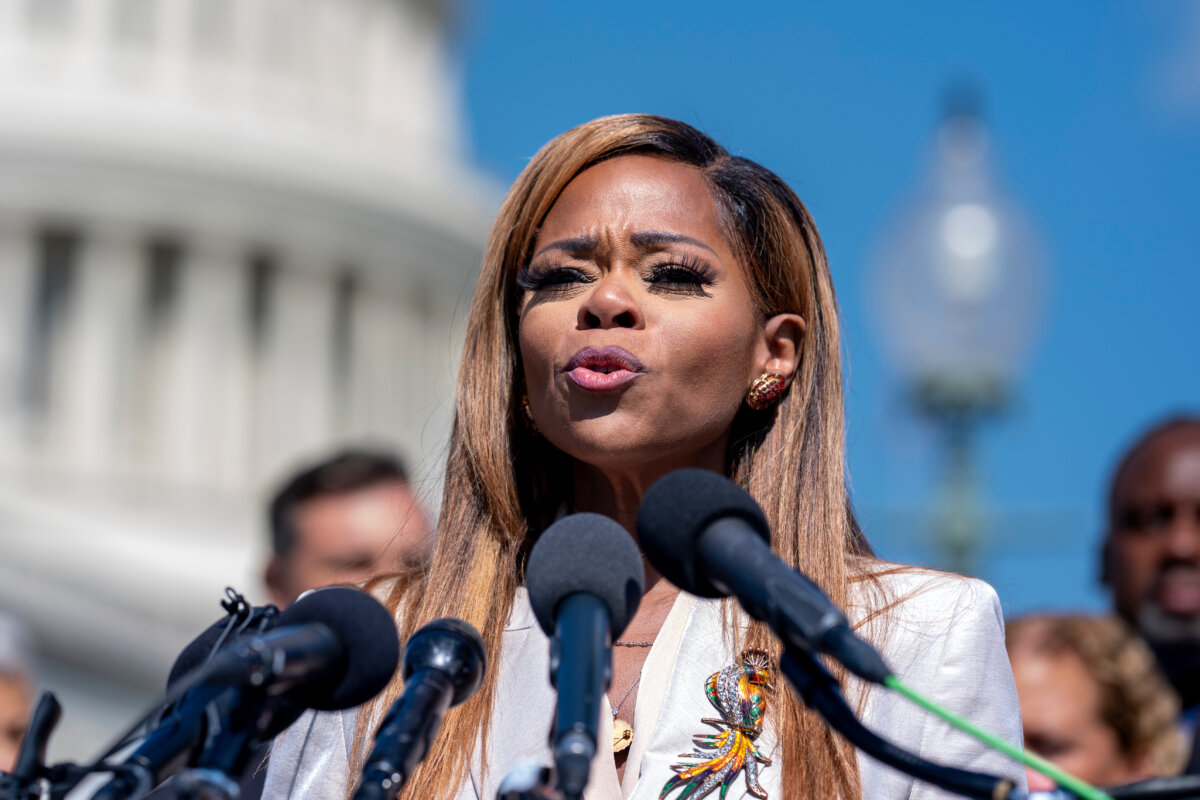

A bipartisan House Ethics Committee panel found on March 27 that Rep. Sheila Cherfilus-McCormick (D-Fla.) committed 25 ethics violations, a ruling that sets the stage for a sanctions hearing and a potential expulsion vote on the House floor.
The eight-member adjudicatory subcommittee, composed of four Republicans and four Democrats, found Counts one through 15 and 17 through 26 of a 27-count Statement of Alleged Violations proven by clear and convincing evidence.
The panel deliberated past midnight following a seven-hour public hearing on March 26 before announcing the findings early Friday. The full committee will hold a sanctions hearing after the House returns from the April recess to determine a recommended punishment, the committee noted in its statement announcing the ruling.
Rep. Greg Steube (R-Fla.) told reporters he would “move on the floor to expel” Cherfilus-McCormick once the committee makes its determination. Expulsion from the House requires a two-thirds vote.
Rep. Marie Gluesenkamp Perez (D-Wash.) posted on X Friday, “You can’t crime your way into legitimate power. Since she was found guilty, she should resign or be removed.”
House Democratic leaders have repeatedly declined to comment on the allegations against Cherfilus-McCormick, saying they want to see the ethics process play out. The top four Democrats in the House and the Democratic National Committee did not respond to a request for comment on Friday.
“I look forward to proving my innocence,” the congresswoman’s office told The Epoch Times via email. “Until then, my focus remains where it belongs: showing up for the great people of Florida’s 20th District who sent me to Washington to fight for them.”
The allegations the committee said were proven include campaign finance fraud, money laundering of COVID-19 relief funds, straw donor schemes, financial disclosure failures, acceptance of improper voluntary services in the congresswoman’s official office, and special favors tied to federal appropriations requests, according to the statement of alleged violations from December.
Two counts were not in the committee’s grouping of proven counts: Count 16, alleging money laundering of funds from Petrogaz-Haiti, a Florida company funded by the Haitian government, and Count 27, alleging a lack of candor during the investigation.
A representative for the committee declined to comment when asked if those counts being left out of the announcement meant she was found not guilty of those crimes, as the announcement did not clarify the status of those charges.
The hearing was the first public ethics adjudicatory proceeding against a sitting House member since the case of then-Rep. Charles Rangel (D-N.Y.) in 2010.
The last member expelled from Congress was Rep. George Santos (R-N.Y.) in 2023. Santos and House Speaker Mike Johnson (R-La.) argued at the time that the House would be setting a precedent by expelling a member before a criminal trial.
The Allegations
At the center of the case is Cherfilus-McCormick’s family health care company, Trinity Health Care Services. Trinity received more than $14.3 million from the Florida Division of Emergency Management for COVID-19 vaccination work in 2021, including at least $5.78 million in overpayments. The largest single error was a payment of roughly $5 million on an invoice of $50,578.50.
Investigators found at least $3.6 million of Trinity’s funds that allegedly made their way into Cherfilus-McCormick’s campaign. The congresswoman reported millions in personal loans to fund her campaign, but the investigative subcommittee found the money originated from Trinity and was routed through a network of family-controlled companies and bank accounts.
Investigators found no written agreement or legal basis establishing that Cherfilus-McCormick was entitled to the money she received from Trinity beyond her $86,000 annual salary.
Cherfilus-McCormick won her seat in a January 2022 special election by five votes after running on what her campaign called a “self-bought, unbossed” platform.
Text messages cited in the Statement of Alleged Violations indicate the self-funding strategy may have been designed to inflate the campaign’s apparent financial strength.
In a June 2021 exchange, Cherfilus-McCormick told senior campaign adviser Hector Roos her goal was “$2 million at least $1.5” and that she was “not planning on using that amount just leveraging.” Roos responded, “Indeed. But nobody has to know that.” She replied, “Yes.”
Investigators also cited a June 28, 2021, text message from Cherfilus-McCormick to her campaign treasurer describing a straw donor arrangement: “The max is 2 checks of 2900. That is why [respondent’s sister] had to give money to Nadege for her to make another donation.”
The committee’s investigation lasted more than two years. The investigative subcommittee met 12 times, sent 30 requests for information, issued 59 subpoenas, reviewed more than 33,000 documents, and conducted 28 witness interviews.
Cherfilus-McCormick invoked her Fifth Amendment right against self-incrimination and declined to testify. During closing arguments at the hearing, committee counsel told the panel the charges were supported by objective documents.
“The record establishes that there was a scheme to impermissibly funnel Trinity’s money to respondent’s special election campaign via both direct transactions and using various conduits,” committee senior counsel Sydney Bellwoar said at the close of Thursday’s hearing.
Cherfilus-McCormick’s attorney, William Barzee, argued the panel should have held a full evidentiary hearing with witnesses rather than ruling on summary judgment. Barzee told the panel he had only had the case for 21 days and was not prepared to call witnesses.
“The greatest material fact in dispute right now is apparently whether or not she was entitled to the money that she received from Trinity,” Barzee said.
He described Trinity as “a family corporation that had been in business for over 30 years” and said the congresswoman’s father “had COVID, they thought he was dying from COVID, the family sat down and talked about how to divide up the ‘profits’ of Trinity.”
Barzee said he introduced a document he described as evidence of a profit-sharing agreement among the family. He acknowledged it was informal.
“I understand it is not your typical profit-sharing agreement that you would see if you helmed a corporation and had lawyers handling these things for you,” Barzee said. “That doesn’t mean it’s not true. It doesn’t mean that in the Haitian-American community, family members don’t put things in writing like that. They shake hands and they trust each other.
“But to suggest that there’s no material fact and you can just decide to throw a woman out of Congress who was duly elected by her constituents because of ‘bank records,’ that’s not enough,” Barzee added.
Cherfilus-McCormick also faces a federal indictment in the Southern District of Florida filed Nov. 19, 2025. She and her brother Edwin Cherfilus were charged with conspiracy to commit theft of government funds, theft of government funds, conspiracy to commit money laundering, and eight counts of money laundering.
The indictment also charged her and her district chief of staff, Nadege LeBlanc, with conspiring to make straw donor contributions. Her tax preparer was charged separately with tax fraud-related counts, according to the Department of Justice.
The Associated Press contributed to this report.
 Friends Read Free
Copy
Facebook
Tweet
Friends Read Free
Copy
Facebook
Tweet