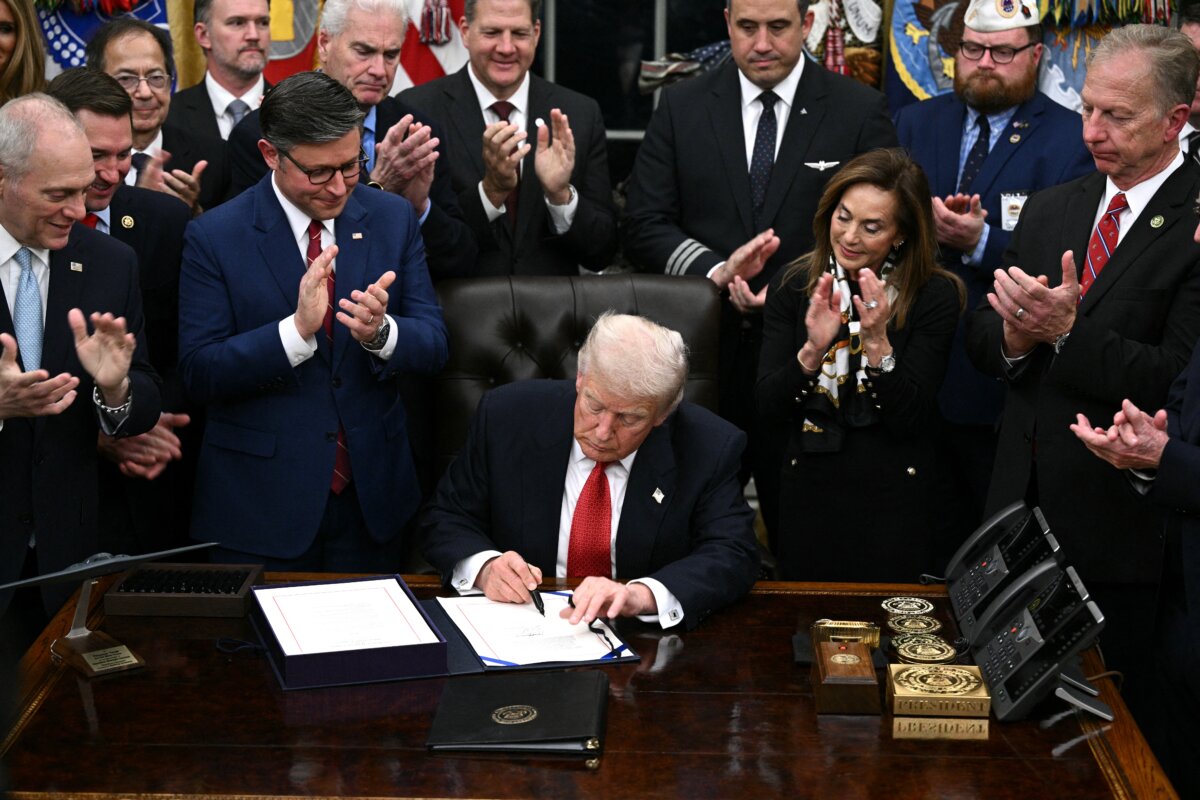


President Donald Trump on Nov. 12 signed a bill passed by both chambers of Congress to fund the government until January, formally bringing an end to the longest government shutdown in U.S. history.
“Today, we’re sending a clear message that we’ll never give in to extortion,” Trump said from the Oval Office shortly before signing the bill, referring to the Democratic demands that had driven the previous standoff.
Trump also repeated calls to end the filibuster, the 60-vote Senate rule that enabled the shutdown.
The president signed the bill around 10:25 p.m. local time, approximately 2 hours after the House passed the bill in a bipartisan vote.
It formally brings an end to the government shutdown on its 43rd day, less than an hour before the shutdown hit day 43, now the longest in U.S. history.
Trump’s signature means that back pay for federal workers who haven’t received pay in over a month will be processed quickly, while furloughed federal employees will return to work. The bill will also ensure funding for the Supplemental Nutrition Assistance Program (SNAP) and other food assistance programs, which had been delayed by the shutdown, for a full year.
It will also mean a gradual return to normal air travel in the United States, which had been badly impacted by the shutdown as air traffic controllers skipped work and take-offs were limited by the FAA out of safety concerns.
In a 222–209 vote, the House approved the measure around 8:20 p.m. ET. Six Democrats—Reps. Jared Golden (D-Maine), Adam Gray (D-Calif.), Don Davis (D-N.C.), Henry Cuellar (D-Texas), Tom Suozzi (D-N.Y.), and Marie Gluesenkamp-Perez (D-Wash.)—voted for the package.
Two Republicans, Reps. Thomas Massie (R-Ky.) and Greg Steube (R-Fla.), voted against the bill.
The House approved the measure after the Senate passed it on Monday with the backing of eight members of the Senate Democratic conference.
“[Democrats] didn’t achieve anything with this at all,” House Speaker Mike Johnson (R-La.) told reporters at a press conference on Capitol Hill immediately following the House vote.
Aside from punting government funding to Jan. 30, 2026, and thereby ending the 43-day shutdown, the measure fully funds three sectors of government, including the Department of Agriculture, the Department of Veterans Affairs, and the Legislative Branch, through Sept. 30, 2026.
It also includes full-year funding for the Supplemental Nutrition Assistance Program and the subsidiary Women, Infants, and Children program. Funding for these programs has been delayed by the shutdown.
Senate Payout Controversy
Ahead of the vote, many Republicans joined Democrats in condemning a controversial provision of the bill that allows senators whose phone records were pulled without their knowledge to sue the government.
Specifically, the provision, wrapped into the legislative branch funding bill, would allow senators to sue the government for at least $500,000 when federal law enforcement searches their phone records without notifying them, including in cases where a judge authorized the search.
After his conference’s frustration with the measure became clear, Johnson promised members that the lower chamber would fast-track standalone legislation to reverse the Senate provision.
The provision at issue relates to subpoenas issued under President Joe Biden, which were related to the investigation into efforts to challenge congressional certification of Biden’s 2020 election victory.
The provision was criticized by Republicans including Rep. Morgan Griffith (R-Va.), who said during a House Rules Committee hearing on the package that he agreed with Democrats’ skepticism about that portion of the text.
Rep. John Rose (R-Tenn.) also spoke against the Senate provision during a speech on the House floor.
He agreed with many other Republicans that Biden’s Department of Justice (DOJ) had overreached in their investigations into the 2020 election and Jan. 6, 2021, Capitol breach, but said the measure was nevertheless inappropriate.
“No elected official should profit from the political calculations of left-wing bureaucrats and judges,” Rose said, adding that it is “shameful” to ask American taxpayers to finance the measure.
Speaking to reporters on Wednesday, Johnson said that he was “surprised” by the Senate bill provision, noting that many in the House “have a strong opinion about it.”
Steube announced ahead of the vote that he would be opposing the measure, expressing skepticism that the Senate would even consider Johnson’s proposal.
“The Senate will never take up your ‘standalone’ bill. This is precisely why you shouldn’t let the Senate jam the House,” Steube wrote in a post on X.
The Wednesday vote series on the package marks the first time that the full House has been in session on Capitol Hill for official business in eight weeks.
It was also the first vote in which freshman Rep. Adelita Grijalva (D-Ariz.) took part.
The lawmaker was sworn in more than seven weeks after she won a special election to replace her father, the late Rep. Raúl Grijalva (D-Ariz.).
Grijalva’s delayed confirmation to the post has drawn attention primarily due to her commitment to provide the final signature for a discharge petition to require the DOJ to publicly release files on the case of billionaire sex offender Jeffrey Epstein.
Johnson had adjourned the session following the lower chamber’s passage of a stopgap funding bill, a move that Democrats alleged was intended to put pressure on the Senate.
January Shutdown Possible: DeLauro
Health care has been the primary issue that led to and sustained the shutdown.
According to House Appropriations Committee Chairwoman Rosa DeLauro (D-Conn.), the same issue could drive another shutdown in January.
“I’m concerned,” DeLauro told The Epoch Times when asked about the prospect. “On January 30, we could find ourselves in the same position. Keep in mind, we got nine more appropriations.”
Democrats have been calling for a one-year extension of tax subsidies for Affordable Care Act (ACA) policies, which are due to expire at the end of this year.
Some experts have warned that the lapsing of these subsidies could cause drastic increases in the premiums for ACA policies.
Several Democrats on the Rules panel and later in remarks on the House floor reported personally hearing from their constituents who are facing premium increases of several thousand dollars next year.
House Minority Leader Hakeem Jeffries (D-N.Y.) on Tuesday evening called for an amendment to extend ACA subsidies by three years. The measure failed, as did other efforts by Democrats to attach ACA subsidy extensions to the package.
Republicans have proposed a litany of competing alternatives to ACA subsidies.
One of these proposals is to offer direct payments or rebate checks in lieu of ACA subsidies, a possibility put forward by Trump.
Sen. Bill Cassidy (R-La.) has raised the possibility of converting ACA subsidy funds toward Health Savings Accounts and Flexible Spending Accounts. Sen. Lindsey Graham (R-S.C.), meanwhile, has raised the possibility of block grants to states for health care-related purposes.
It is currently unclear if these proposals would gain enough support among Republicans.
The Senate passed the funding bill on Nov. 10, with seven Democrats and one independent joining all Republicans but one. Those were Sens. Jacky Rosen (D-Nev.), Catherine Cortez Masto (D-Nev.), Tim Kaine (D-Va.), John Fetterman (D-Pa.), Maggie Hassan (D-N.H.), Jeanne Shaheen (D-N.H.), Dick Durbin (D-Ill.), and Angus King (I-Maine), who caucuses with the Democrats.
During a press conference on Sunday evening after she cast her vote for the funding measure, Shaheen also suggested that Democrats may consider shutting down the government again in January if extensions to ACA tax credits aren’t approved.
At the press conference following the House’s passage of the funding measure on Wednesday, Johnson declined to commit to holding a vote for extending ACA subsidies.
Jackson Richman contributed to this report.
Correction: A previous version of this article misstated the length of the federal government shutdown that started on Oct. 1. The Epoch Times regrets the error.
 Friends Read Free
Copy
Facebook
Tweet
Friends Read Free
Copy
Facebook
Tweet