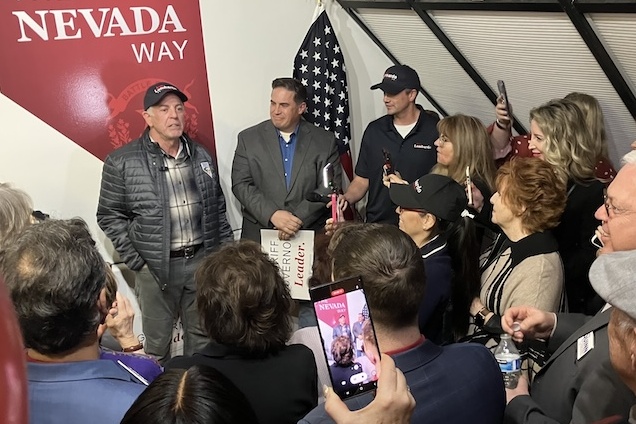
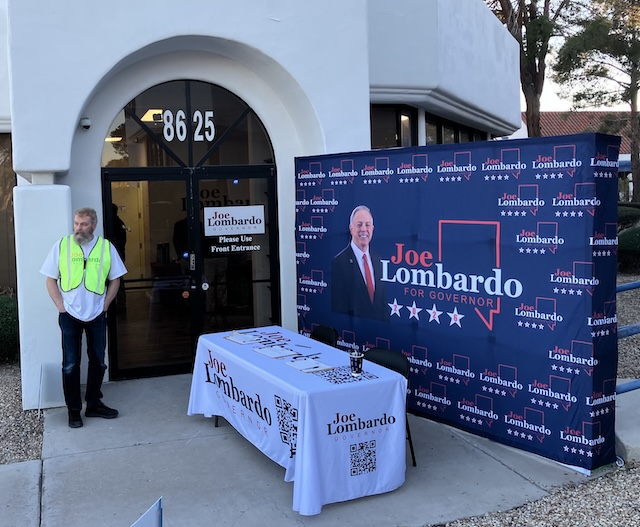
LAS VEGAS—The governor worked his way through the hall, backslapped his way across the foyer, and shook hands while descending the stairs to stand in a sunken lobby under a glass panel roof, surrounded by 80 tightly pressed supporters, to commemorate the Jan. 16 opening of his campaign headquarters.
“Should have gotten a bigger space,” Nevada Gov. Joe Lombardo said of the crowded confines within his campaign’s labyrinthine office suite in Lakeside Village Plaza about seven miles west of the Las Vegas Strip.
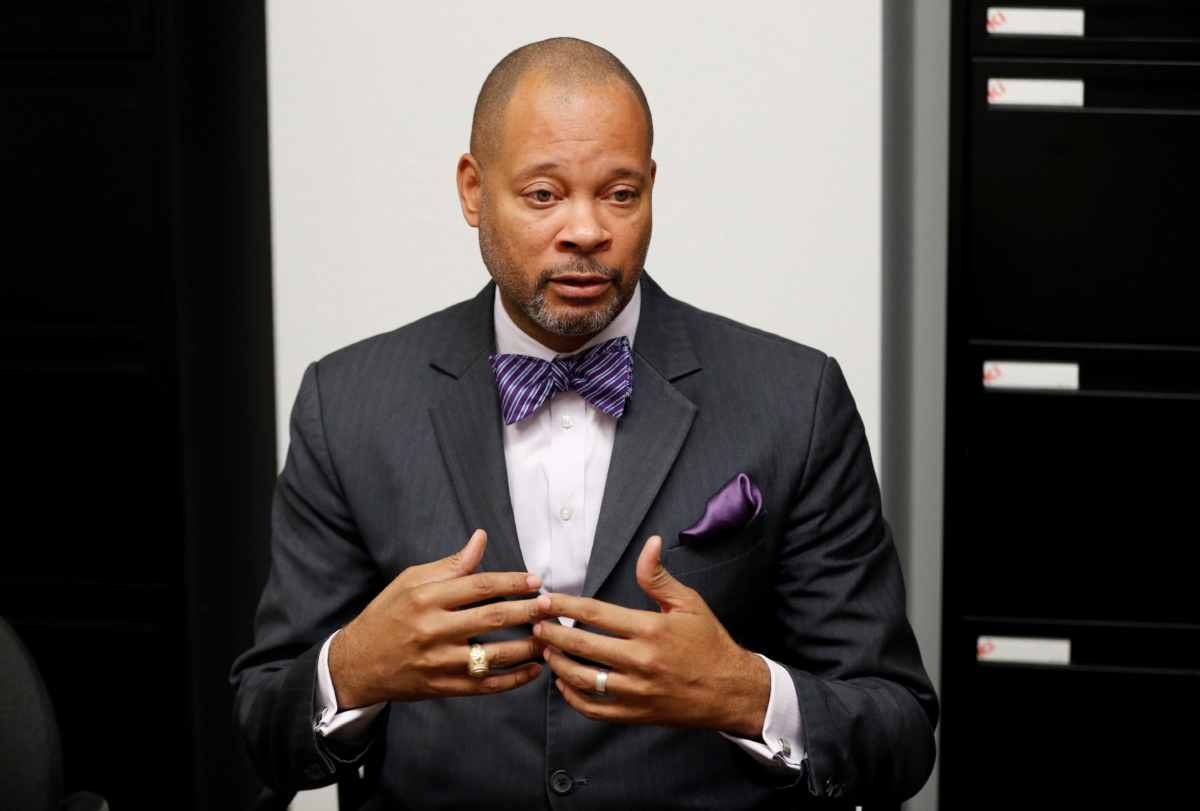
Facing little pressure in the state’s June 9 Republican primary, his reelection campaign is bracing for a November challenge by two-term Nevada Attorney General Aaron Ford, heavily favored to be the Democratic nominee.
Winning a second four-year term will require relentless appeal to independents and canvassing neighborhoods door to door to find uncast ballots, Lombardo said. “It will all happen here,” he added, describing his new campaign offices as a laboratory for grassroots canvassing to appeal to an evolving electorate.
Nevada’s elections dynamic has been changing. Democrats have lost more than 60,000 registered voters since 2021 while the GOP has gained 20,000. According to Nevada’s Secretary of State, of 2.1 million registered to vote on Jan. 1, 596,164 are Republicans, 593,029 are Democrats—and 787,853 are independents.
Independents have been a majority in Nevada since mid-2023—part of a broader trend with 45 percent of the nation’s registered voters now non-affiliated—and their numbers are growing rapidly into dominance; 94 percent of 105,000 new voter registrations in Clark County in 2025 were independents.
The good news, Lombardo told staffers and volunteers, is Democrats no longer have the 58,000-voter registration advantage they had in 2022. The bad news, he said, is that while he won the un-affiliated vote by 4 percentage points four years ago, “We’ll need to go to 8 percent to win in 2026.”
Independent voters are often “low-engagement” constituents who don’t follow politics as though it were a reality TV soap opera, he said, adding that most are repulsed by it, but that they do know the price of things such as gas, groceries, and housing.
In Nevada, “Everybody is talking about housing,” Lombardo said. However, it was Ford who struck first in appealing to unaffiliated voters on the issue with the Jan. 15 release of his Ford Housing Plan.
Key 2026 Race
There are 26 Republican governors and 24 Democratic governors heading into a 2026 election cycle that will see voters in 36 states cast ballots in gubernatorial races. Those 36 governor’s offices are now occupied by 18 Democrats and 18 Republicans.
Democrats are defending five governorships in states President Donald Trump won in 2024—Arizona, Kansas, Michigan, Pennsylvania, and Wisconsin—and there is primary drama building in Ohio and New York.
Lombardo, the longtime Clark County sheriff, earned 49 percent of the 2022 vote to unseat two-term Democratic incumbent Steve Sisolak, the only Democrat to serve as Nevada governor in the 21st century.
While President Donald Trump won Nevada by 3 percentage points in 2024, ending two decades of the state supporting Democratic presidential candidates, other Republicans did not fare as well. Nevada voters in 2024 sent incumbent Democrats back to the Senate and House, including all three from the Las Vegas-area seats that the GOP has unsuccessfully targeted over the last five election cycles.
That makes purple Nevada’s 2026 gubernatorial race among the most carefully watched midterm barometers of the national tenor. Cooks Political Report with Amy Walter calls a near-certain Lombardo–Ford contest a “toss-up.” Sabato’s Crystal Ball gives it a “Lean R” and Inside Elections with Nathan Gonzales gives it a “Tilt R” rating.
Early polls confirm Ford is a viable contender. A November Emerson College poll found Lombardo and Ford tied at 41 percent, with 18 percent of respondents undecided. An October survey by Arizona-based Noble Predictive Insights had Lombardo at 40 percent, Ford at 37 percent, and 23 percent undecided.
Predictive markets are highly variable. On Kalshi, 53 percent were buying Republican shares in response to the proposition, “Who Will Win The Governorship in Nevada?” It was just the opposite on Polymarket, while more than 60 percent of investors on PredictIt were buying Democratic shares as of Jan. 17.
Lombardo has a large fundraising advantage. After raising more than $4.28 million in 2025, he ended the year with a $15 million war chest, “the highest non-election year total on hand of any governor in Nevada history,” his campaign said.
Ford reported raising $2.2 million in 2025 for his campaign with his Forward Nevada political action committee contributing. His campaign began the year with more than $2 million in the bank.
Home Is Where the Votes Are
Housing will again be a front-burner issue in Nevada, where more than 42 percent of households are renters, at least 10 percentage points higher than the national average, and a growing share of single-family homes, especially in the Las Vegas area, are “investor-owned.”
According to a 2024 Guinn Center analysis, more than half of Nevada renters—28 percent of all households in the state—and nearly one-quarter of homeowners are “cost-burdened,” meaning they spend more than 35 percent of monthly income on housing.
The National Low Income Housing Coalition calculates a full-time worker must earn $32.94 hourly to afford the average $1,713 monthly rent for a two-bedroom apartment in the Las Vegas area. A Nevada household would need $68,507 in annual income to afford standard rent, the coalition states, noting renter households on average earn 30 percent to 50 percent less than the state’s $81,134 median household income.
Ford’s campaign in its Jan. 16 release of the housing plan claims that under Lombardo, “Nevada’s housing crisis has only intensified. Nevada now ranks second-highest in the nation for cost-burdened renters and fifth highest for excessively cost-burdened homeowners.” The governor counters with data indicating his actions are paying dividends in making housing more available.
Ford’s plan includes a cap on security deposits at one month of rent, replacing the three-month cap now allowed, and restrictions on “junk fees” that can be imposed on renters, but does not espouse any type of rent control.
He will expand rental assistance programs, boost funding for affordable housing development, and push lawmakers to re-adopt a bill Lombardo vetoed in 2023 that imposed limits on “corporate ownership” of single-family homes and condos. “Under Lombardo’s watch, the largest homeowner in our state is a New York hedge fund,” Ford said in a statement.
Ford supports dedicating federal public lands to the development of affordable housing and has praised Trump administration initiatives in easing mortgage access. These policies are also promoted by Lombardo, who said his opponent’s housing plan is basically his plan “copied and pasted” with one modification.
Since assuming office in January 2023, the governor said he has shepherded a key bill through the Democrat-controlled legislature that cut administrative barriers, allocated $183 million to secure 6,500 affordable rental homes, and authorized the Nevada Housing Division to earmark $1 billion in bonding authority to develop more than 5,500 rental homes and $900 million to support 3,300 new Nevada homeowners.
The only big difference between their housing planks, Lombardo said, is that he’d still veto a bill banning investors from owning more than 100 residential properties—a prohibition Ford is campaigning strongly for—not because he’s opposed to it but because “it’s unconstitutional as written” and would not survive legal challenges.
 Friends Read Free
Copy
Facebook
Tweet
Friends Read Free
Copy
Facebook
Tweet