
ZURICH—Italian Foreign Minister Antonio Tajani has canceled a planned visit to the United States after a television channel reported that President Donald Trump said Italian Prime Minister Giorgia Meloni had “begged” him for a photograph at the G7 summit.
In a brief phone interview broadcast by Italian TV La7 on June 19, Trump said that he met the Italian leader at the G7. When asked about the meeting, he said: “I don’t know what to say! She begged me for a picture! She wanted a picture with me so badly. I would haven’t done it, but I felt sorry for her!”
Daniele Compatangelo, White House Correspondent for La7, shared the transcript of the call on X.
In a June 19 post on X, Tajani said that the “serious and offensive words” of Trump towards Meloni “offend all of Italy.”
“For this reason, I have decided to cancel my visit to the United States scheduled for the next 21 and 22 June,” he said.
Meloni said she was “astonished” by his comments, which she said were “completely made up.”
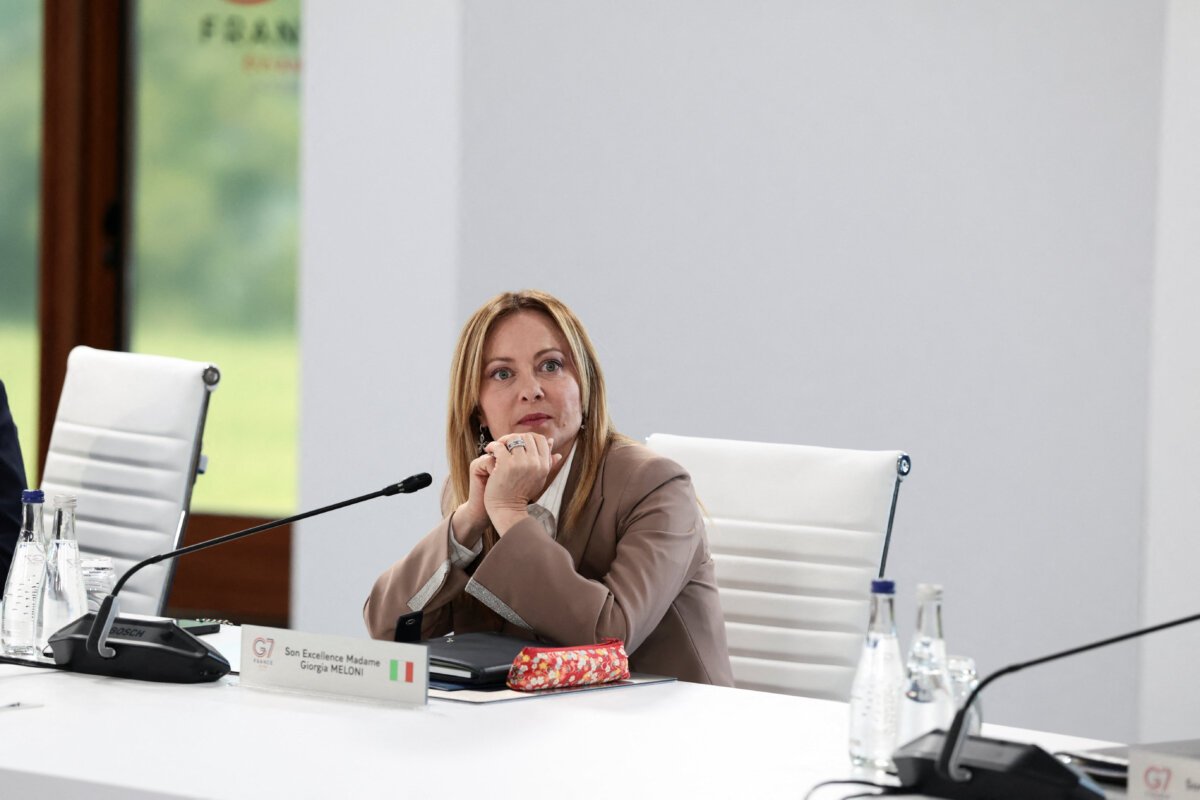
In a video from the G7 event in France, Meloni and Trump were filmed deep in conversation.
“Probably she is happy that I talked to her! I didn’t have to talk to her!” Trump said, according to La7.
“Donald Trump’s statements are completely made up. I am frankly astonished. I don’t know why the president of the United States behaves like this towards his allies: it is not the first time, moreover,” Meloni said in Italian in a video posted on X on June 19. “I can only say it is disappointing that he does not show the same determination with the enemies of the West and of the United States, whose leaders he instead treats with far greater indulgence.”
“There is one thing he should remember: neither I nor Italy ever beg,” she added.
Meloni is one of Trump’s closest allies in Europe.
Teresa Coratella, deputy head of the Rome office at the European Council on Foreign Relations, said in February 2025 that Meloni and Trump are ideologically aligned.
“There is also an ideological similarity, especially on civil rights issues, and their shared view of the traditional family ideal,” she said. “They are both very conservative and on this topic, Meloni aligns more closely with Trump than other European leaders.”
Meloni has led calls to make Europe hawkish on immigration.
Last year, she organised an open letter calling for the European Convention on Human Rights (ECHR) to be reinterpreted because it is limiting their “ability to make political decisions” in their “own democracies.”
In the same year, Italy, under her Brothers of Italy party rule, became the first EU state to successfully send rejected asylum-seekers beyond the bloc’s borders, after its first three attempts were blocked by national and European courts.
Meloni’s bid to divert sea arrivals from North Africa to a non-EU “return hub” in Albania was blocked by courts three times after efforts began in October 2024.
Only by adding Albania to its own safe third-country list and rebranding detention centers as “repatriation hubs” did Italy manage to bypass a European Court of Justice ban. In April last year, it sent 40 rejected asylum-seekers to the Italian-run centers there.
Under the safe third-country principle, used to avoid overloading countries with asylum claims, asylum-seekers can be sent for protection to a country other than the one in which they initially sought asylum.
The Epoch Times contacted the White House for comment.
Reuters contributed to this report.
 Friends Read Free
Copy
Facebook
Tweet
Friends Read Free
Copy
Facebook
Tweet